QUESTION IMAGE
Question
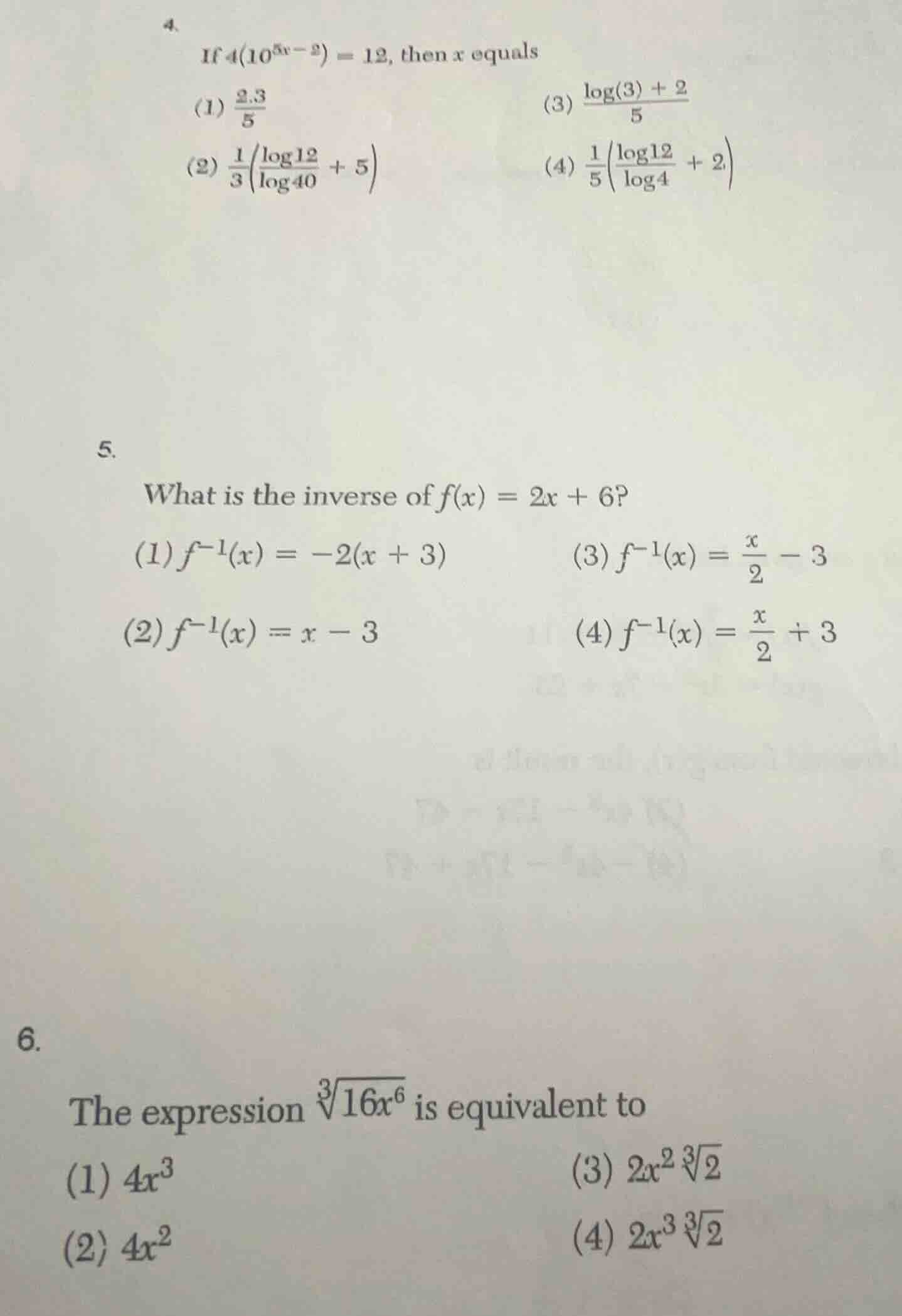
- if $4(10^{5x - 2}) = 12$, then $x$ equals
(1) $\frac{2.3}{5}$
(3) $\frac{\log(3) + 2}{5}$
(2) $\frac{1}{3}\left(\frac{\log 12}{\log 40} + 5\
ight)$
(4) $\frac{1}{5}\left(\frac{\log 12}{\log 4} + 2\
ight)$
- what is the inverse of $f(x) = 2x + 6$?
(1) $f^{-1}(x) = -2(x + 3)$
(3) $f^{-1}(x) = \frac{x}{2} - 3$
(2) $f^{-1}(x) = x - 3$
(4) $f^{-1}(x) = \frac{x}{2} + 3$
- the expression $\sqrt3{16x^6}$ is equivalent to
(1) $4x^3$
(3) $2x^2\sqrt3{2}$
(2) $4x^2$
(4) $2x^3\sqrt3{2}$
Problem 4
Step1: Isolate the exponential term
Divide both sides by 4:
$$10^{5x-2} = \frac{12}{4} = 3$$
Step2: Convert to logarithmic form
Use $\log_{10}(10^a)=a$:
$$5x - 2 = \log(3)$$
Step3: Solve for x
Isolate x and rearrange:
$$5x = \log(3) + 2$$
$$x = \frac{\log(3) + 2}{5}$$
Step1: Replace f(x) with y
$$y = 2x + 6$$
Step2: Swap x and y
$$x = 2y + 6$$
Step3: Solve for y
Isolate y and simplify:
$$2y = x - 6$$
$$y = \frac{x}{2} - 3$$
Step1: Rewrite radical as exponent
Use $\sqrt[3]{a}=a^{\frac{1}{3}}$:
$$\sqrt[3]{16x^6} = (16x^6)^{\frac{1}{3}}$$
Step2: Apply exponent rules
Distribute the exponent to each term:
$$16^{\frac{1}{3}} \cdot (x^6)^{\frac{1}{3}} = (8 \cdot 2)^{\frac{1}{3}} \cdot x^{2}$$
Step3: Simplify the constant term
$$8^{\frac{1}{3}} \cdot 2^{\frac{1}{3}} \cdot x^2 = 2x^2\sqrt[3]{2}$$

Snap & solve any problem in the app
Get step-by-step solutions on Sovi AI
Photo-based solutions with guided steps
Explore more problems and detailed explanations
(3) $\frac{\log(3) + 2}{5}$
---