QUESTION IMAGE
Question
of equations
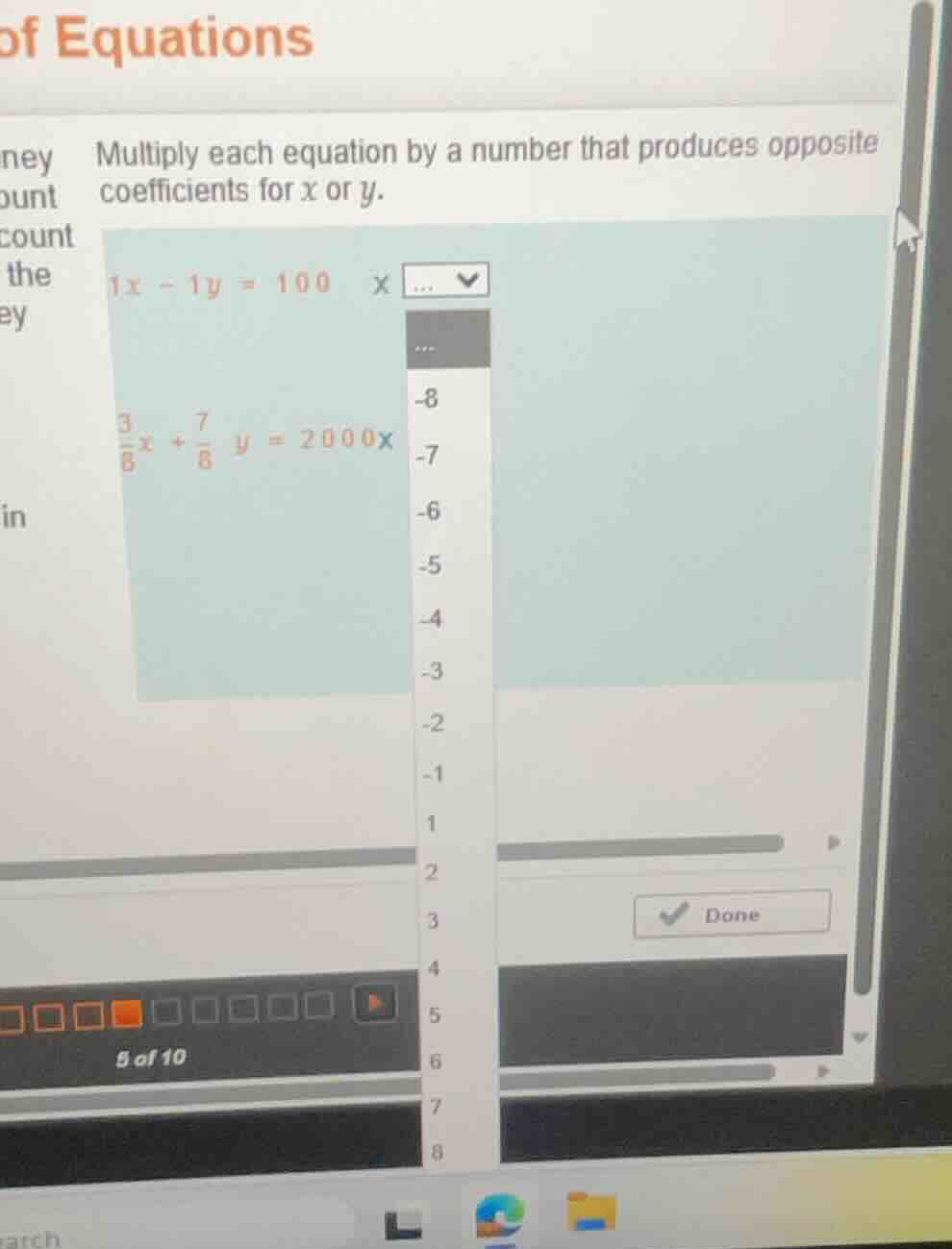
multiply each equation by a number that produces opposite coefficients for x or y.
1x - 1y = 100 x ...
\\(\frac{3}{8}x + \frac{7}{8}y = 2000\\)x ...
options: -8, -7, -6, -5, -4, -3, -2, -1, 1, 2, 3, 4, 5, 6, 7, 8
Step1: Target x coefficients
We aim to make x coefficients opposites. The first equation has $x$ coefficient $1$, the second has $\frac{3}{8}$. Multiply first equation by $-3$.
$1x \times (-3) -1y \times (-3) = 100 \times (-3)$
$\implies -3x + 3y = -300$
Step2: Multiply second equation by 8
Eliminate fraction, get $3x +7y=16000$. Now x coefficients $-3$ and $3$ are opposites.
$\frac{3}{8}x \times 8 + \frac{7}{8}y \times 8 = 2000 \times 8$
$\implies 3x +7y=16000$
Alternative Step (Target y):
Step1: Target y coefficients
First equation has $y$ coefficient $-1$, second has $\frac{7}{8}$. Multiply first equation by $7$.
$1x \times7 -1y \times7 =100 \times7$
$\implies7x -7y=700$
Step2: Multiply second equation by 8
$\frac{3}{8}x \times8 + \frac{7}{8}y \times8=2000 \times8$
$\implies3x +7y=16000$
Now y coefficients $-7$ and $7$ are opposites.

Snap & solve any problem in the app
Get step-by-step solutions on Sovi AI
Photo-based solutions with guided steps
Explore more problems and detailed explanations
Option 1 (for x opposites): Multiply first equation by $\boldsymbol{-3}$, multiply second equation by $\boldsymbol{8}$
Option 2 (for y opposites): Multiply first equation by $\boldsymbol{7}$, multiply second equation by $\boldsymbol{8}$