QUESTION IMAGE
Question
equivalent experience_ma.912.ar.5.6
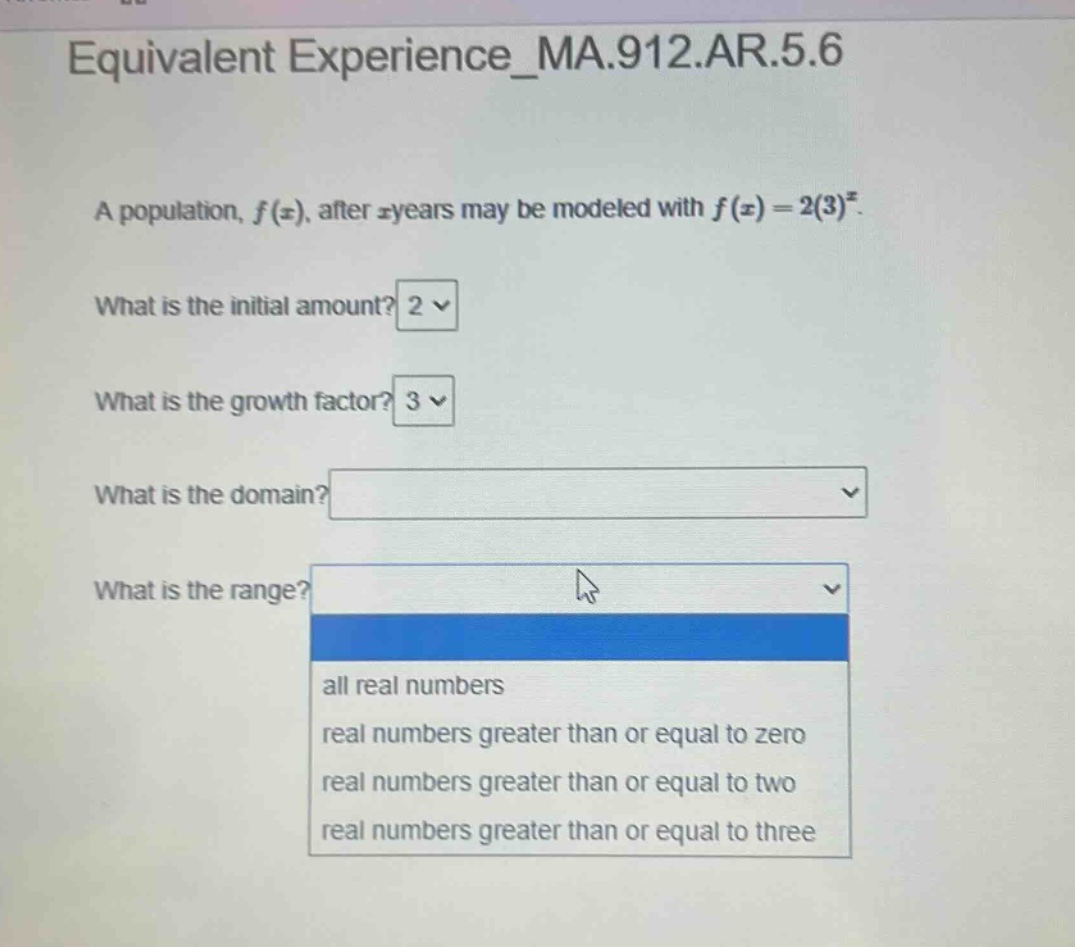
a population, f(x), after x years may be modeled with f(x) = 2(3)^x.
what is the initial amount? 2
what is the growth factor? 3
what is the domain?
what is the range?
all real numbers
real numbers greater than or equal to zero
real numbers greater than or equal to two
real numbers greater than or equal to three
For the domain:
Step1: Identify the function type
The function \( f(x) = 2(3)^x \) is an exponential function. For exponential functions of the form \( f(x)=a(b)^x \), the domain (set of all possible \( x \)-values) is all real numbers because we can raise the base (\( 3 \) here) to any real number exponent.
Step2: Determine the domain
Since \( x \) represents the number of years, and in the context of an exponential growth model for population, \( x \) can be any non - negative real number (we can't have a negative number of years in a real - world population context), but mathematically, the exponential function \( y = a(b)^x \) is defined for all real numbers \( x \). However, in the context of the number of years (the independent variable \( x \) here), \( x\geq0 \) because we start counting from \( x = 0 \) (initial time) and go forward. But if we consider the function purely as a mathematical function (ignoring the real - world context for a moment), the domain of \( y = 2(3)^x \) is all real numbers. But in the context of the problem where \( x \) is the number of years, the domain is real numbers greater than or equal to zero.
For the range:
Step1: Analyze the exponential function
The function is \( f(x)=2(3)^x \). The base of the exponential function \( 3^x \) has the property that for all real numbers \( x \), \( 3^x>0 \) (because any positive number raised to a real power is positive).
Step2: Find the range of \( f(x) \)
Multiply both sides of the inequality \( 3^x > 0 \) by \( 2 \) (since \( 2>0 \), the direction of the inequality remains the same). We get \( 2\times3^x>0\times2 \), which simplifies to \( 2(3)^x>0 \). But when \( x = 0 \), \( f(0)=2(3)^0=2\times1 = 2 \). As \( x \) increases, \( 3^x \) increases, so \( 2(3)^x \) increases. As \( x \) approaches \( -\infty \) (but in the context of the problem, \( x\geq0 \), however, mathematically), \( 3^x \) approaches \( 0 \), so \( 2(3)^x \) approaches \( 0 \), but since \( x\geq0 \) in the context of years, when \( x = 0 \), \( f(x)=2 \), and as \( x \) increases, \( f(x) \) increases. So the range of the function (in the context of the problem where \( x\geq0 \)) is real numbers greater than or equal to \( 2 \).

Snap & solve any problem in the app
Get step-by-step solutions on Sovi AI
Photo-based solutions with guided steps
Explore more problems and detailed explanations
- Domain: real numbers greater than or equal to zero
- Range: real numbers greater than or equal to two