QUESTION IMAGE
Question
equivalent experience_ma.912.gr.1.3_unit 6
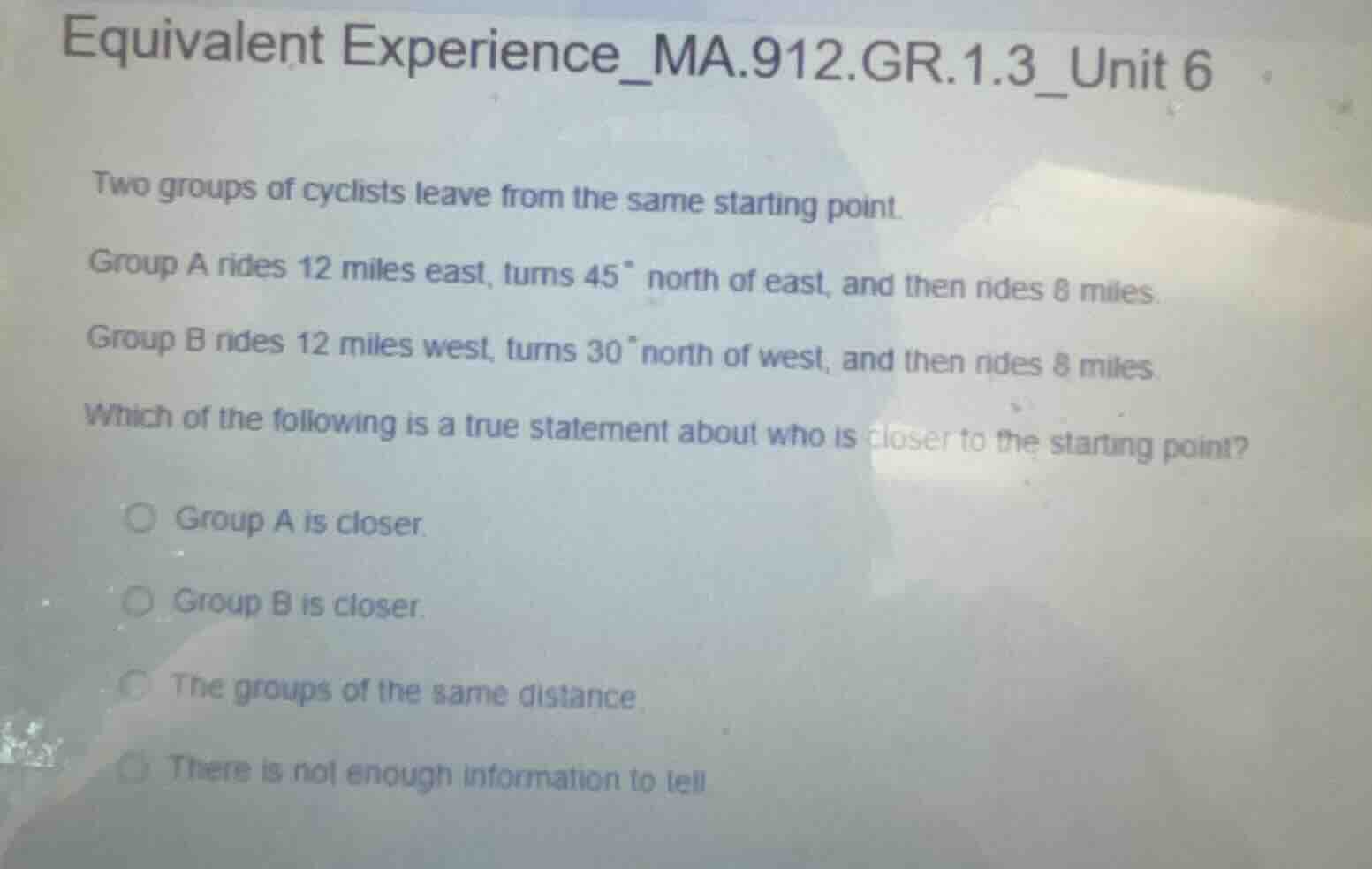
two groups of cyclists leave from the same starting point.
group a rides 12 miles east, turns 45° north of east, and then rides 8 miles.
group b rides 12 miles west, turns 30° north of west, and then rides 8 miles.
which of the following is a true statement about who is closer to the starting point?
○ group a is closer.
○ group b is closer.
○ the groups of the same distance.
○ there is not enough information to tell
Step1: Analyze Group A's displacement
Group A first moves 12 miles east, then 8 miles at 45° north of east. To find the distance from the start, we can use the Law of Cosines. The angle between the two paths for Group A: the first path is east, the second is 45° north of east, so the angle between them is 180° - 45° = 135°? Wait, no. Wait, when moving east, then turning 45° north of east, the angle between the initial eastward path and the new path is 45°? Wait, no. Let's think again. The first leg is east (let's say along the positive x-axis), then turning 45° north of east, so the angle between the two legs (12 miles and 8 miles) is 180° - 45°? No, wait, when you go east, then turn 45° north of east, the angle between the two vectors (the first displacement vector and the second displacement vector) is 180° - 45°? Wait, no. Let's model the vectors. The first vector for Group A: \(\vec{v}_1 = (12, 0)\) (east is positive x). The second vector: magnitude 8, angle 45° from the x-axis (since north of east is still in the first quadrant, angle with positive x-axis is 45°). So the second vector is \(\vec{v}_2 = (8\cos45°, 8\sin45°)\). Then the total displacement vector for Group A is \(\vec{v}_A = \vec{v}_1 + \vec{v}_2 = (12 + 8\cos45°, 0 + 8\sin45°)\). The distance from start is \(d_A = \sqrt{(12 + 8\cos45°)^2 + (8\sin45°)^2}\). Let's expand this: \(d_A^2 = (12 + 8\cos45°)^2 + (8\sin45°)^2 = 12^2 + 2128\cos45° + (8\cos45°)^2 + (8\sin45°)^2 = 144 + 192\cos45° + 64(\cos^245° + \sin^245°)\). Since \(\cos^2\theta + \sin^2\theta = 1\), this becomes \(144 + 192\cos45° + 64 = 208 + 192\cos45°\).
Step2: Analyze Group B's displacement
Group B first moves 12 miles west (so \(\vec{u}_1 = (-12, 0)\) in x-axis, west is negative x). Then turns 30° north of west. North of west means the angle with the negative x-axis is 30°, so the angle with the positive x-axis is 180° - 30° = 150°. So the second vector for Group B: magnitude 8, angle 150° from positive x-axis. So \(\vec{u}_2 = (8\cos150°, 8\sin150°)\). Then total displacement vector for Group B: \(\vec{u}_B = \vec{u}_1 + \vec{u}_2 = (-12 + 8\cos150°, 0 + 8\sin150°)\). The distance from start is \(d_B = \sqrt{(-12 + 8\cos150°)^2 + (8\sin150°)^2}\). Let's expand this: \(d_B^2 = (-12 + 8\cos150°)^2 + (8\sin150°)^2 = 12^2 - 2128\cos150° + (8\cos150°)^2 + (8\sin150°)^2 = 144 - 192\cos150° + 64(\cos^2150° + \sin^2150°)\). Again, \(\cos^2\theta + \sin^2\theta = 1\), so this becomes \(144 - 192\cos150° + 64 = 208 - 192\cos150°\).
Step3: Compare \(d_A^2\) and \(d_B^2\)
We know that \(\cos45° \approx 0.7071\), \(\cos150° = \cos(180° - 30°) = -\cos30° \approx -0.8660\). Let's compute \(d_A^2\) and \(d_B^2\):
For \(d_A^2\): \(208 + 192*0.7071 \approx 208 + 192*0.7071 \approx 208 + 135.76 \approx 343.76\)
For \(d_B^2\): \(208 - 192(-0.8660) = 208 + 1920.8660 \approx 208 + 166.27 \approx 374.27\)
Since \(d_A^2 < d_B^2\), then \(d_A < d_B\). So Group A is closer. Wait, but wait, did I make a mistake in the angle for Group B? Let's re-examine Group B's path. Group B rides 12 miles west (negative x), then turns 30° north of west. So the angle between the first leg (west, negative x) and the second leg (30° north of west) is 180° - 30°? No, when you go west (negative x), then turn 30° north of west, the angle between the two legs (the 12-mile leg and the 8-mile leg) is 180° - 30°? Wait, no. Let's model the vectors again. The first vector: \(\vec{u}_1 = (-12, 0)\) (west is negative x). The second vector: direction is 30° north of west, so the angle with the negative x-axis is 30°, so the angle with…

Snap & solve any problem in the app
Get step-by-step solutions on Sovi AI
Photo-based solutions with guided steps
Explore more problems and detailed explanations
Group A is closer.