QUESTION IMAGE
Question
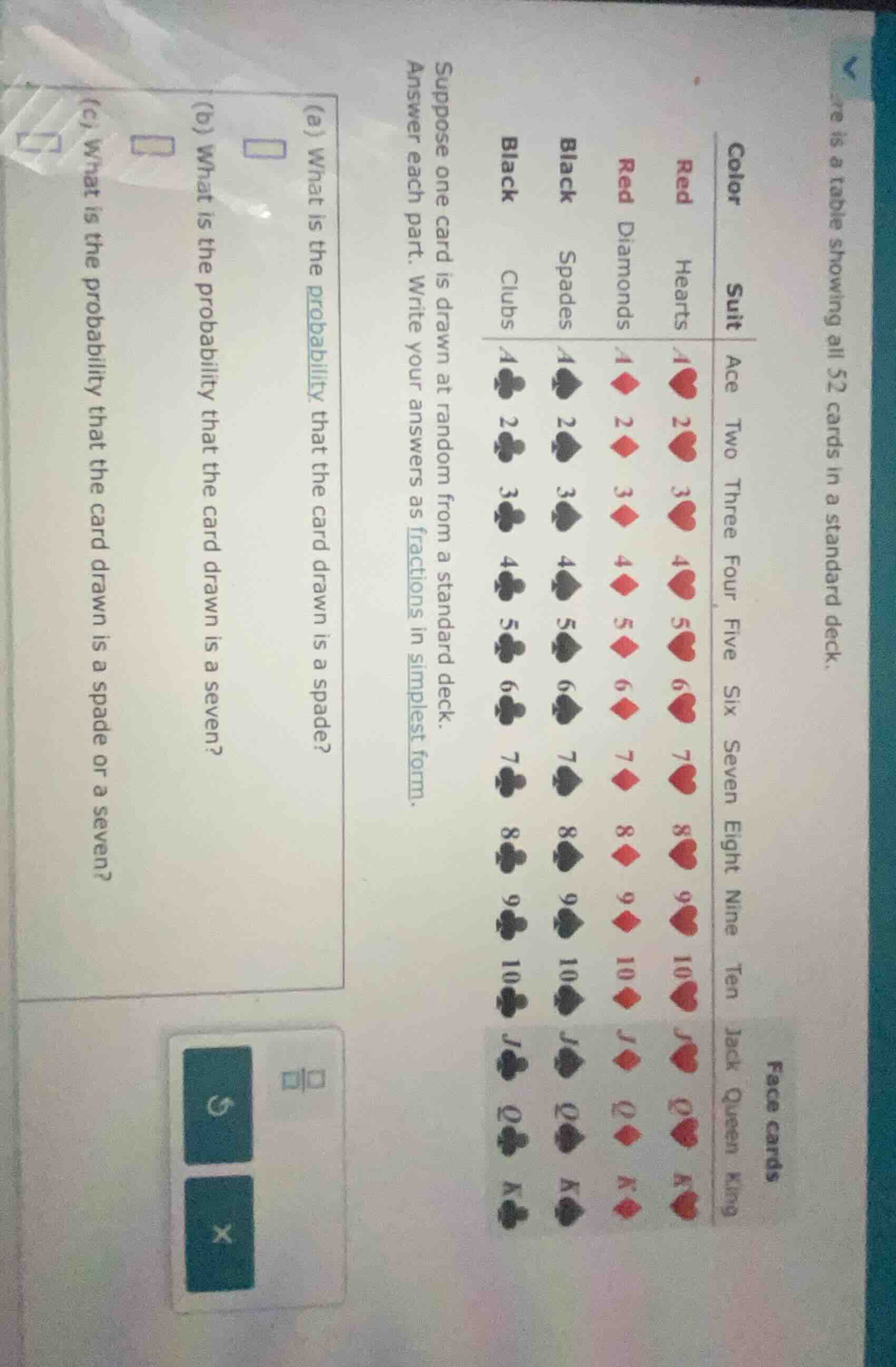
ere is a table showing all 52 cards in a standard deck. suppose one card is drawn at random from a standard deck. answer each part. write your answers as fractions in simplest form. (a) what is the probability that the card drawn is a spade? (b) what is the probability that the card drawn is a seven? (c) what is the probability that the card drawn is a spade or a seven?
Part (a)
Step1: Determine total number of cards
A standard deck has 52 cards. So total number of possible outcomes, \( n(S) = 52 \).
Step2: Determine number of spade cards
In a standard deck, there are 13 spade cards (Ace to King of spades). So number of favorable outcomes for drawing a spade, \( n(E) = 13 \).
Step3: Calculate probability
Probability \( P(E) = \frac{n(E)}{n(S)} = \frac{13}{52} = \frac{1}{4} \).
Step1: Determine total number of cards
Total number of cards in a deck, \( n(S) = 52 \).
Step2: Determine number of seven cards
There are 4 seven cards (one in each suit: hearts, diamonds, clubs, spades). So number of favorable outcomes for drawing a seven, \( n(E) = 4 \).
Step3: Calculate probability
Probability \( P(E) = \frac{n(E)}{n(S)} = \frac{4}{52} = \frac{1}{13} \).
Step1: Recall the formula for probability of union
The formula for \( P(A \cup B) = P(A) + P(B) - P(A \cap B) \), where \( A \) is the event of drawing a spade and \( B \) is the event of drawing a seven.
Step2: Find \( P(A) \), \( P(B) \) and \( P(A \cap B) \)
- From part (a), \( P(A) = \frac{13}{52} \)
- From part (b), \( P(B) = \frac{4}{52} \)
- For \( P(A \cap B) \): There is 1 seven of spades, so \( n(A \cap B) = 1 \), thus \( P(A \cap B) = \frac{1}{52} \)
Step3: Calculate \( P(A \cup B) \)
\( P(A \cup B) = \frac{13}{52} + \frac{4}{52} - \frac{1}{52} = \frac{13 + 4 - 1}{52} = \frac{16}{52} = \frac{4}{13} \)

Snap & solve any problem in the app
Get step-by-step solutions on Sovi AI
Photo-based solutions with guided steps
Explore more problems and detailed explanations
\(\frac{1}{4}\)