QUESTION IMAGE
Question
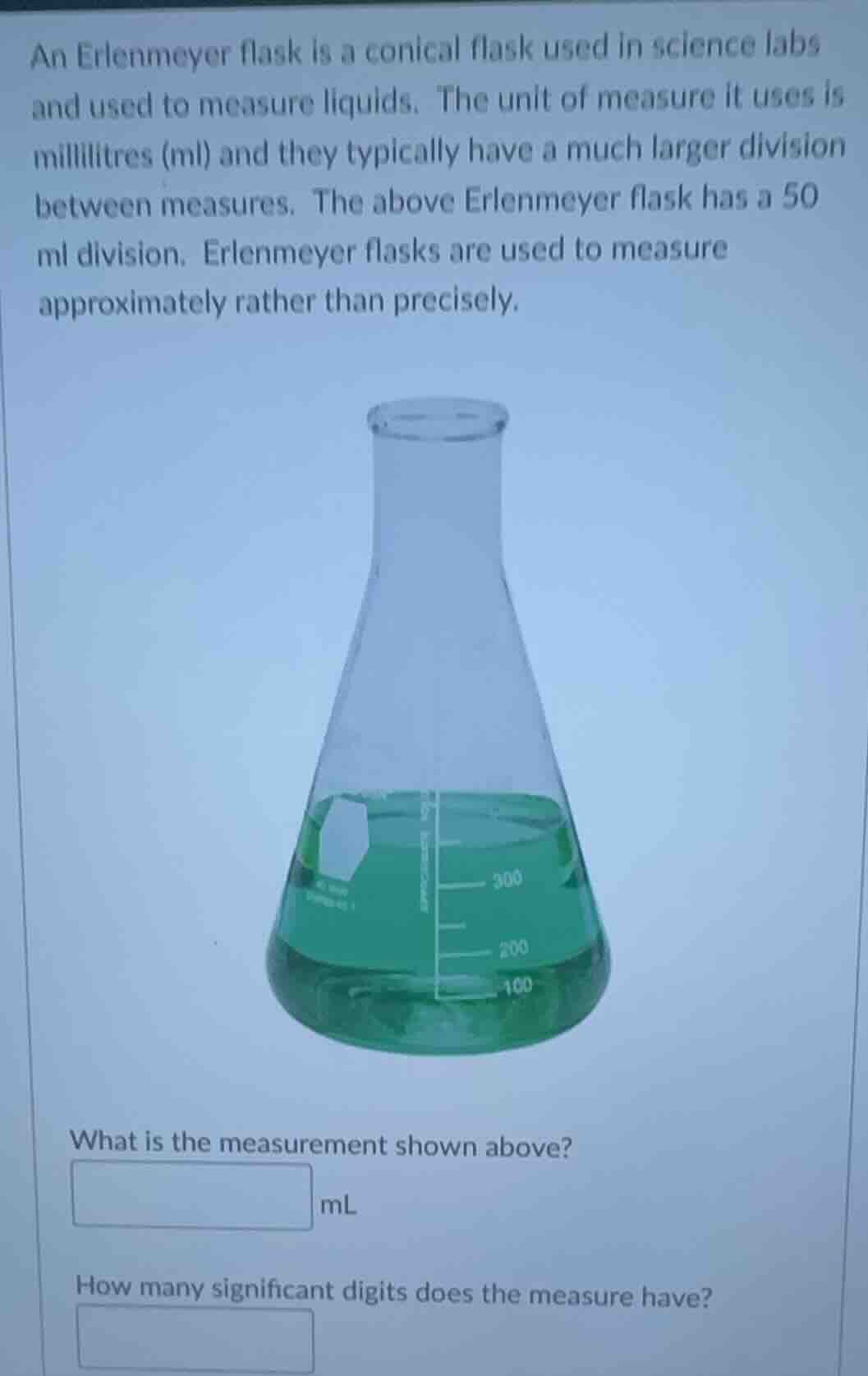
an erlenmeyer flask is a conical flask used in science labs and used to measure liquids. the unit of measure it uses is millilitres (ml) and they typically have a much larger division between measures. the above erlenmeyer flask has a 50 ml division. erlenmeyer flasks are used to measure approximately rather than precisely.
what is the measurement shown above?
______ ml
how many significant digits does the measure have?
______
First Sub - Question: Measurement of the liquid in the flask
Step 1: Identify the scale division
The Erlenmeyer flask has a 50 mL division. Looking at the scale, between 200 mL and 300 mL, there are divisions. Since the division is 50 mL, the marks are at 100, 200, 250, 300... (assuming each major division is 50 mL apart). The liquid level is at the mark that is 50 mL above 200 mL.
Step 2: Calculate the volume
To find the volume, we add the base value (200 mL) and the value of the division above it. So, \(200 + 50=250\) mL.
Step 1: Recall the rules for significant digits
Significant digits are the digits in a number that carry meaningful information about its precision. For a number like 250, we need to check the rules. Trailing zeros in a whole number without a decimal point may or may not be significant, but in 250, the non - zero digits (2 and 5) are significant. The zero here is a trailing zero in a whole number, but since the measurement is 250 mL (with the precision from the flask's scale), the digits 2 and 5 are significant, and we consider how many significant digits there are.
Step 2: Determine the significant digits
The number 250 has two non - zero digits (2 and 5) that are significant. The zero is a placeholder in this case (because the flask measures approximately, and the precision is to the tens place? Wait, no. Wait, 250: the 2, 5 are significant. Let's think again. The measurement is 250 mL. The digits 2 and 5 are significant. So the number of significant digits is 2? Wait, no. Wait, 250: if we consider that the measurement is made to the nearest 50 mL? Wait, no, the first sub - question gave us 250. Let's re - evaluate. The number 250: the digits 2 and 5 are significant. So the number of significant digits is 2? Wait, no, 250 has two significant digits? Wait, no, 250: the 2, 5 are significant, and the 0 is a trailing zero. But in the context of this measurement, since the flask has a 50 mL division, the measurement is 250 mL. The digits 2 and 5 are significant. So the number of significant digits is 2? Wait, no, 250: let's use the rules. For a number without a decimal, trailing zeros are not significant unless there is a decimal. But 250: the non - zero digits are 2 and 5, so there are 2 significant digits? Wait, no, 250: 2, 5, and the zero? Wait, no, the zero is just a placeholder. Wait, maybe I made a mistake. Wait, 250: if we consider that the measurement is 250, the significant digits are 2 and 5, so two significant digits? Wait, no, 250 has two significant digits? Wait, no, 250: the 2, 5 are significant, so the number of significant digits is 2. Wait, but maybe I'm wrong. Let's check again. The number 250: the first two digits (2 and 5) are significant, the zero is not (because there's no decimal). So the number of significant digits is 2.

Snap & solve any problem in the app
Get step-by-step solutions on Sovi AI
Photo-based solutions with guided steps
Explore more problems and detailed explanations
250