QUESTION IMAGE
Question
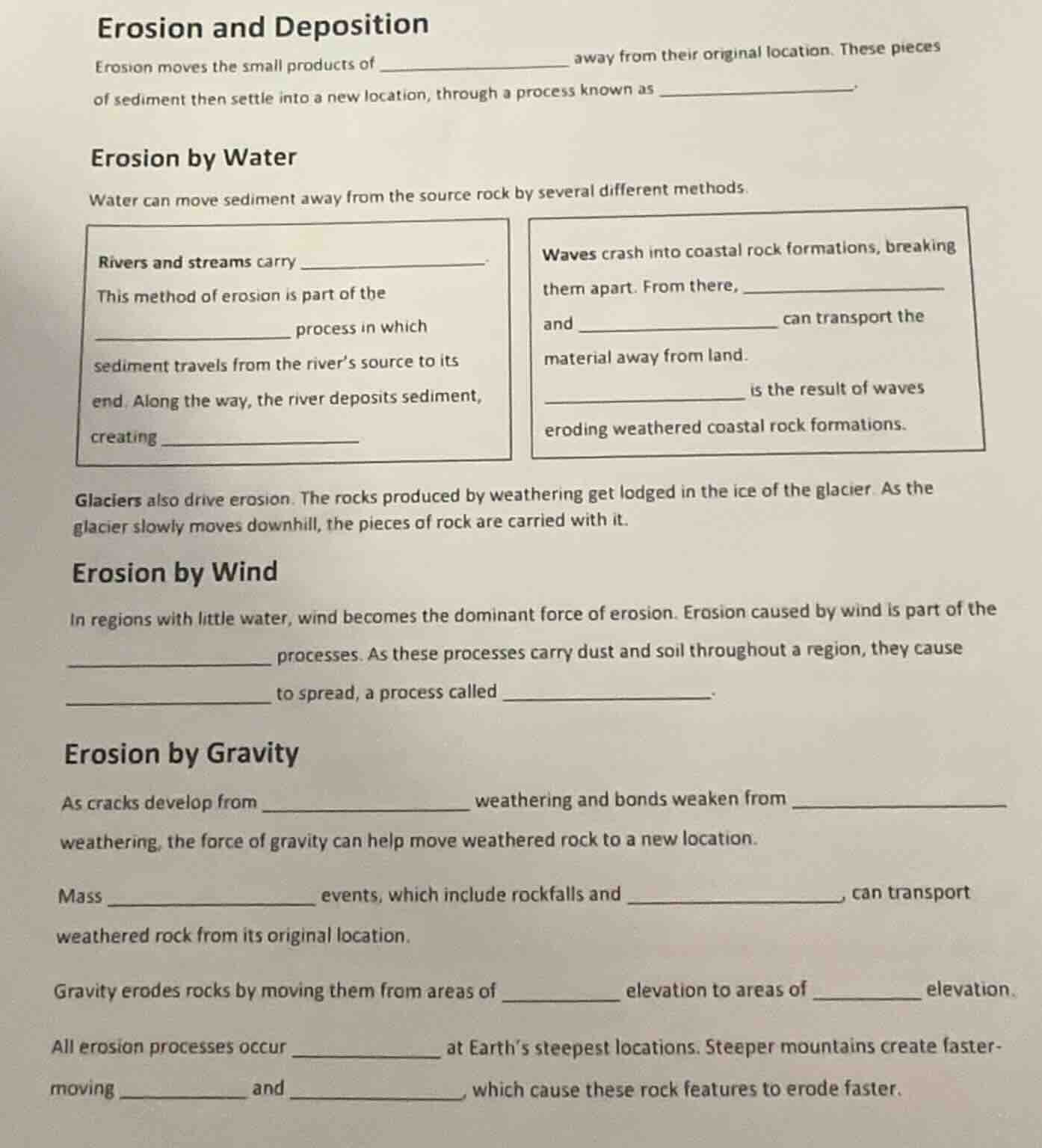
erosion and deposition
erosion moves the small products of _____________ away from their original location. these pieces
of sediment then settle into a new location, through a process known as _____________.
erosion by water
water can move sediment away from the source rock by several different methods.
rivers and streams carry _____________.
waves crash into coastal rock formations, breaking
this method of erosion is part of the
them apart. from there, _____________
_____________ process in which
and _____________ can transport the
sediment travels from the river’s source to its
material away from land.
end. along the way, the river deposits sediment,
_____________ is the result of waves
creating _____________
eroding weathered coastal rock formations.
glaciers also drive erosion. the rocks produced by weathering get lodged in the ice of the glacier. as the
glacier slowly moves downhill, the pieces of rock are carried with it.
erosion by wind
in regions with little water, wind becomes the dominant force of erosion. erosion caused by wind is part of the
_____________ processes. as these processes carry dust and soil throughout a region, they cause
___________ to spread, a process called ___________.
erosion by gravity
as cracks develop from ___________ weathering and bonds weaken from ___________
weathering, the force of gravity can help move weathered rock to a new location.
mass ___________ events, which include rockfalls and ___________, can transport
weathered rock from its original location.
gravity erodes rocks by moving them from areas of ______ elevation to areas of _____ elevation.
all erosion processes occur _________ at earth’s steepest locations. steeper mountains create faster-
moving ______ and ________, which cause these rock features to erode faster.
To solve this fill - in - the - blank problem about erosion and deposition, we rely on the basic concepts of geology (a sub - field of Natural Science, specifically Earth Science). Let's go through each blank:
- First part (Erosion and Deposition):
- Erosion moves the small products of weathering away from their original location. Weathering is the process that breaks down rocks into smaller sediments. These pieces of sediment then settle into a new location, through a process known as deposition.
- Erosion by Water - Rivers and Streams:
- Rivers and streams carry sediment. This method of erosion is part of the fluvial process (fluvial refers to processes related to rivers) in which sediment travels from the river’s source to its end. Along the way, the river deposits sediment, creating landforms (such as deltas, alluvial fans, etc.).
- Erosion by Water - Waves:
- Waves crash into coastal rock formations, breaking them apart. From there, currents and tides can transport the material away from land. Coastal erosion (or more specifically, the formation of sea cliffs or beaches depending on deposition, but in terms of erosion product, it could be sediment transport leading to features like sea stacks etc. Here, the result of waves eroding weathered coastal rock formations is often the creation of sea cliffs or the transport of sediment, but a more general term for the result of wave erosion on coastal rocks could be the production of sediment or the formation of coastal landforms. However, if we consider the process, the result of waves eroding weathered coastal rock formations is the creation of sediment (which is then transported) or specific landforms like sea cliffs. But for the blank, a common answer is that the result of waves eroding weathered coastal rock formations is the production of sediment or the formation of coastal landforms. But a more precise answer based on basic concepts is that the result of wave erosion on coastal rocks is the creation of sediment (which is then transported by currents and tides) or landforms like sea cliffs. But if we take the process, the main thing is that waves erode the rocks to produce sediment, and then currents and tides transport it. So the blanks here: after waves break the rocks, currents and tides transport the material, and the result of waves eroding weathered coastal rock formations is the production of sediment (or the formation of coastal landforms like sea cliffs, but sediment is more general).
- Erosion by Wind:
- In regions with little water, wind becomes the dominant force of erosion. Erosion caused by wind is part of the aeolian processes (aeolian refers to wind - related processes). As these processes carry dust and soil throughout a region, they cause sediment (or more specifically, soil, dust, etc.) to spread, a process called deflation (deflation is the removal of fine - grained material by wind) or transportation (but deflation is a more specific wind - erosion process).
- Erosion by Gravity - Weathering Types:
- As cracks develop from physical weathering (physical weathering includes processes like freeze - thaw, exfoliation that create cracks in rocks) and bonds weaken from chemical weathering (chemical weathering includes processes like oxidation, hydrolysis that weaken the chemical bonds in rocks), the force of gravity can help move weathered rock to a new location.
- Erosion by Gravity - Mass Movement Events:
- Mass **wa…

Snap & solve any problem in the app
Get step-by-step solutions on Sovi AI
Photo-based solutions with guided steps
Explore more problems and detailed explanations
s (filling the blanks):
Erosion and Deposition
- Erosion moves the small products of \(\boldsymbol{\text{weathering}}\) away from their original location. These pieces of sediment then settle into a new location, through a process known as \(\boldsymbol{\text{deposition}}\).
Erosion by Water - Rivers and Streams
- Rivers and streams carry \(\boldsymbol{\text{sediment}}\). This method of erosion is part of the \(\boldsymbol{\text{fluvial}}\) process in which sediment travels from the river’s source to its end. Along the way, the river deposits sediment, creating \(\boldsymbol{\text{landforms}}\)
Erosion by Water - Waves
- Waves crash into coastal rock formations, breaking them apart. From there, \(\boldsymbol{\text{currents}}\) and \(\boldsymbol{\text{tides}}\) can transport the material away from land. \(\boldsymbol{\text{Coastal erosion (or sediment transport/sea cliff formation)}}\) is the result of waves eroding weathered coastal rock formations. (A more precise answer for the last blank could be \(\boldsymbol{\text{sediment}}\) if we consider the product of erosion, or a specific landform like \(\boldsymbol{\text{sea cliffs}}\))
Erosion by Wind
- In regions with little water, wind becomes the dominant force of erosion. Erosion caused by wind is part of the \(\boldsymbol{\text{aeolian}}\) processes. As these processes carry dust and soil throughout a region, they cause \(\boldsymbol{\text{sediment (or soil/dust)}}\) to spread, a process called \(\boldsymbol{\text{deflation (or transportation)}}\)
Erosion by Gravity - Weathering Types
- As cracks develop from \(\boldsymbol{\text{physical}}\) weathering and bonds weaken from \(\boldsymbol{\text{chemical}}\) weathering, the force of gravity can help move weathered rock to a new location.
Erosion by Gravity - Mass Movement Events
- Mass \(\boldsymbol{\text{wasting}}\) events, which include rockfalls and \(\boldsymbol{\text{landslides (or mudslides/debris flows)}}\), can transport weathered rock from its original location.
Erosion by Gravity - Elevation and Speed
- Gravity erodes rocks by moving them from areas of \(\boldsymbol{\text{high}}\) elevation to areas of \(\boldsymbol{\text{low}}\) elevation. All erosion processes occur \(\boldsymbol{\text{faster}}\) at Earth’s steepest locations. Steeper mountains create faster - moving \(\boldsymbol{\text{water}}\) and \(\boldsymbol{\text{glaciers (or wind in aeolian areas)}}\), which cause these rock features to erode faster.
(Note: Some of the answers can have slight variations based on the level of detail and specific curriculum, but these are the most common and accurate answers based on basic geological concepts of erosion and deposition.)