QUESTION IMAGE
Question
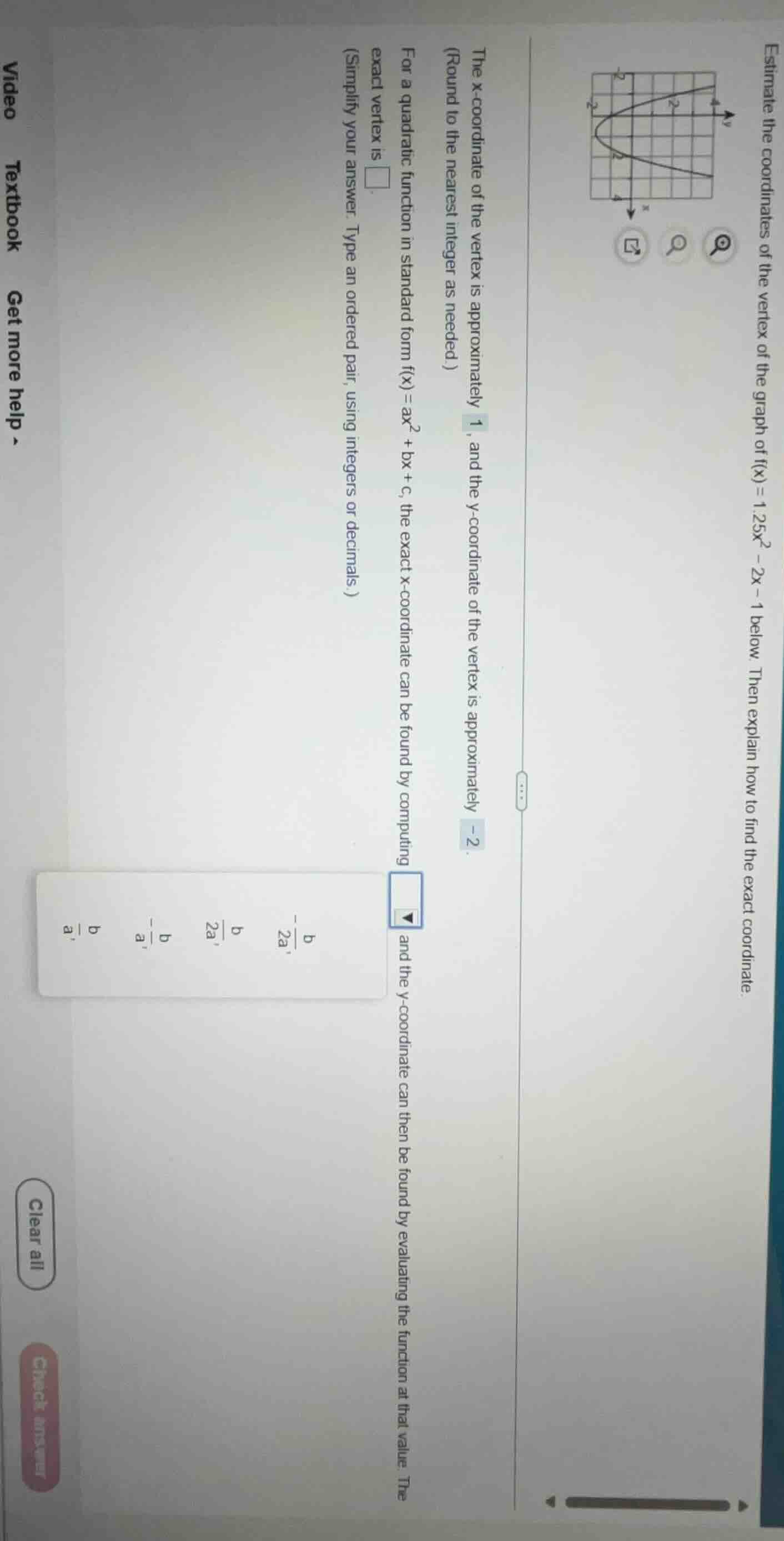
estimate the coordinates of the vertex of the graph of ( f(x) = 1.25x^2 - 2x - 1 ) below. then explain how to find the exact coordinate.
the x - coordinate of the vertex is approximately 1, and the y - coordinate of the vertex is approximately - 2. (round to the nearest integer as needed.)
for a quadratic function in standard form ( f(x)=ax^2 + bx + c ), the exact x - coordinate can be found by computing (\boldsymbol{\frac{-b}{2a}}) (with options (\frac{b}{2a}), (\frac{-b}{2a}), (\frac{b}{2a}), (\frac{b}{a}) shown in a dropdown), and the y - coordinate can then be found by evaluating the function at that value. the exact vertex is (square). (simplify your answer. type an ordered pair, using integers or decimals.)
Step1: Recall vertex formula for quadratic
For \( f(x) = ax^2 + bx + c \), the x - coordinate of the vertex is given by \( x = -\frac{b}{2a} \). Here, \( a = 1.25 \) and \( b=-2 \).
Step2: Calculate x - coordinate
Substitute \( a = 1.25 \) and \( b = - 2 \) into the formula: \( x=-\frac{-2}{2\times1.25}=\frac{2}{2.5} = 0.8\). Wait, but the approximate x - coordinate was given as 1. Wait, maybe I miscalculated? Wait, \( a = 1.25=\frac{5}{4}\), \( b=-2 \). So \( x =-\frac{b}{2a}=-\frac{-2}{2\times\frac{5}{4}}=\frac{2}{\frac{5}{2}}=\frac{4}{5} = 0.8\approx1 \) (rounded to nearest integer). Now, to find the y - coordinate, substitute \( x = 0.8 \) into \( f(x)=1.25x^{2}-2x - 1 \).
\( f(0.8)=1.25\times(0.8)^{2}-2\times0.8 - 1=1.25\times0.64-1.6 - 1 = 0.8-1.6 - 1=-1.8\approx - 2 \) (rounded to nearest integer). Now, the exact vertex: x - coordinate is \( -\frac{b}{2a}=-\frac{-2}{2\times1.25}=\frac{2}{2.5}=0.8=\frac{4}{5} \), y - coordinate: \( f(\frac{4}{5})=1.25\times(\frac{4}{5})^{2}-2\times\frac{4}{5}-1=1.25\times\frac{16}{25}-\frac{8}{5}-1=\frac{20}{25}-\frac{40}{25}-\frac{25}{25}=\frac{20 - 40 - 25}{25}=\frac{-45}{25}=-\frac{9}{5}=-1.8 \). So the exact vertex is \( (\frac{4}{5},-\frac{9}{5}) \) or \( (0.8, - 1.8) \). But the question also has a dropdown for the formula, the x - coordinate of the vertex for \( ax^{2}+bx + c \) is \( -\frac{b}{2a} \), so the first dropdown (the formula) should be \( -\frac{b}{2a} \), and the exact vertex is \( (0.8, - 1.8) \) or \( (\frac{4}{5},-\frac{9}{5}) \). Wait, maybe the problem is about the formula first. The formula for the x - coordinate of the vertex of \( f(x)=ax^{2}+bx + c \) is \( -\frac{b}{2a} \), so the answer for the formula part is \( -\frac{b}{2a} \), and the exact vertex is \( (0.8, - 1.8) \) (or as a fraction \( (\frac{4}{5},-\frac{9}{5}) \)).

Snap & solve any problem in the app
Get step-by-step solutions on Sovi AI
Photo-based solutions with guided steps
Explore more problems and detailed explanations
The formula for the x - coordinate of the vertex is \( \boldsymbol{-\frac{b}{2a}} \), and the exact vertex is \( \boldsymbol{(0.8, - 1.8)} \) (or \( \boldsymbol{(\frac{4}{5},-\frac{9}{5})} \)).