QUESTION IMAGE
Question
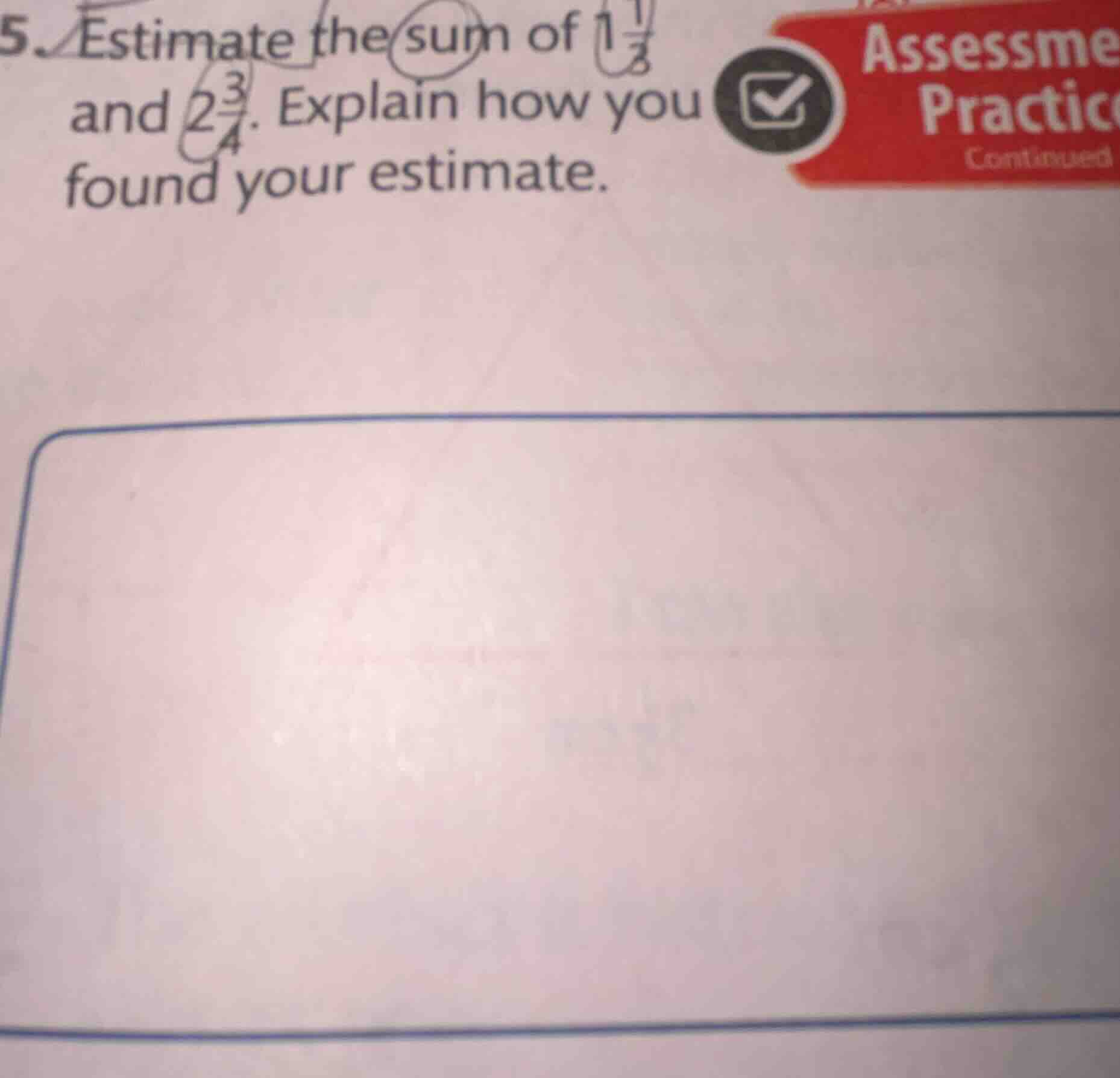
- estimate the sum of $1\frac{1}{3}$ and $2\frac{3}{4}$. explain how you found your estimate.
Step1: Estimate \(1\frac{1}{3}\)
The fraction \(\frac{1}{3}\) is less than \(\frac{1}{2}\), so we round \(1\frac{1}{3}\) down to the nearest whole number, which is \(1\). But wait, actually, when estimating sums of mixed numbers, another way is to look at the fraction part. \(\frac{1}{3}\) is close to \(0\) but maybe we can also consider if we round to the nearest whole or to the nearest half. Wait, let's correct: for \(1\frac{1}{3}\), the fractional part \(\frac{1}{3}\) is less than \(\frac{1}{2}\), so when estimating, we can round \(1\frac{1}{3}\) to \(1\) or maybe to \(1.5\)? Wait, no, standard estimation for mixed numbers: if the fraction is less than \(\frac{1}{2}\), we round down the whole number, if more than \(\frac{1}{2}\), round up. But \(\frac{1}{3}\approx0.33\), so \(1\frac{1}{3}\approx1\) (rounding to whole number) or maybe \(1.5\) is not right. Wait, actually, for estimation, sometimes we can also use compatible numbers or round to the nearest whole. Now for \(2\frac{3}{4}\), the fractional part \(\frac{3}{4}\) is more than \(\frac{1}{2}\), so we round \(2\frac{3}{4}\) up to \(3\). But wait, maybe a better way: \(1\frac{1}{3}\) is close to \(1\) (since \(\frac{1}{3}\) is small) and \(2\frac{3}{4}\) is close to \(3\) (since \(\frac{3}{4}\) is almost \(1\)). But wait, another approach: add the whole numbers and the fractions separately. The whole numbers: \(1 + 2 = 3\). The fractions: \(\frac{1}{3}+\frac{3}{4}\). Let's estimate the sum of fractions: \(\frac{1}{3}\approx0.33\), \(\frac{3}{4}=0.75\), so their sum is approximately \(0.33 + 0.75 = 1.08\). Then total sum is approximately \(3 + 1.08 = 4.08\), so approximately \(4\). Alternatively, round \(1\frac{1}{3}\) to \(1\) (since \(\frac{1}{3}<\frac{1}{2}\)) and \(2\frac{3}{4}\) to \(3\) (since \(\frac{3}{4}>\frac{1}{2}\)), then \(1 + 3 = 4\). Or, round \(1\frac{1}{3}\) to \(1.5\) (midway) and \(2\frac{3}{4}\) to \(3\), then \(1.5+3 = 4.5\), but the first method is more standard. Let's go with the first method:
Step1: Estimate \(1\frac{1}{3}\)
The mixed number \(1\frac{1}{3}\) has a fractional part \(\frac{1}{3}\), which is less than \(\frac{1}{2}\). So we can round \(1\frac{1}{3}\) to the nearest whole number, which is \(1\) (or we can also consider it as approximately \(1\) since \(\frac{1}{3}\) is small).
Step2: Estimate \(2\frac{3}{4}\)
The mixed number \(2\frac{3}{4}\) has a fractional part \(\frac{3}{4}\), which is greater than \(\frac{1}{2}\). So we round \(2\frac{3}{4}\) up to the nearest whole number, which is \(3\).
Step3: Sum the estimates
Now, add the estimated whole numbers: \(1 + 3 = 4\). Alternatively, if we estimate the fractions: \(\frac{1}{3}\approx0.3\) and \(\frac{3}{4}\approx0.8\), so \(\frac{1}{3}+\frac{3}{4}\approx0.3 + 0.8 = 1.1\). Then add the whole numbers \(1 + 2 = 3\), so total sum is \(3 + 1.1 = 4.1\), which is approximately \(4\).

Snap & solve any problem in the app
Get step-by-step solutions on Sovi AI
Photo-based solutions with guided steps
Explore more problems and detailed explanations
The estimated sum of \(1\frac{1}{3}\) and \(2\frac{3}{4}\) is approximately \(4\). We estimate by rounding each mixed number to the nearest whole number: \(1\frac{1}{3}\) (with \(\frac{1}{3}<\frac{1}{2}\)) rounds to \(1\), and \(2\frac{3}{4}\) (with \(\frac{3}{4}>\frac{1}{2}\)) rounds to \(3\). Then we add these rounded values: \(1 + 3 = 4\). (Another way: estimating the fractional parts and adding to the sum of whole numbers also gives an approximate sum of \(4\).)