QUESTION IMAGE
Question
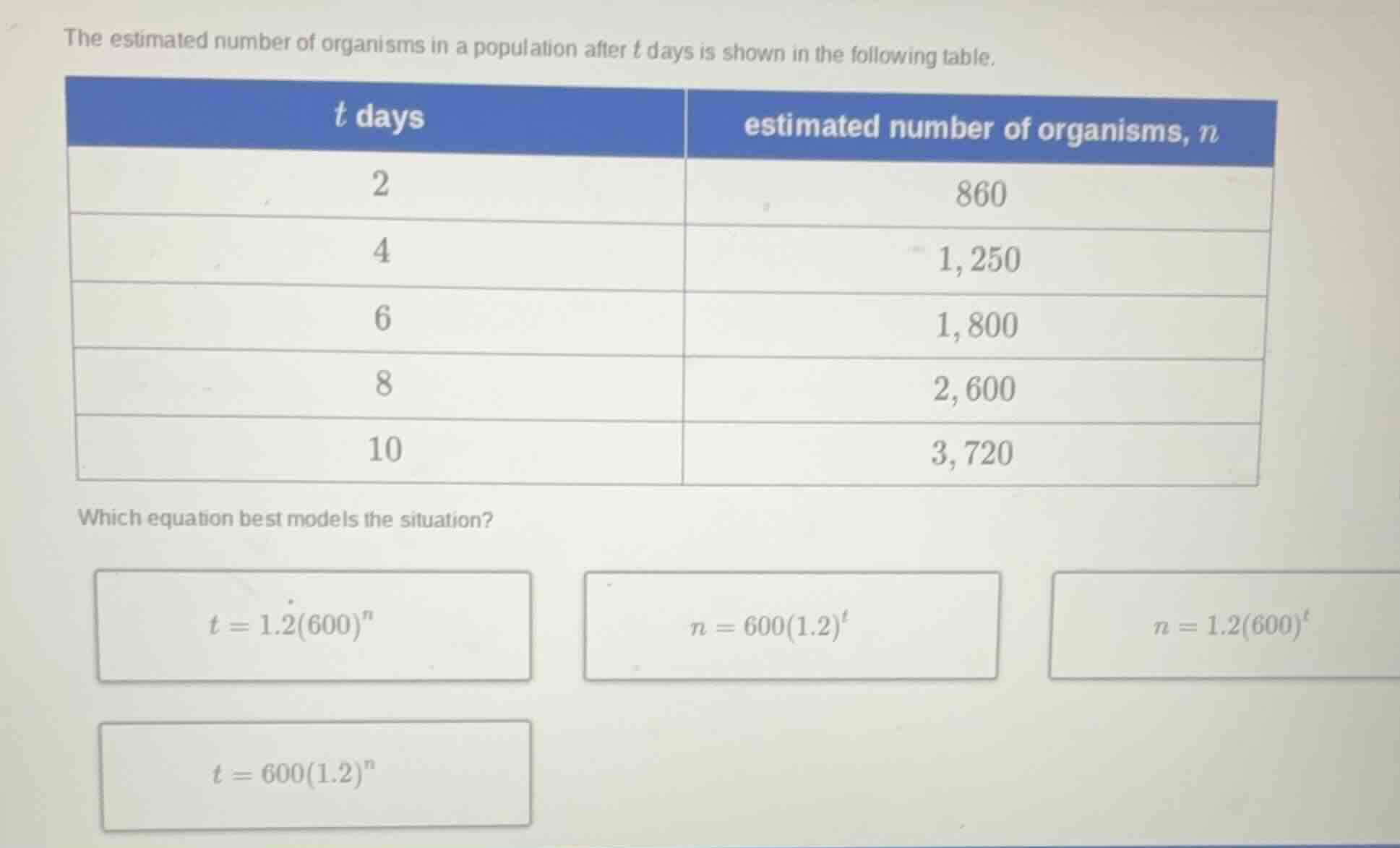
the estimated number of organisms in a population after t days is shown in the following table.
| t days | estimated number of organisms, n |
|---|---|
| 4 | 1,250 |
| 6 | 1,800 |
| 8 | 2,600 |
| 10 | 3,720 |
which equation best models the situation?
$t = 1.2(600)^n$ $n = 600(1.2)^t$ $n = 1.2(600)^t$
$t = 600(1.2)^n$
Step1: Analyze the relationship between t and n
We know that the number of organisms \( n \) should be a function of time \( t \), so the independent variable is \( t \) and the dependent variable is \( n \). So we can eliminate the options where \( t \) is the dependent variable (the first and the fourth options).
Step2: Recall the exponential growth model
The general form of an exponential growth model is \( n = a(b)^{t} \), where \( a \) is the initial amount, \( b \) is the growth factor, and \( t \) is the time.
Step3: Check the remaining options
We have two remaining options: \( n = 600(1.2)^{t} \) and \( n=1.2(600)^{t} \)
Let's test \( t = 2 \) in \( n = 600(1.2)^{t} \):
\( n=600\times(1.2)^{2}=600\times1.44 = 864 \), which is close to 860 (the given value for \( t = 2 \)).
Now test \( t = 2 \) in \( n = 1.2\times(600)^{t} \):
\( n=1.2\times(600)^{2}=1.2\times360000 = 432000 \), which is way larger than 860. So the second option \( n = 600(1.2)^{t} \) is the correct model.

Snap & solve any problem in the app
Get step-by-step solutions on Sovi AI
Photo-based solutions with guided steps
Explore more problems and detailed explanations
\( n = 600(1.2)^{t} \) (the second option among the given choices)