QUESTION IMAGE
Question
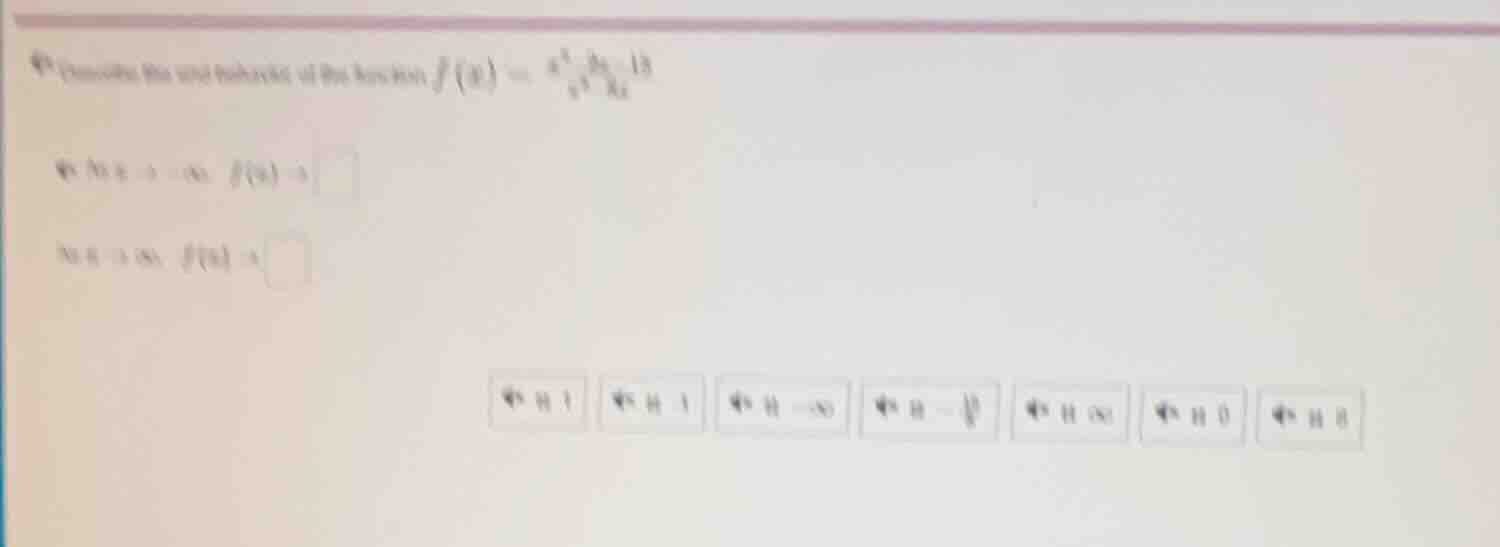
evaluate the end behavior of the function $f(x) = \frac{x^5 + 2x - 13}{x^3 - 8x}$
as $x \to \infty$, $f(x) \to \square$
as $x \to -\infty$, $f(x) \to \square$
options: $\infty$, $-\infty$, $-\frac{1}{2}$, $\frac{1}{2}$, $0$, $1$, $-1$
Step1: Simplify the function
Factor numerator and denominator:
$f(x)=\frac{x^2-2x-15}{x^2-3x}=\frac{(x-5)(x+3)}{x(x-3)}$
Step2: Analyze $x \to 0^-$
Substitute $x$ approaching 0 from left:
$x$ is a small negative number, so $x \to 0^-$, $(x-5)<0$, $(x+3)>0$, $(x-3)<0$.
$f(x)=\frac{(-)(+)}{(-)(-)}=\frac{-}{+}=$ negative denominator, numerator negative.
$\lim_{x \to 0^-} \frac{(x-5)(x+3)}{x(x-3)} = \frac{(-5)(3)}{0^-(-3)}=\frac{-15}{0^+}=\infty$
Step3: Analyze $x \to 0^+$
Substitute $x$ approaching 0 from right:
$x$ is a small positive number, so $x \to 0^+$, $(x-5)<0$, $(x+3)>0$, $(x-3)<0$.
$f(x)=\frac{(-)(+)}{(+)(-)}=\frac{-}{-}=$ positive denominator, numerator negative.
$\lim_{x \to 0^+} \frac{(x-5)(x+3)}{x(x-3)} = \frac{(-5)(3)}{0^+(-3)}=\frac{-15}{0^-}=-\infty$

Snap & solve any problem in the app
Get step-by-step solutions on Sovi AI
Photo-based solutions with guided steps
Explore more problems and detailed explanations
- As $x \to 0^-$, $f(x) \to \infty$
- As $x \to 0^+$, $f(x) \to -\infty$