QUESTION IMAGE
Question
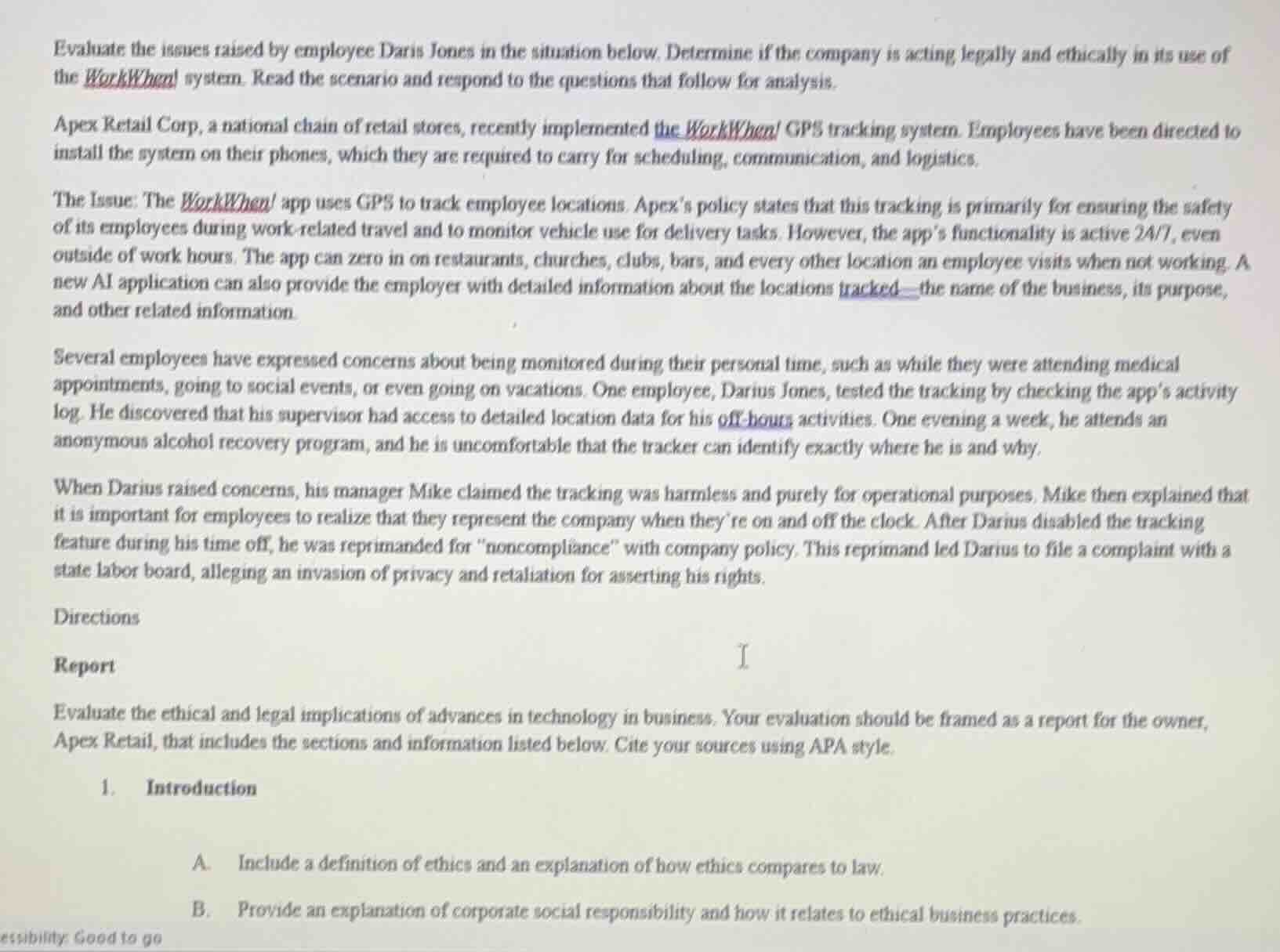
evaluate the issues raised by employee daris jones in the situation below. determine if the company is acting legally and ethically in its use of the workwhen system. read the scenario and respond to the questions that follow for analysis. apex retail corp, a national chain of retail stores, recently implemented the workwhen! gps tracking system. employees have been directed to install the system on their phones, which they are required to carry for scheduling, communication, and logistics. the issue: the workwhen! app uses gps to track employee locations. apex’s policy states that this tracking is primarily for ensuring the safety of its employees during work - related travel and to monitor vehicle use for delivery tasks. however, the app’s functionality is active 24/7, even outside of work hours. the app can zero in on restaurants, churches, clubs, bars, and every other location an employee visits when not working. a new ai application can also provide the employer with detailed information about the locations tracked—the name of the business, its purpose, and other related information. several employees have expressed concerns about being monitored during their personal time, such as while they were attending medical appointments, going to social events, or even going on vacations. one employee, darius jones, tested the tracking by checking the app’s activity log. he discovered that his supervisor had access to detailed location data for his off - hours activities. one evening a week, he attends an anonymous alcohol recovery program, and he is uncomfortable that the tracker can identify exactly where he is and why. when darius raised concerns, his manager mike claimed the tracking was harmless and purely for operational purposes. mike then explained that it is important for employees to realize that they represent the company when they’re on and off the clock. after darius disabled the tracking feature during his time off, he was reprimanded for “noncompliance” with company policy. this reprimand led darius to file a complaint with a state labor board, alleging an invasion of privacy and retaliation for asserting his rights. directions report evaluate the ethical and legal implications of advances in technology in business. your evaluation should be framed as a report for the owner, apex retail, that includes the sections and information listed below. cite your sources using apa style. 1. introduction a. include a definition of ethics and an explanation of how ethics compares to law. b. provide an explanation of corporate social responsibility and how it relates to ethical business practices.
1. Introduction
A. Definition of Ethics and Comparison with Law
- Ethics refers to the moral principles that govern a person's or group's behavior, focusing on what is right or wrong, just or unjust (Velasquez et al., 2015). It is a set of standards shaped by values, culture, and personal beliefs, guiding actions to promote well - being and fairness.
- Law is a system of rules established by a governing authority (e.g., government) that are enforceable through legal mechanisms (such as courts, fines, or imprisonment). While law sets the minimum standards of behavior that society deems acceptable and provides a formal framework for resolving disputes, ethics goes beyond the law. An action can be legal (i.e., it does not violate any laws) but still be unethical. For example, a company may legally exploit a loophole in environmental regulations to pollute, but this action could be considered unethical as it harms the environment and the public. Conversely, some ethical actions may not be legally required (e.g., a company voluntarily providing higher - than - minimum wages to its employees).
B. Corporate Social Responsibility (CSR) and Ethical Business Practices
- Corporate Social Responsibility is a business approach where companies take responsibility for their impact on society and the environment. It involves actions that go beyond profit - maximization and legal compliance, encompassing economic, social, and environmental dimensions (Carroll, 1991). For example, a company may engage in CSR by implementing sustainable supply chain practices, supporting local communities through charitable donations, or promoting diversity and inclusion in the workplace.
- Relationship with Ethical Business Practices: Ethical business practices are a core component of CSR. When a company acts ethically, it is fulfilling its social responsibility. For instance, in the case of Apex Retail Corp, if the company were to respect employees' privacy rights (an ethical practice), it would be demonstrating social responsibility towards its employees. Ethical practices help build trust with stakeholders (employees, customers, investors), which is essential for long - term business success and is in line with the broader goals of CSR.
References
Carroll, A. B. (1991). The pyramid of corporate social responsibility: Toward the moral management of organizational stakeholders. Business Horizons, 34(4), 39 - 48.
Velasquez, M. G., Andre, C., Shanks, T., & Meyer, M. J. (2015). Ethics: Theory and practice. Pearson.

Snap & solve any problem in the app
Get step-by-step solutions on Sovi AI
Photo-based solutions with guided steps
Explore more problems and detailed explanations
1. Introduction
A. Definition of Ethics and Comparison with Law
- Ethics refers to the moral principles that govern a person's or group's behavior, focusing on what is right or wrong, just or unjust (Velasquez et al., 2015). It is a set of standards shaped by values, culture, and personal beliefs, guiding actions to promote well - being and fairness.
- Law is a system of rules established by a governing authority (e.g., government) that are enforceable through legal mechanisms (such as courts, fines, or imprisonment). While law sets the minimum standards of behavior that society deems acceptable and provides a formal framework for resolving disputes, ethics goes beyond the law. An action can be legal (i.e., it does not violate any laws) but still be unethical. For example, a company may legally exploit a loophole in environmental regulations to pollute, but this action could be considered unethical as it harms the environment and the public. Conversely, some ethical actions may not be legally required (e.g., a company voluntarily providing higher - than - minimum wages to its employees).
B. Corporate Social Responsibility (CSR) and Ethical Business Practices
- Corporate Social Responsibility is a business approach where companies take responsibility for their impact on society and the environment. It involves actions that go beyond profit - maximization and legal compliance, encompassing economic, social, and environmental dimensions (Carroll, 1991). For example, a company may engage in CSR by implementing sustainable supply chain practices, supporting local communities through charitable donations, or promoting diversity and inclusion in the workplace.
- Relationship with Ethical Business Practices: Ethical business practices are a core component of CSR. When a company acts ethically, it is fulfilling its social responsibility. For instance, in the case of Apex Retail Corp, if the company were to respect employees' privacy rights (an ethical practice), it would be demonstrating social responsibility towards its employees. Ethical practices help build trust with stakeholders (employees, customers, investors), which is essential for long - term business success and is in line with the broader goals of CSR.
References
Carroll, A. B. (1991). The pyramid of corporate social responsibility: Toward the moral management of organizational stakeholders. Business Horizons, 34(4), 39 - 48.
Velasquez, M. G., Andre, C., Shanks, T., & Meyer, M. J. (2015). Ethics: Theory and practice. Pearson.