QUESTION IMAGE
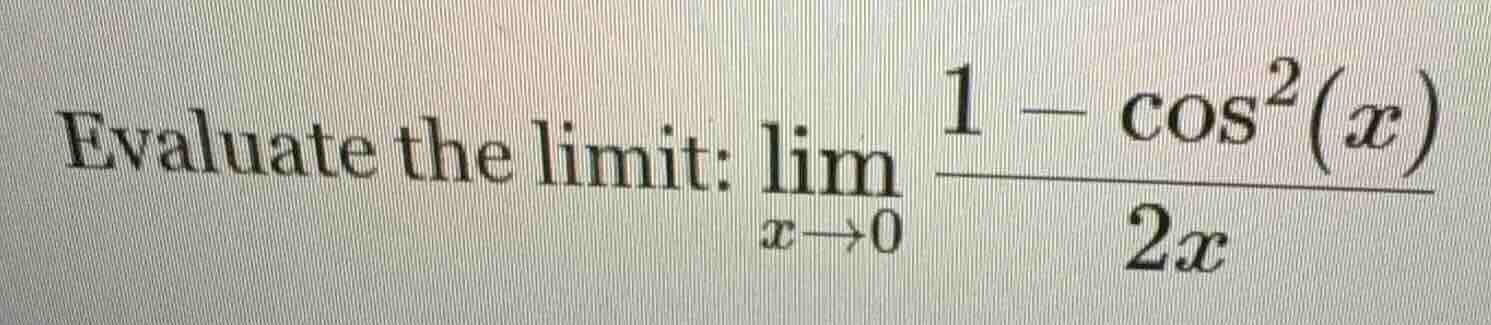
Question
evaluate the limit: \\(\lim_{x \to 0} \frac{1 - \cos^2(x)}{2x}\\)
Step1: Use trigonometric identity
We know the Pythagorean identity \(1 - \cos^{2}(x)=\sin^{2}(x)\). So we can rewrite the numerator:
\(\lim_{x
ightarrow0}\frac{\sin^{2}(x)}{2x}\)
Step2: Simplify the expression
We can split the fraction as \(\lim_{x
ightarrow0}\frac{\sin(x)}{2}\cdot\frac{\sin(x)}{x}\)
We know that \(\lim_{x
ightarrow0}\frac{\sin(x)}{x} = 1\) (a standard limit result). And \(\lim_{x
ightarrow0}\frac{\sin(x)}{2}=\frac{\sin(0)}{2}=0\)
So we have \(\lim_{x
ightarrow0}\frac{\sin(x)}{2}\cdot\lim_{x
ightarrow0}\frac{\sin(x)}{x}\) (by the product rule of limits)
Substituting the known limits: \(0\times1 = 0\)
Alternatively, we can also use L'Hopital's Rule. Since as \(x
ightarrow0\), the numerator \(1-\cos^{2}(x)
ightarrow0\) and the denominator \(2x
ightarrow0\), so it is in the \(\frac{0}{0}\) form.
Differentiate the numerator and the denominator:
The derivative of the numerator \(1 - \cos^{2}(x)\) with respect to \(x\) is \(2\cos(x)\sin(x)\) (using chain rule: derivative of \(\cos^{2}(x)\) is \(2\cos(x)(-\sin(x))\), so derivative of \(1-\cos^{2}(x)\) is \(2\cos(x)\sin(x)\))
The derivative of the denominator \(2x\) with respect to \(x\) is \(2\)
So now we have \(\lim_{x
ightarrow0}\frac{2\cos(x)\sin(x)}{2}=\lim_{x
ightarrow0}\cos(x)\sin(x)\)
Substituting \(x = 0\), we get \(\cos(0)\sin(0)=1\times0 = 0\)

Snap & solve any problem in the app
Get step-by-step solutions on Sovi AI
Photo-based solutions with guided steps
Explore more problems and detailed explanations
\(0\)