QUESTION IMAGE
Question
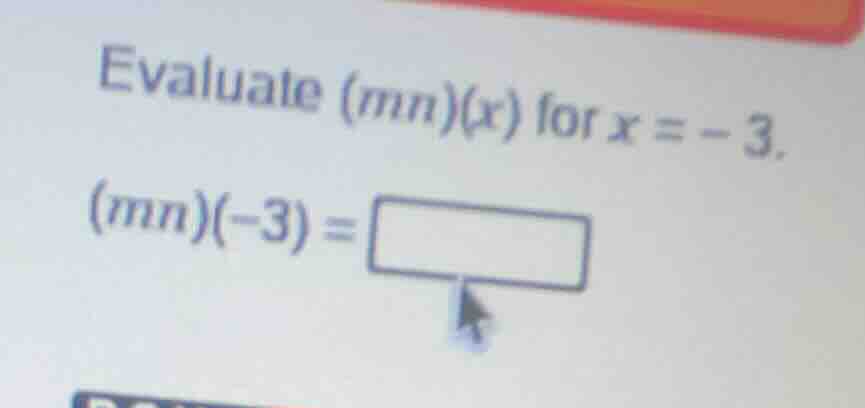
evaluate (mn)(x) for x = - 3. (mn)(-3) =
To solve this problem, we need to know the functions \( m(x) \) and \( n(x) \) to compute the product \( (mn)(x) = m(x) \cdot n(x) \) and then evaluate it at \( x = -3 \). Since the specific functions \( m(x) \) and \( n(x) \) are not provided in the image, we can't proceed with the calculation.
However, if we assume we have the functions, here's the general step - by - step process:
Step 1: Recall the definition of the product of two functions
The product of two functions \( m(x) \) and \( n(x) \) is defined as \( (mn)(x)=m(x)\times n(x) \).
Step 2: Substitute \( x = - 3 \) into the product function
We would substitute \( x=-3 \) into \( m(x) \) and \( n(x) \) separately, then multiply the results. That is, \( (mn)(-3)=m(-3)\times n(-3) \).
Since the functions \( m(x) \) and \( n(x) \) are not given, we can't find a numerical answer. If you provide the definitions of \( m(x) \) and \( n(x) \), we can complete the evaluation.

Snap & solve any problem in the app
Get step-by-step solutions on Sovi AI
Photo-based solutions with guided steps
Explore more problems and detailed explanations
To solve this problem, we need to know the functions \( m(x) \) and \( n(x) \) to compute the product \( (mn)(x) = m(x) \cdot n(x) \) and then evaluate it at \( x = -3 \). Since the specific functions \( m(x) \) and \( n(x) \) are not provided in the image, we can't proceed with the calculation.
However, if we assume we have the functions, here's the general step - by - step process:
Step 1: Recall the definition of the product of two functions
The product of two functions \( m(x) \) and \( n(x) \) is defined as \( (mn)(x)=m(x)\times n(x) \).
Step 2: Substitute \( x = - 3 \) into the product function
We would substitute \( x=-3 \) into \( m(x) \) and \( n(x) \) separately, then multiply the results. That is, \( (mn)(-3)=m(-3)\times n(-3) \).
Since the functions \( m(x) \) and \( n(x) \) are not given, we can't find a numerical answer. If you provide the definitions of \( m(x) \) and \( n(x) \), we can complete the evaluation.