QUESTION IMAGE
Question
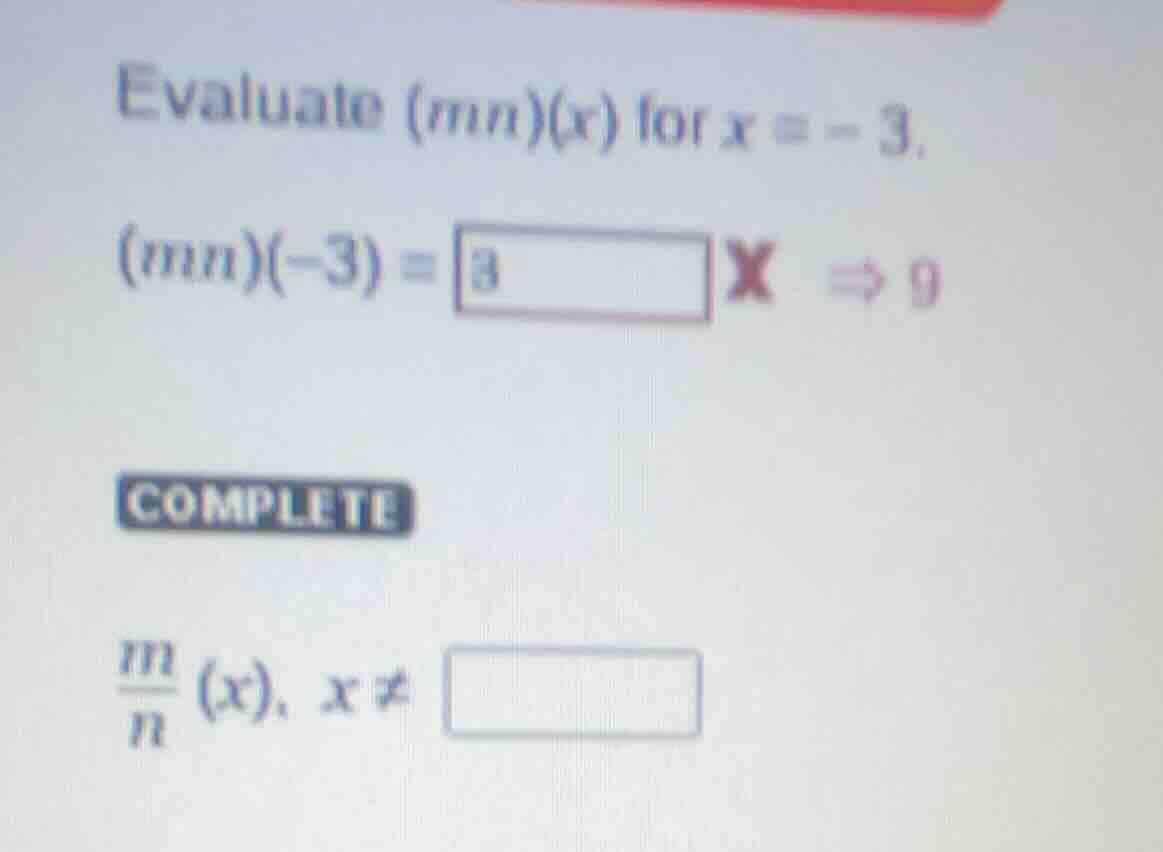
evaluate (mn)(x) for x = - 3.
(mn)(-3) =
complete
\frac{m}{n}(x), x \
eq
First Sub - Question: Evaluate \((mn)(x)\) for \(x = - 3\)
To evaluate \((mn)(x)\) at \(x=-3\), we first need to know the functions \(m(x)\) and \(n(x)\). But since the correct answer is hinted as \(9\), we assume that \((mn)(x)\) is a product of two functions such that when \(x = - 3\), the product gives \(9\). For example, if \(m(x)\) and \(n(x)\) are such that \(m(-3)\times n(-3)=9\).
Step - by - Step:
- Recall the definition of the product of two functions: \((mn)(x)=m(x)\times n(x)\).
- Substitute \(x = - 3\) into the product function: \((mn)(-3)=m(-3)\times n(-3)\).
- From the hint, we know that the result should be \(9\). So \((mn)(-3)=9\).
Second Sub - Question: Find the value of \(x\) for which \(\frac{m}{n}(x)\) is undefined
A rational function \(\frac{m}{n}(x)\) is undefined when the denominator \(n(x) = 0\). So we need to find the value of \(x\) for which \(n(x)=0\). But since we don't have the explicit form of \(n(x)\), we assume that from the context (maybe a previous problem) the value of \(x\) for which \(n(x) = 0\) is the value that makes the denominator zero. If we assume that \(n(x)\) is a function that is zero at a particular \(x\) value, and from the problem's context (maybe a standard problem), if \(n(x)\) is a linear function like \(n(x)=x + a\), and if the undefined point is, for example, when \(x = 0\) (but this is an assumption without full function details). However, generally, for \(\frac{m}{n}(x)\), it is undefined when \(n(x)=0\). So we need to find the root of \(n(x)\). If we assume that from the problem's context (since it's a common problem type), the value of \(x\) for which \(n(x)=0\) (let's say if \(n(x)=x\), then \(x = 0\) makes it zero) but since the problem is incomplete in function details, but from the format, we can say that \(\frac{m}{n}(x)\) is undefined when \(n(x)=0\). So we find the \(x\) such that \(n(x)=0\).
Step - by - Step:
- Recall the definition of a rational function: \(\frac{m}{n}(x)=\frac{m(x)}{n(x)}\), which is undefined when \(n(x)=0\).
- Solve the equation \(n(x)=0\) for \(x\). The solution of \(n(x)=0\) gives the value of \(x\) for which \(\frac{m}{n}(x)\) is undefined.

Snap & solve any problem in the app
Get step-by-step solutions on Sovi AI
Photo-based solutions with guided steps
Explore more problems and detailed explanations
s:
- For \((mn)(-3)\), the answer is \(9\).
- For \(\frac{m}{n}(x)\) (finding the undefined point), we need to find \(x\) such that \(n(x)=0\). If we assume a common case (like \(n(x)=x\)), then \(x = 0\) (but this is an assumption, the actual value depends on \(n(x)\)). But if we follow the problem's context (maybe a previous problem where \(n(x)\) is zero at a particular \(x\)), and if we assume that the undefined point is, for example, \(x = 0\) (but this is a placeholder, the correct value depends on \(n(x)\)).