QUESTION IMAGE
Question
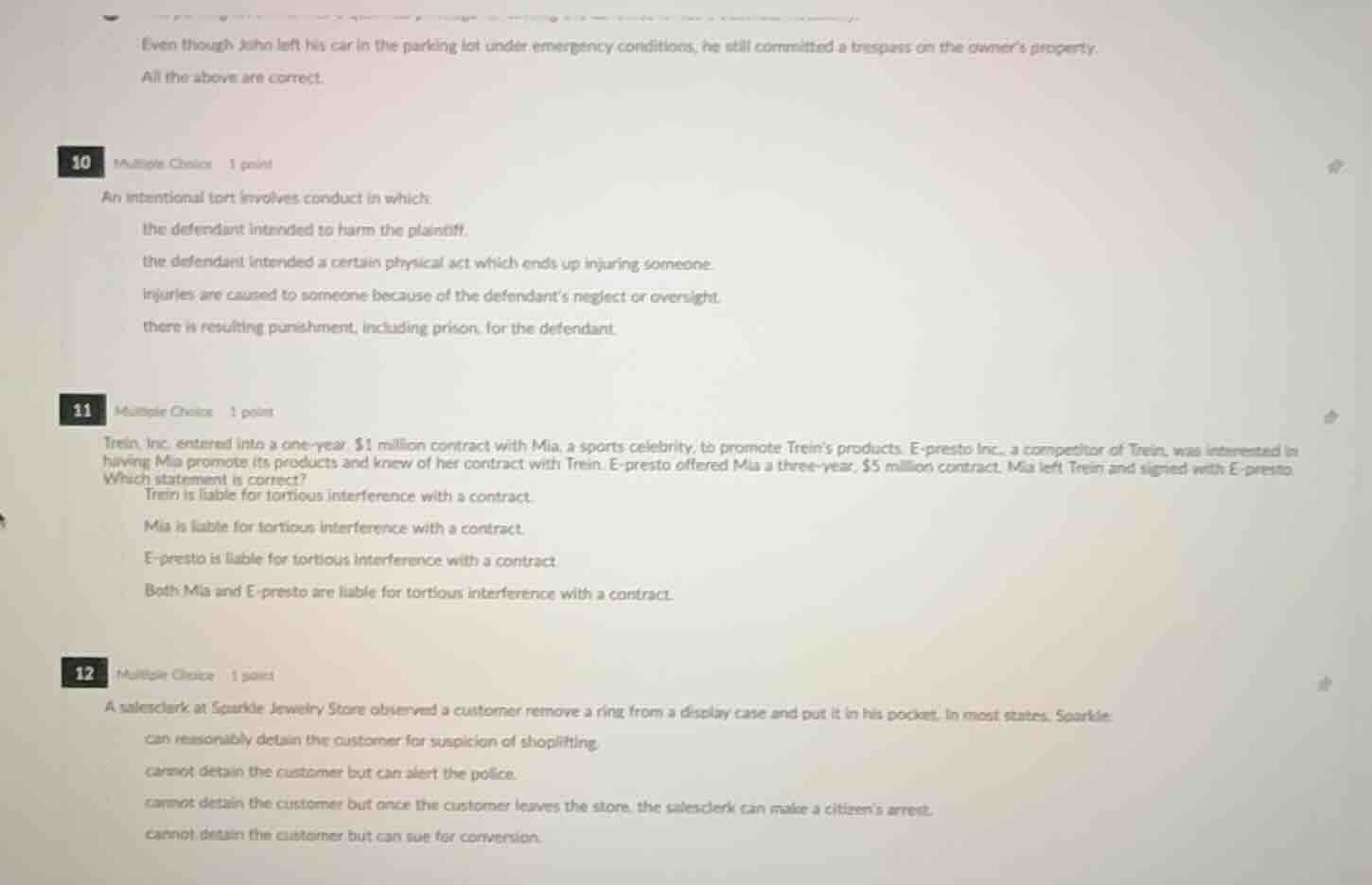
even though john left his car in the parking lot under emergency conditions, he still committed a trespass on the owners property. all the above are correct. 10 multiple choice 1 point an intentional tort involves conduct in which: the defendant intended to harm the plaintiff. the defendant intended a certain physical act which ends up injuring someone. injuries are caused to someone because of the defendants neglect or oversight. there is resulting punishment, including prison, for the defendant. 11 multiple choice 1 point trein, inc. entered into a one - year, $1 million contract with mia, a sports celebrity, to promote treins products. e - presto inc., a competitor of trein, was interested in having mia promote its products and knew of her contract with trein. e - presto offered mia a three - year, $5 million contract. mia left trein and signed with e - presto. which statement is correct? trein is liable for tortious interference with a contract. mia is liable for tortious interference with a contract. e - presto is liable for tortious interference with a contract both mia and e - presto are liable for tortious interference with a contract. 12 multiple choice 1 point a salesclerk at sparkle jewelry store observed a customer remove a ring from a display case and put it in his pocket. in most states, sparkle can reasonably detain the customer for suspicion of shoplifting. cannot detain the customer but can alert the police. cannot detain the customer but once the customer leaves the store, the salesclerk can make a citizens arrest. cannot detain the customer but can sue for conversion.
Question 10:
Intentional torts require the defendant to intend the act that causes harm, not necessarily the harm itself. Negligence is a separate tort category, and prison is a criminal, not civil tort, consequence.
Question 11:
Tortious interference with a contract requires a third party to intentionally induce a breach of a valid contract. E-presto, as a competitor aware of Mia's existing contract with Trein, induced her to breach it, making E-presto liable. Mia is a party to the original contract, not a third party interfering.
Question 12:
Most states recognize the shopkeeper's privilege, which allows a store to reasonably detain a customer suspected of shoplifting to investigate, as long as the detention is reasonable in time and manner.

Snap & solve any problem in the app
Get step-by-step solutions on Sovi AI
Photo-based solutions with guided steps
Explore more problems and detailed explanations
- the defendant intended a certain physical act which ends up injuring someone.
- E-presto is liable for tortious interference with a contract.
- can reasonably detain the customer for suspicion of shoplifting.