QUESTION IMAGE
Question
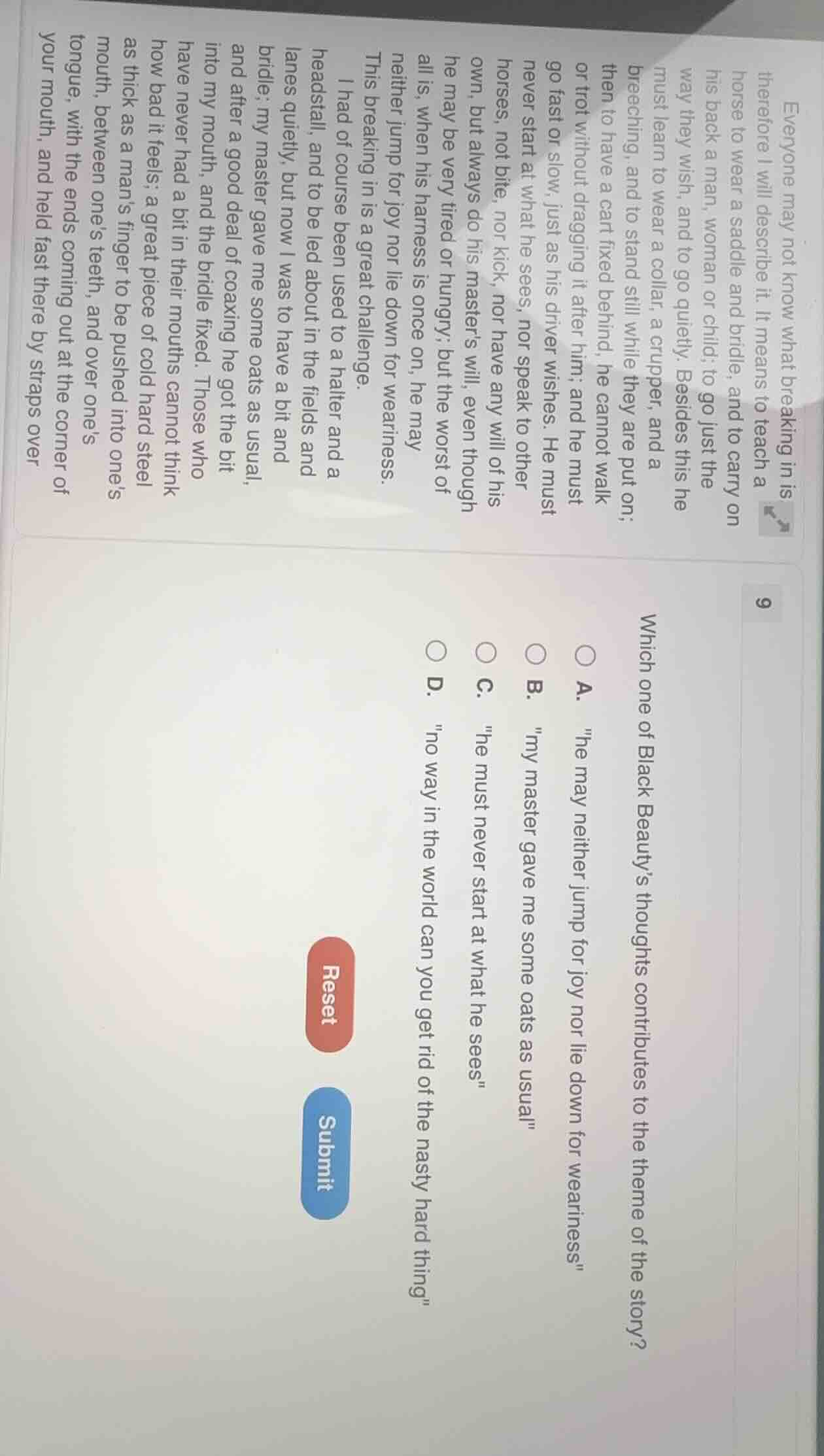
everyone may not know what breaking in is therefore i will describe it. it means to teach a horse to wear a saddle and bridle, and to carry on his back a man, woman or child; to go just the way they wish, and to go quietly. besides this he must learn to wear a collar, a crupper, and a breeching, and to stand still while they are put on; then to have a cart fixed behind, he cannot walk or trot without dragging it after him; and he must go fast or slow, just as his driver wishes. he must never start at what he sees, nor speak to other horses, not bite, nor kick, nor have any will of his own, but always do his masters will, even though he may be very tired or hungry; but the worst of all is, when his harness is once on, he may neither jump for joy nor lie down for weariness. this breaking in is a great challenge.
i had of course been used to a halter and a headstall, and to be led about in the fields and lanes quietly, but now i was to have a bit and bridle; my master gave me some oats as usual, and after a good deal of coaxing he got the bit into my mouth, and the bridle fixed. those who have never had a bit in their mouths cannot think how bad it feels; a great piece of cold hard steel as thick as a mans finger to be pushed into ones mouth, between ones teeth, and over ones tongue, with the ends coming out at the corner of your mouth, and held fast there by straps over
9
which one of black beautys thoughts contributes to the theme of the story?
a. \he may neither jump for joy nor lie down for weariness\
b. \my master gave me some oats as usual\
c. \he must never start at what he sees\
d.
o way in the world can you get rid of the nasty hard thing\
The passage focuses on the loss of autonomy and hardship of a horse during breaking-in. Option D expresses Black Beauty's distress about the bit, which highlights the suffering and loss of control tied to the story's theme of the harsh realities of a working horse's life. The other options either describe training rules or a minor positive moment, not contributing to the core theme of the horse's constrained experience.

Snap & solve any problem in the app
Get step-by-step solutions on Sovi AI
Photo-based solutions with guided steps
Explore more problems and detailed explanations
D. "no way in the world can you get rid of the nasty hard thing"