QUESTION IMAGE
Question
evidence 6: normal distribution & correlation current score: 0
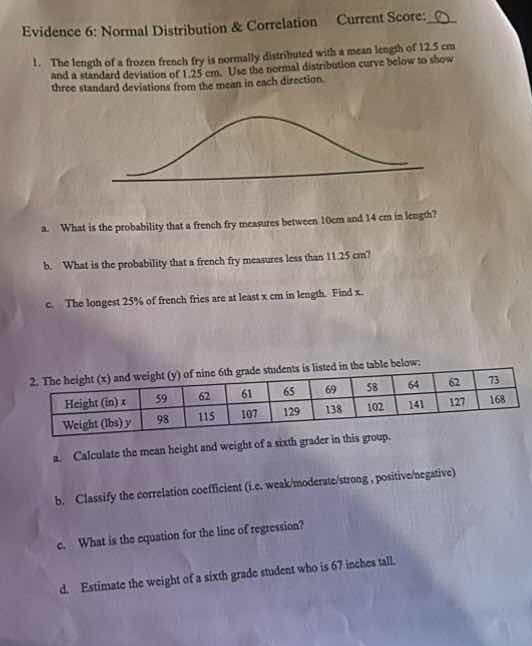
- the length of a frozen french fry is normally distributed with a mean length of 12.5 cm and a standard deviation of 1.25 cm. use the normal distribution curve below to show three standard deviations from the mean in each direction.
a. what is the probability that a french fry measures between 10cm and 14 cm in length?
b. what is the probability that a french fry measures less than 11.25 cm?
c. the longest 25% of french fries are at least x cm in length. find x.
- the height (x) and weight (y) of nine 6th grade students is listed in the table below:
| height (in) x | 59 | 62 | 61 | 65 | 69 | 58 | 64 | 62 | 73 |
| weight (lbs) y | 98 | 115 | 107 | 129 | 138 | 102 | 141 | 127 | 168 |
a. calculate the mean height and weight of a sixth grader in this group.
b. classify the correlation coefficient (i.e. weak/moderate/strong, positive/negative)
c. what is the equation for the line of regression?
d. estimate the weight of a sixth grade student who is 67 inches tall.
---
Problem 1:
Step1: Identify given parameters
Mean $\mu = 12.5$ cm, standard deviation $\sigma = 1.25$ cm
Step2: Calculate z-scores for 10 & 14 cm
For $x=10$: $z_1 = \frac{10 - 12.5}{1.25} = -2$
For $x=14$: $z_2 = \frac{14 - 12.5}{1.25} = 1.2$
Step3: Find probability for part a
Use z-table: $P(Z < -2) = 0.0228$, $P(Z < 1.2) = 0.8849$
$P(10 < X < 14) = 0.8849 - 0.0228 = 0.8621$
Step4: Calculate z-score for 11.25 cm
$z = \frac{11.25 - 12.5}{1.25} = -1$
Step5: Find probability for part b
Use z-table: $P(Z < -1) = 0.1587$
Step6: Find z-score for 75th percentile
75th percentile corresponds to $z = 0.674$
Step7: Solve for x in part c
$x = \mu + z\sigma = 12.5 + (0.674)(1.25) = 13.3425$
Step1: Calculate mean height (part a)
$\bar{x} = \frac{59+62+61+65+69+58+64+62+73}{9} = \frac{573}{9} = 63.67$
Step2: Calculate mean weight (part a)
$\bar{y} = \frac{98+115+107+129+138+102+141+127+168}{9} = \frac{1125}{9} = 125$
Step3: Calculate correlation coefficient (part b)
Use formula $r = \frac{n\sum xy - \sum x \sum y}{\sqrt{[n\sum x^2 - (\sum x)^2][n\sum y^2 - (\sum y)^2]}}$
$\sum xy = (59*98)+(62*115)+...+(73*168) = 72667$
$\sum x^2 = 59^2+62^2+...+73^2 = 36563$
$\sum y^2 = 98^2+115^2+...+168^2 = 146263$
$r = \frac{9*72667 - 573*1125}{\sqrt{[9*36563 - 573^2][9*146263 - 1125^2]}} \approx 0.92$
Step4: Classify correlation (part b)
$r \approx 0.92$ is strong, positive
Step5: Calculate regression slope (part c)
$b = \frac{n\sum xy - \sum x \sum y}{n\sum x^2 - (\sum x)^2} = \frac{9*72667 - 573*1125}{9*36563 - 573^2} \approx 4.83$
Step6: Calculate regression intercept (part c)
$a = \bar{y} - b\bar{x} = 125 - (4.83)(63.67) \approx -182.53$
Step7: Write regression equation (part c)
$\hat{y} = -182.53 + 4.83x$
Step8: Estimate weight for x=67 (part d)
$\hat{y} = -182.53 + (4.83)(67) = 141.08$

Snap & solve any problem in the app
Get step-by-step solutions on Sovi AI
Photo-based solutions with guided steps
Explore more problems and detailed explanations
a. 0.8621
b. 0.1587
c. 13.34 cm (rounded to two decimal places)
---