QUESTION IMAGE
Question
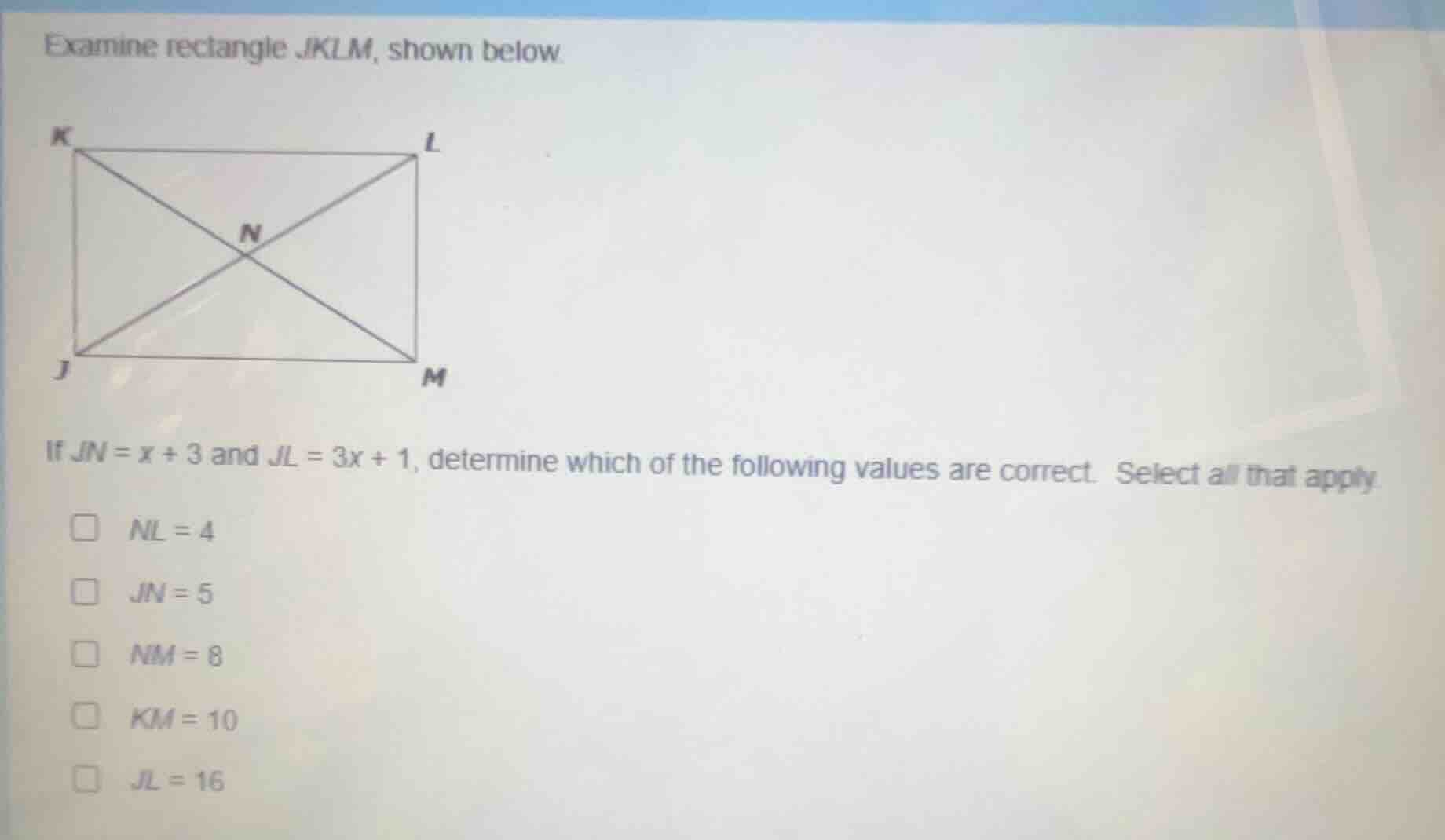
examine rectangle jklm, shown below
image of rectangle jklm with diagonals intersecting at n
if ( jn = x + 3 ) and ( jl = 3x + 1 ), determine which of the following values are correct. select all that apply.
- ( nl = 4 )
- ( jn = 5 )
- ( nm = 8 )
- ( km = 10 )
- ( jl = 16 )
Step1: Recall rectangle diagonals property
In a rectangle, the diagonals are equal and bisect each other. So, \( JL = 2 \times JN \) (since \( N \) is the midpoint of \( JL \)).
Given \( JN = x + 3 \) and \( JL = 3x + 1 \), we set up the equation:
\( 3x + 1 = 2(x + 3) \)
Step2: Solve for \( x \)
Expand the right - hand side: \( 3x + 1 = 2x + 6 \)
Subtract \( 2x \) from both sides: \( 3x - 2x+ 1=2x - 2x + 6 \), which simplifies to \( x + 1 = 6 \)
Subtract 1 from both sides: \( x=6 - 1=5 \)
Step3: Calculate \( JN \), \( JL \), and other segments
- Calculate \( JN \): Substitute \( x = 5 \) into \( JN=x + 3 \), so \( JN=5 + 3 = 8 \)? Wait, no, wait. Wait, we made a mistake above. Wait, let's re - do step 2.
Wait, the equation is \( JL = 2JN \), so \( 3x + 1=2(x + 3) \)
Expand: \( 3x+1 = 2x + 6 \)
Subtract \( 2x \) from both sides: \( 3x-2x + 1=2x-2x + 6\Rightarrow x + 1=6\Rightarrow x = 5 \)
Then \( JN=x + 3=5 + 3 = 8 \)? Wait, no, that can't be. Wait, maybe I messed up the property. Wait, in a rectangle, diagonals are equal and bisect each other. So \( JL=KM \), and \( JN = NL=NM = NK \) (since diagonals bisect each other). So \( JL = 2JN \), so \( 3x + 1=2(x + 3) \)
\( 3x+1=2x + 6\)
\( 3x-2x=6 - 1\)
\( x = 5 \)
Then \( JN=x + 3=5 + 3 = 8 \)? Wait, no, if \( x = 5 \), \( JN=5 + 3 = 8 \), \( JL=3x + 1=3\times5+1 = 16 \). Then \( JN=\frac{JL}{2}\), so \( 8=\frac{16}{2}\), that's correct.
Now let's check each option:
- \( NL \): Since \( JN = NL \) (diagonals bisect each other), \( NL=JN = 8 \)? No, wait, no. Wait, \( JL = 16 \), so \( JN=\frac{JL}{2}=8 \), so \( NL = JN = 8 \)? But the option says \( NL = 4 \), which is wrong.
- \( JN \): \( JN=x + 3=5 + 3 = 8 \)? Wait, the option says \( JN = 5 \), which is wrong. Wait, I must have made a mistake in solving for \( x \). Wait, let's re - solve the equation \( 3x + 1=2(x + 3) \)
\( 3x+1=2x + 6\)
\( 3x-2x=6 - 1\)
\( x = 5 \). Then \( JN=5 + 3 = 8 \), \( JL=3\times5 + 1=16 \)
- \( NM \): Since diagonals bisect each other, \( NM = JN = 8 \), so the option \( NM = 8 \) is correct.
- \( KM \): In a rectangle, \( KM=JL \), \( JL = 16 \), so \( KM = 16 \), the option \( KM = 10 \) is wrong.
- \( JL \): \( JL=3x + 1=3\times5+1 = 16 \), so the option \( JL = 16 \) is correct. Wait, but earlier I thought \( JN = 8 \), but the option \( JN = 5 \) is wrong, \( NL \): since \( NL=JN = 8 \), the option \( NL = 4 \) is wrong. Wait, maybe I made a mistake in the property. Wait, maybe the diagonals bisect each other, so \( JN=NL \), and \( JL=JN + NL=2JN \). So if \( JN=x + 3 \), \( JL = 2(x + 3) \), and we are given \( JL=3x + 1 \). So \( 2(x + 3)=3x + 1 \)
\( 2x+6 = 3x + 1\)
\( 6 - 1=3x - 2x\)
\( x = 5 \)
Then \( JN=x + 3=8 \), \( JL=3x + 1=16 \), \( NL=JN = 8 \), \( NM=JN = 8 \) (since diagonals in a rectangle are equal and bisect each other, so \( KM = JL = 16 \), and \( NM=\frac{KM}{2}=8 \))
So the correct options are:
- \( NM = 8 \) (because \( NM = JN = 8 \))
- \( JL = 16 \) (because \( JL=3x + 1=3\times5 + 1 = 16 \))
Wait, but let's re - check:
If \( x = 5 \):
- \( JN=x + 3=8 \) (so option \( JN = 5 \) is wrong)
- \( NL=JN = 8 \) (so option \( NL = 4 \) is wrong)
- \( NM=JN = 8 \) (so option \( NM = 8 \) is correct)
- \( KM=JL = 16 \) (so option \( KM = 10 \) is wrong)
- \( JL=3x + 1=16 \) (so option \( JL = 16 \) is correct)

Snap & solve any problem in the app
Get step-by-step solutions on Sovi AI
Photo-based solutions with guided steps
Explore more problems and detailed explanations
- \( NM = 8 \)
- \( JL = 16 \)