QUESTION IMAGE
Question
example 4
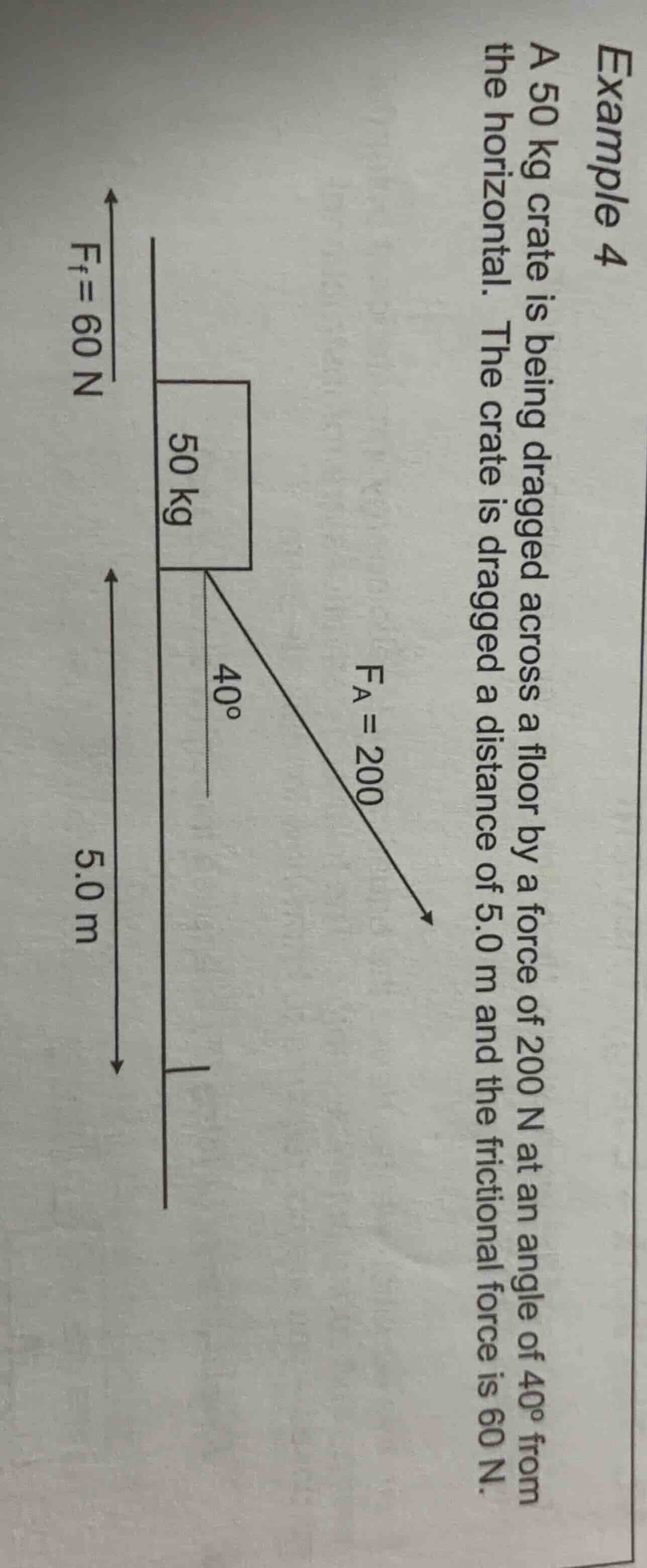
a 50 kg crate is being dragged across a floor by a force of 200 n at an angle of 40° from the horizontal. the crate is dragged a distance of 5.0 m and the frictional force is 60 n.
(image shows a 50 kg crate, a force ( f_a = 200 ) n at 40°, frictional force ( f_f = 60 ) n, and distance 5.0 m)
Step1: Calculate work done by applied force
First, find the horizontal component of the applied force, then multiply by distance.
$W_A = F_A \cos\theta \cdot d = 200 \cos(40^\circ) \cdot 5.0$
$\cos(40^\circ) \approx 0.7660$, so $W_A \approx 200 \cdot 0.7660 \cdot 5.0 = 766\ \text{J}$
Step2: Calculate work done by friction
Friction acts opposite to displacement, so work is negative.
$W_f = -F_f \cdot d = -60 \cdot 5.0 = -300\ \text{J}$
Step3: Calculate net work done
Sum the work from all forces.
$W_{net} = W_A + W_f = 766 - 300 = 466\ \text{J}$

Snap & solve any problem in the app
Get step-by-step solutions on Sovi AI
Photo-based solutions with guided steps
Explore more problems and detailed explanations
The net work done on the crate is $\boldsymbol{466\ \text{J}}$
(Note: If calculating work for individual forces: Work from applied force is $766\ \text{J}$, work from friction is $-300\ \text{J}$)