QUESTION IMAGE
Question
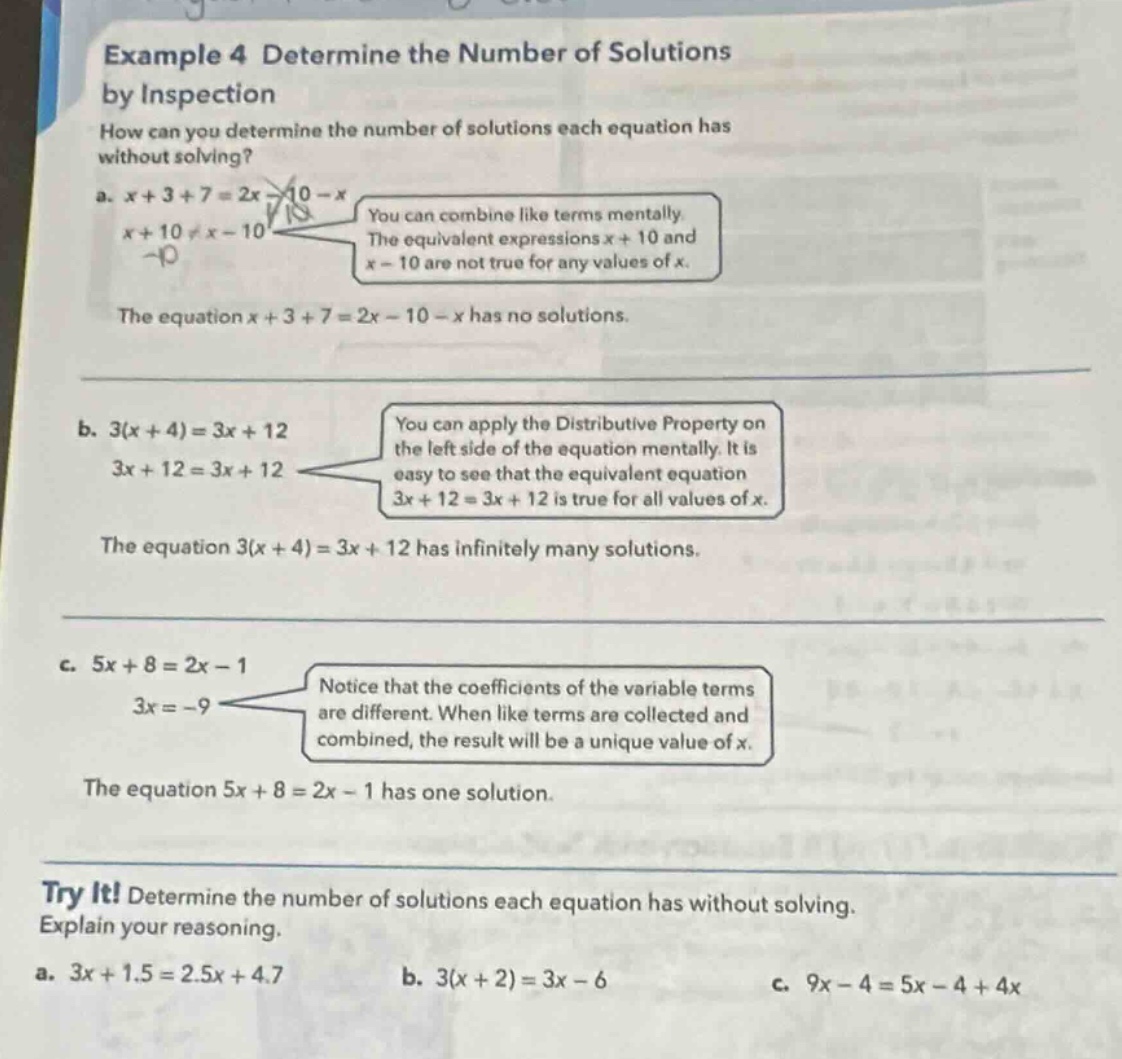
example 4 determine the number of solutions by inspection how can you determine the number of solutions each equation has without solving? a. $x + 3 + 7 = 2x - 10 - x$ $x + 10 \
eq x - 10$ the equation $x + 3 + 7 = 2x - 10 - x$ has no solutions. b. $3(x + 4) = 3x + 12$ $3x + 12 = 3x + 12$ the equation $3(x + 4) = 3x + 12$ has infinitely many solutions. c. $5x + 8 = 2x - 1$ $3x = -9$ the equation $5x + 8 = 2x - 1$ has one solution. try it! determine the number of solutions each equation has without solving. explain your reasoning. a. $3x + 1.5 = 2.5x + 4.7$ b. $3(x + 2) = 3x - 6$ c. $9x - 4 = 5x - 4 + 4x$
Part a: Equation \( 3x + 1.5 = 2.5x + 4.7 \)
Step1: Analyze variable terms
The variable terms are \( 3x \) (left) and \( 2.5x \) (right). Their coefficients (\( 3 \) and \( 2.5 \)) are different.
Step2: Predict solution count
When combining like terms (subtract \( 2.5x \) and \( 1.5 \) from both sides), we’ll get a linear equation with a unique solution for \( x \).
Step1: Apply Distributive Property
Left side: \( 3(x + 2) = 3x + 6 \).
Step2: Compare both sides
Equation becomes \( 3x + 6 = 3x - 6 \). Subtract \( 3x \) from both sides: \( 6 = -6 \), which is false.
Step1: Combine like terms on right
Right side: \( 5x + 4x - 4 = 9x - 4 \).
Step2: Compare both sides
Equation becomes \( 9x - 4 = 9x - 4 \), which is true for all \( x \).

Snap & solve any problem in the app
Get step-by-step solutions on Sovi AI
Photo-based solutions with guided steps
Explore more problems and detailed explanations
One solution (since variable term coefficients differ, combining like terms gives a unique \( x \)).