QUESTION IMAGE
Question
example
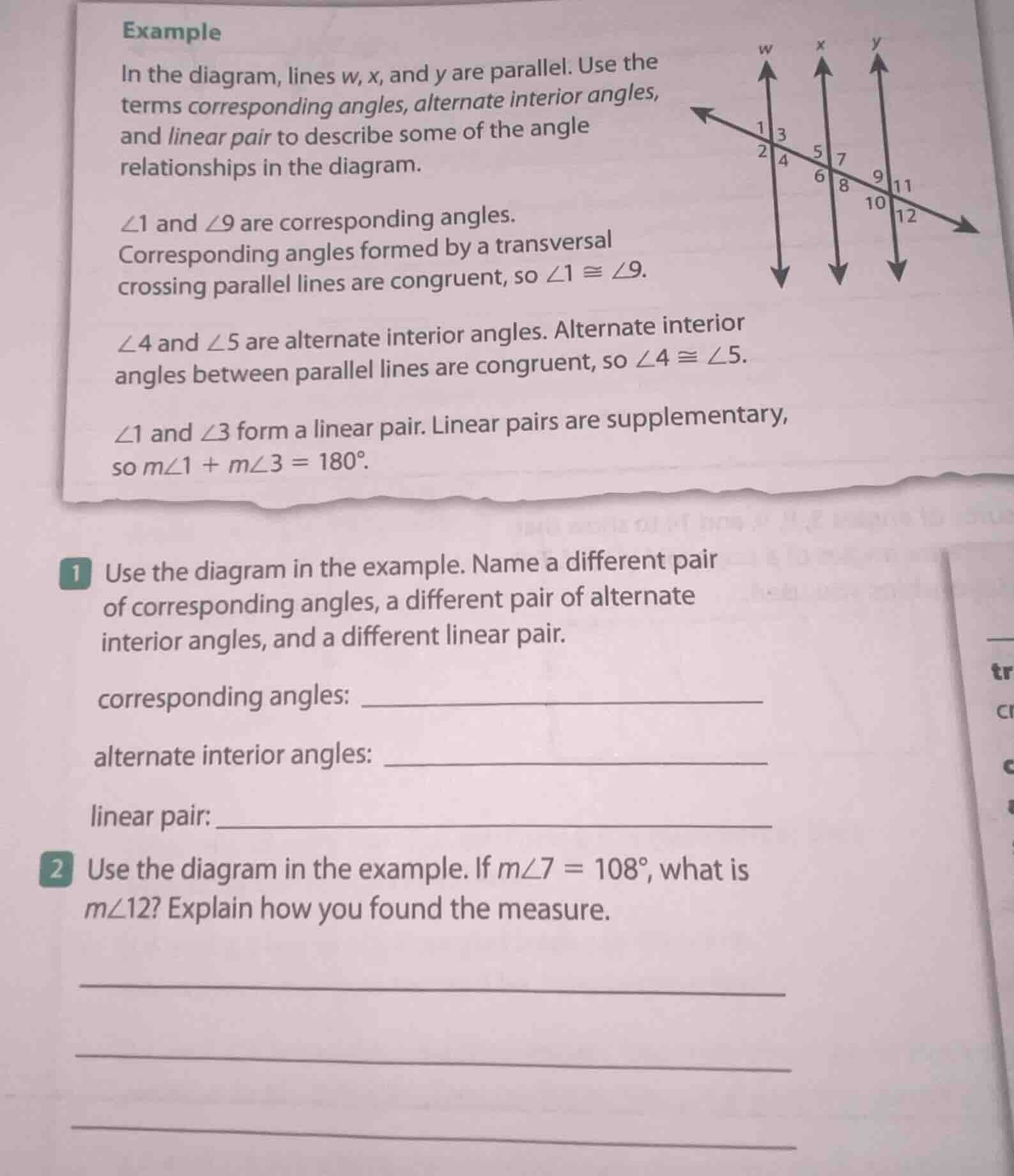
in the diagram, lines w, x, and y are parallel. use the
terms corresponding angles, alternate interior angles,
and linear pair to describe some of the angle
relationships in the diagram.
∠1 and ∠9 are corresponding angles.
corresponding angles formed by a transversal
crossing parallel lines are congruent, so ∠1 ≅ ∠9.
∠4 and ∠5 are alternate interior angles. alternate interior
angles between parallel lines are congruent, so ∠4 ≅ ∠5.
∠1 and ∠3 form a linear pair. linear pairs are supplementary,
so m∠1 + m∠3 = 180°.
1 use the diagram in the example. name a different pair
of corresponding angles, a different pair of alternate
interior angles, and a different linear pair.
corresponding angles:
alternate interior angles:
linear pair:
2 use the diagram in the example. if m∠7 = 108°, what is
m∠12? explain how you found the measure.
Sub - question 1
- Corresponding Angles: Corresponding angles are in the same relative position at each intersection where a transversal crosses parallel lines. For example, $\angle 3$ and $\angle 7$: $\angle 3$ is at the top - right intersection of line $w$ and the transversal, and $\angle 7$ is at the top - right intersection of line $x$ and the transversal. Since lines $w$, $x$, $y$ are parallel, they are corresponding angles.
- Alternate Interior Angles: Alternate interior angles are non - adjacent angles that lie between the two parallel lines and on opposite sides of the transversal. For example, $\angle 6$ and $\angle 4$: $\angle 4$ is between lines $w$ and $x$ on the left - hand side of the transversal, and $\angle 6$ is between lines $w$ and $x$ on the right - hand side of the transversal.
- Linear Pair: A linear pair of angles is formed when two adjacent angles form a straight line (their non - common sides are opposite rays). For example, $\angle 2$ and $\angle 4$: they share a common side and their non - common sides form a straight line, so they are a linear pair.
Step 1: Identify the relationship between $\angle 7$ and $\angle 12$
First, we note that $\angle 7$ and $\angle 11$ are corresponding angles (since lines $x$ and $y$ are parallel and cut by a transversal). So $\angle 7\cong\angle 11$, which means $m\angle 7 = m\angle 11=108^{\circ}$.
Step 2: Analyze the linear pair relationship of $\angle 11$ and $\angle 12$
$\angle 11$ and $\angle 12$ form a linear pair. By the definition of a linear pair, the sum of the measures of two angles in a linear pair is $180^{\circ}$. So we have the equation $m\angle 11 + m\angle 12=180^{\circ}$.
Step 3: Solve for $m\angle 12$
We know that $m\angle 11 = 108^{\circ}$. Substitute this value into the equation $m\angle 11 + m\angle 12=180^{\circ}$. We get $108^{\circ}+m\angle 12 = 180^{\circ}$. Then, subtract $108^{\circ}$ from both sides of the equation: $m\angle 12=180^{\circ}- 108^{\circ}=72^{\circ}$.

Snap & solve any problem in the app
Get step-by-step solutions on Sovi AI
Photo-based solutions with guided steps
Explore more problems and detailed explanations
corresponding angles: $\boldsymbol{\angle 3}$ and $\boldsymbol{\angle 7}$ (or other valid pairs like $\angle 5$ and $\angle 9$, $\angle 2$ and $\angle 10$ etc.)
alternate interior angles: $\boldsymbol{\angle 6}$ and $\boldsymbol{\angle 4}$ (or other valid pairs like $\angle 8$ and $\angle 4$, $\angle 8$ and $\angle 10$ etc.)
linear pair: $\boldsymbol{\angle 2}$ and $\boldsymbol{\angle 4}$ (or other valid pairs like $\angle 3$ and $\angle 1$, $\angle 5$ and $\angle 6$ etc.)