QUESTION IMAGE
Question
example 3
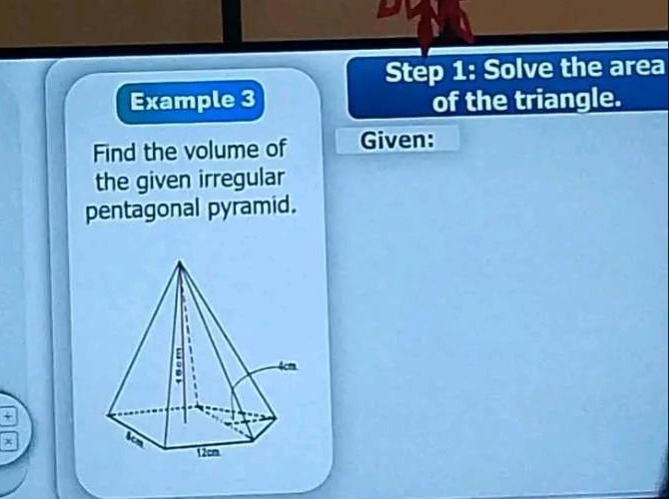
find the volume of
the given irregular
pentagonal pyramid.
step 1: solve the area
of the triangle.
given:
Step 1: Find the area of the base (irregular pentagon)
The base of the pentagonal pyramid can be divided into a rectangle and a triangle (or other combinations, but from the given dimensions: length \( l = 12\) cm, width \( w = 8\) cm, and the other part seems to form a triangle? Wait, maybe the base is a pentagon that can be split into a rectangle and a triangle. Wait, actually, looking at the diagram, maybe the base is composed of a rectangle with length 12 cm and width 8 cm, and a triangle? Wait, no, maybe the base is a pentagon where we can calculate its area. Wait, alternatively, maybe the base is a pentagon that can be considered as a combination, but perhaps the given dimensions: the base has a length of 12 cm, width of 8 cm, and the slant side? Wait, maybe the base area is calculated as the area of a rectangle plus the area of a triangle. Wait, the height of the pyramid is 14 cm, and the base has sides 8 cm, 12 cm, and 4 cm? Wait, maybe the base is a pentagon that can be divided into a rectangle (12 cm by 8 cm) and a triangle with base 8 cm and height 4 cm? Wait, no, let's re - examine.
Wait, the formula for the volume of a pyramid is \( V=\frac{1}{3}Bh\), where \( B\) is the area of the base and \( h\) is the height of the pyramid.
First, let's find the area of the base (irregular pentagon). Let's assume that the base can be split into a rectangle and a triangle. The rectangle has length \( l = 12\) cm and width \( w = 8\) cm. The triangle has base \( b = 8\) cm and height \( h_{triangle}=4\) cm.
Area of rectangle \( A_{rectangle}=l\times w=12\times8 = 96\) \( cm^{2}\)
Area of triangle \( A_{triangle}=\frac{1}{2}\times b\times h_{triangle}=\frac{1}{2}\times8\times4=16\) \( cm^{2}\)
Total area of the base \( B=A_{rectangle}+A_{triangle}=96 + 16=112\) \( cm^{2}\)
Step 2: Calculate the volume of the pyramid
The height of the pyramid \( h = 14\) cm.
Using the formula for the volume of a pyramid \( V=\frac{1}{3}Bh\)
Substitute \( B = 112\) \( cm^{2}\) and \( h = 14\) cm into the formula:
\( V=\frac{1}{3}\times112\times14=\frac{1}{3}\times1568=\frac{1568}{3}\approx522.67\) \( cm^{3}\)
Wait, maybe my base area calculation is wrong. Let's try another approach. Maybe the base is a pentagon with a different composition. Alternatively, maybe the base is a pentagon where the area can be calculated as the area of a trapezoid - like shape? Wait, no, let's check the diagram again. The base has a length of 12 cm, a width of 8 cm, and a side of 4 cm. Wait, maybe the base is a rectangle with length 12 cm and width 8 cm, and two triangles? No, maybe the initial assumption is wrong. Wait, perhaps the base is a pentagon with area calculated as follows: the base is a polygon with vertices such that we can use the formula for the area of a pentagon. Alternatively, maybe the base is a rectangle with length 12 cm and width 8 cm, and the other part is a square? No, the diagram shows a pentagonal base.
Wait, maybe the base area is calculated as the area of a rectangle (12 * 8) plus the area of a triangle (with base 8 and height 4). So \( B=12\times8+\frac{1}{2}\times8\times4=96 + 16 = 112\) \( cm^{2}\)
Then volume \( V=\frac{1}{3}\times112\times14=\frac{1568}{3}\approx522.67\) \( cm^{3}\)

Snap & solve any problem in the app
Get step-by-step solutions on Sovi AI
Photo-based solutions with guided steps
Explore more problems and detailed explanations
The volume of the irregular pentagonal pyramid is \(\frac{1568}{3}\approx522.67\) cubic centimeters (or if the base area calculation is different, the answer will change. But based on the given diagram and assumed base area calculation, the volume is \(\frac{1568}{3}\approx522.67\) \( cm^{3}\))