QUESTION IMAGE
Question
example 2 use the binomial theorem
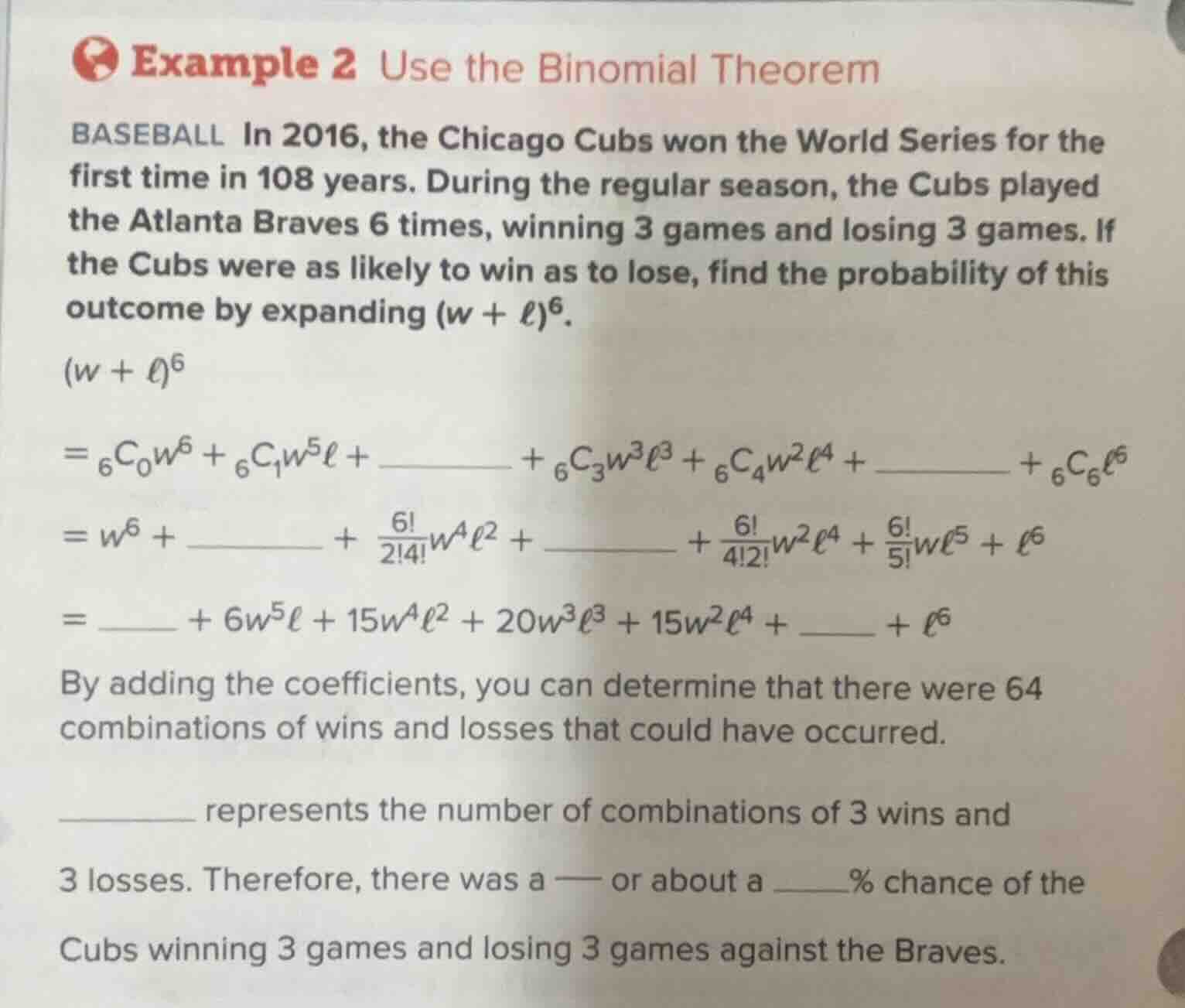
baseball in 2016, the chicago cubs won the world series for the first time in 108 years. during the regular season, the cubs played the atlanta braves 6 times, winning 3 games and losing 3 games. if the cubs were as likely to win as to lose, find the probability of this outcome by expanding ((w + ell)^6).
((w + ell)^6)
(= {_6c_0}w^6 + {_6c_1}w^5ell + _____ + {_6c_3}w^3ell^3 + {_6c_4}w^2ell^4 + _____ + {_6c_6}ell^6)
(= w^6 + ___ + \frac{6!}{2!4!}w^4ell^2 + ___ + \frac{6!}{4!2!}w^2ell^4 + \frac{6!}{5!}well^5 + ell^6)
(= __ + 6w^5ell + 15w^4ell^2 + 20w^3ell^3 + 15w^2ell^4 + __ + ell^6)
by adding the coefficients, you can determine that there were 64 combinations of wins and losses that could have occurred.
_____ represents the number of combinations of 3 wins and
3 losses. therefore, there was a _ or about a _% chance of the cubs winning 3 games and losing 3 games against the braves.
Step1: Expand \((w + \ell)^6\) using Binomial Theorem
The Binomial Theorem states that \((a + b)^n=\sum_{k = 0}^{n}\binom{n}{k}a^{n - k}b^{k}\), where \(\binom{n}{k}=\frac{n!}{k!(n - k)!}\). For \((w+\ell)^6\), \(n = 6\).
- For the first blank in the first expansion row (the term with \(w^{4}\ell^{2}\)): When \(k = 2\), \(\binom{6}{2}=\frac{6!}{2!(6 - 2)!}=\frac{6!}{2!4!}\), so the term is \(\binom{6}{2}w^{4}\ell^{2}\) or \(_{6}C_{2}w^{4}\ell^{2}\).
- For the second blank in the first expansion row (the term with \(w^{1}\ell^{5}\)): When \(k = 5\), \(\binom{6}{5}=\frac{6!}{5!(6 - 5)!}=\frac{6!}{5!1!}\), so the term is \(\binom{6}{5}w^{1}\ell^{5}\) or \(_{6}C_{5}w\ell^{5}\).
Step2: Calculate binomial coefficients
- For the coefficient of \(w^{5}\ell\): \(\binom{6}{1}=\frac{6!}{1!(6 - 1)!}=\frac{6!}{1!5!}=6\), so the term is \(6w^{5}\ell\).
- For the coefficient of \(w^{3}\ell^{3}\): \(\binom{6}{3}=\frac{6!}{3!(6 - 3)!}=\frac{6!}{3!3!}=20\), so the term is \(20w^{3}\ell^{3}\).
Step3: Complete the expansion
- The first term: When \(k = 0\), \(\binom{6}{0}=\frac{6!}{0!(6 - 0)!}=1\), so the first term is \(w^{6}\).
- The term with \(w\ell^{5}\): The coefficient \(\binom{6}{5}=6\), so the term is \(6w\ell^{5}\).
Step4: Find the number of combinations for 3 wins and 3 losses
The term \(20w^{3}\ell^{3}\) has a coefficient of 20, which represents the number of combinations of 3 wins and 3 losses.
Step5: Calculate the probability
The total number of combinations is \(2^{6}=64\) (since each game has 2 outcomes, win or loss, and 6 games). The number of favorable outcomes (3 wins and 3 losses) is 20. So the probability \(P=\frac{20}{64}=\frac{5}{16}\approx0.3125\) or \(31.25\%\).
Filling the blanks:
- First expansion row blanks: \(_{6}C_{2}w^{4}\ell^{2}\), \(_{6}C_{5}w\ell^{5}\)
- Coefficient of \(w^{5}\ell\): \(6w^{5}\ell\)
- Coefficient of \(w^{3}\ell^{3}\): \(20w^{3}\ell^{3}\)
- First term: \(w^{6}\)
- Term with \(w\ell^{5}\): \(6w\ell^{5}\)
- Number of combinations for 3 wins and 3 losses: \(20\)
- Probability: \(\frac{20}{64}=\frac{5}{16}\), percentage: \(31.25\%\)

Snap & solve any problem in the app
Get step-by-step solutions on Sovi AI
Photo-based solutions with guided steps
Explore more problems and detailed explanations
- First expansion row blanks: \(_{6}C_{2}w^{4}\ell^{2}\), \(_{6}C_{5}w\ell^{5}\)
- Coefficient of \(w^{5}\ell\): \(6w^{5}\ell\)
- Coefficient of \(w^{3}\ell^{3}\): \(20w^{3}\ell^{3}\)
- First term: \(w^{6}\)
- Term with \(w\ell^{5}\): \(6w\ell^{5}\)
- Number of combinations for 3 wins and 3 losses: \(20\)
- Probability: \(\frac{5}{16}\) (or \(20/64\)), percentage: \(31.25\%\)
(If we consider the final probability - related blanks: The number of combinations of 3 wins and 3 losses is \(20\). The probability is \(\frac{20}{64}=\frac{5}{16}\) or about \(31.25\%\))