QUESTION IMAGE
Question
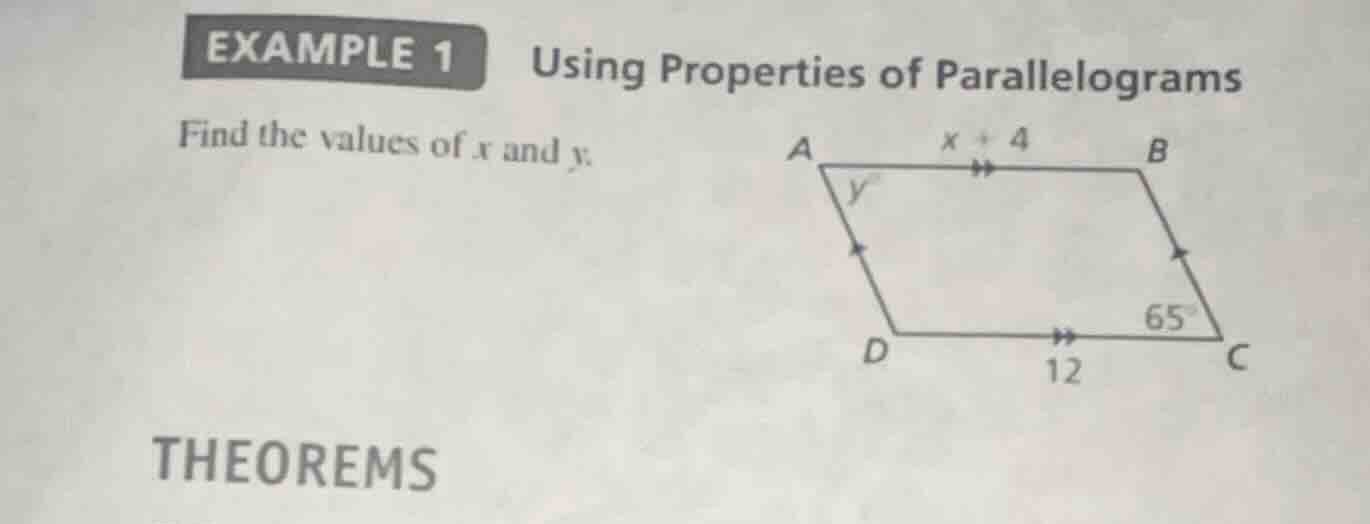
example 1 using properties of parallelograms find the values of x and y. theorems
Step1: Find x using opposite sides of parallelogram
In a parallelogram, opposite sides are equal. So, \( AB = DC \). Given \( AB = x + 4 \) and \( DC = 12 \), we set up the equation:
\( x + 4 = 12 \)
Subtract 4 from both sides:
\( x = 12 - 4 = 8 \)
Step2: Find y using consecutive angles of parallelogram
In a parallelogram, consecutive angles are supplementary (sum to \( 180^\circ \))? Wait, no, actually, in a parallelogram, opposite angles are equal, and consecutive angles are supplementary? Wait, no, looking at the diagram, angle C is \( 65^\circ \), and angle A (which is y) and angle D? Wait, no, in a parallelogram, \( AB \parallel DC \) and \( AD \parallel BC \). So angle A and angle D are consecutive? Wait, no, angle C and angle B are consecutive? Wait, no, let's correct: in a parallelogram, opposite angles are equal, and consecutive angles are supplementary. Wait, but angle C is \( 65^\circ \), and angle A: wait, in the parallelogram ABCD, angle A and angle C are opposite? Wait, no, ABCD: A---B, D---C, so AB is top, DC is bottom, AD and BC are sides. So angle at A (y) and angle at C (65°): are they opposite? Wait, no, angle A and angle C: in a parallelogram, opposite angles are equal. Wait, no, angle A and angle C: let's see, AB is parallel to DC, AD is transversal, so angle A and angle D are supplementary. But angle C and angle D: DC and AB are parallel, BC is transversal, so angle C and angle B are supplementary. Wait, maybe I made a mistake. Wait, in a parallelogram, opposite angles are equal. So angle A (y) and angle C (65°): are they opposite? Wait, ABCD: vertices in order, so angle A is at (A), angle B at (B), angle C at (C), angle D at (D). So angle A and angle C are opposite? Wait, no, angle A and angle C: A is adjacent to B and D, C is adjacent to B and D. Wait, no, in a parallelogram, opposite angles are equal: angle A = angle C? Wait, no, that can't be, because if AB is parallel to DC, and AD is a transversal, then angle A + angle D = 180°, and angle D + angle C = 180°, so angle A = angle C. Wait, yes! Because angle A + angle D = 180°, angle D + angle C = 180°, so angle A = angle C. Wait, but angle C is 65°, so angle A (y) is 65°? Wait, no, that would mean consecutive angles are equal, which would make it a rectangle, but no, wait, maybe I messed up. Wait, no, in a parallelogram, opposite angles are equal. So angle A (y) and angle C (65°) are opposite? Wait, no, angle A and angle C: let's label the parallelogram: A(angle y), B, C(65°), D. So AB is parallel to DC, AD is parallel to BC. So angle A and angle B are consecutive, angle B and angle C are consecutive, angle C and angle D are consecutive, angle D and angle A are consecutive. Wait, no, consecutive angles are adjacent. So angle A (y) and angle B: consecutive, angle B and angle C (65°): consecutive, angle C and angle D: consecutive, angle D and angle A: consecutive. In a parallelogram, consecutive angles are supplementary (sum to 180°), and opposite angles are equal. So angle A (y) and angle C (65°): are they opposite? Wait, A and C: in the order ABCD, A is (0,0), B is (a,0), C is (a + b, c), D is (b, c). Then angle at A: between AD (from A to D: (b, c)) and AB (from A to B: (a, 0)). Angle at C: between BC (from C to B: (-a, 0)) and DC (from C to D: (-b, -c)). So the angle at A and angle at C: are they equal? Let's compute the vectors: AD is (b, c), AB is (a, 0). The angle at A is between (b, c) and (a, 0). The angle at C is between (-a, 0) and (-b, -c). The angle between (b, c) and (a, 0) is equal to the angle between (-b, -c) and (-a, 0) because of refle…

Snap & solve any problem in the app
Get step-by-step solutions on Sovi AI
Photo-based solutions with guided steps
Explore more problems and detailed explanations
\( x = 8 \), \( y = 65^\circ \)