QUESTION IMAGE
Question
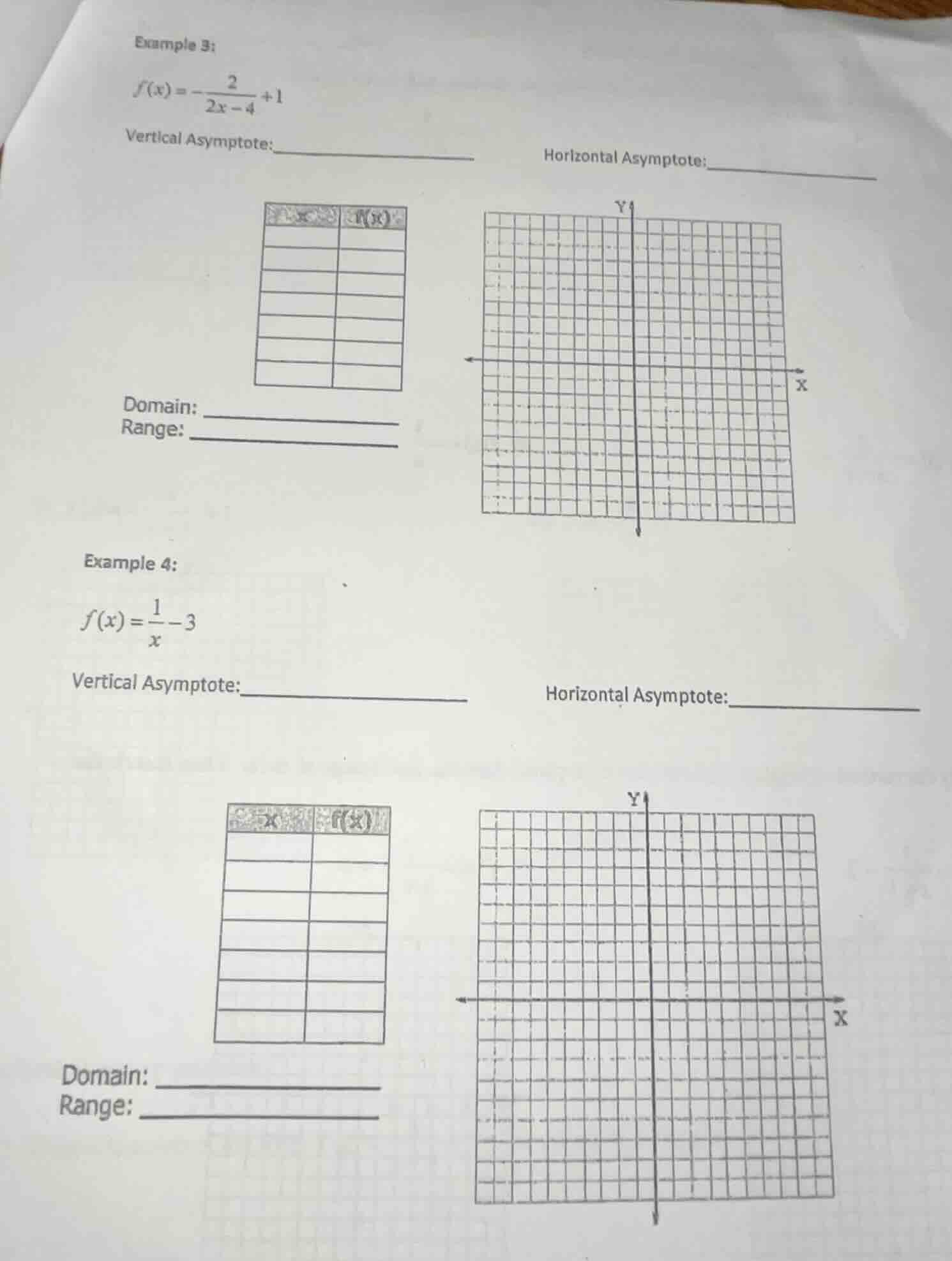
example 3:
$f(x)=-dfrac{2}{2x - 4}+1$
vertical asymptote:
horizontal asymptote:
domain:
range:
example 4:
$f(x)=dfrac{1}{x}-3$
vertical asymptote:
horizontal asymptote:
domain:
range:
Example 3: \( f(x) = -\frac{2}{2x - 4} + 1 \)
Vertical Asymptote:
Step 1: Find where denominator is zero
Set \( 2x - 4 = 0 \).
\( 2x = 4 \)
Step 2: Solve for x
\( x = \frac{4}{2} = 2 \)
Step 1: Analyze degree of numerator and denominator
For rational functions, if degree of numerator (here, numerator of the fractional part is constant, degree 0) is less than degree of denominator (degree 1 for \( 2x - 4 \)), the horizontal asymptote is \( y = \) the constant term added (after simplifying the fractional part's horizontal asymptote, which is \( y = 0 \) for \( \frac{\text{constant}}{\text{linear}} \), then we add 1).
Step 2: Determine horizontal asymptote
The horizontal asymptote of \( -\frac{2}{2x - 4} \) is \( y = 0 \), then adding 1 gives \( y = 1 \).
Step 1: Identify excluded value
From vertical asymptote, \( x = 2 \) is excluded.
Step 2: Write domain
All real numbers except \( x = 2 \), so \( (-\infty, 2) \cup (2, \infty) \)

Snap & solve any problem in the app
Get step-by-step solutions on Sovi AI
Photo-based solutions with guided steps
Explore more problems and detailed explanations
\( x = 2 \)