QUESTION IMAGE
Question
excerpt from night
elie wiesel,
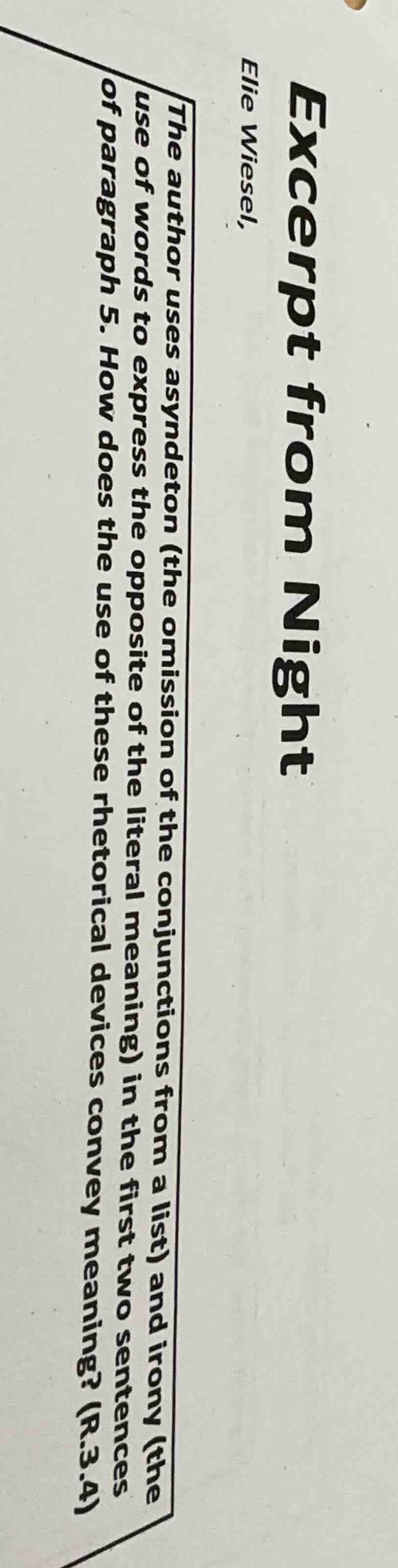
the author uses asyndeton (the omission of the conjunctions from a list) and irony (the use of words to express the opposite of the literal meaning) in the first two sentences of paragraph 5. how does the use of these rhetorical devices convey meaning? (r.3.4)
To answer this, we analyze the rhetorical devices:
- Asyndeton: Omitting conjunctions in a list creates a rapid, urgent rhythm, emphasizing the overwhelming nature of events or emotions.
- Irony (opposite of literal meaning): Contradicts expectations (e.g., “free” in a context of oppression), highlighting absurdity, suffering, or the gap between reality and perception.
- Combined Effect: Asyndeton’s urgency + irony’s contrast conveys trauma, dehumanization, or the surrealism of the Holocaust (e.g., in Night, Wiesel uses such devices to show the breakdown of logic, moral order, or the protagonist’s shattered perspective).

Snap & solve any problem in the app
Get step-by-step solutions on Sovi AI
Photo-based solutions with guided steps
Explore more problems and detailed explanations
The author uses asyndeton to create a rapid, fragmented rhythm that mirrors the chaotic, overwhelming nature of the events (e.g., listing horrors without conjunctions to emphasize their relentless, unrelenting impact). Irony (opposite of literal meaning) highlights the absurdity or tragedy of the situation (e.g., terms like “liberation” or “hope” used ironically to reveal their hollow reality in a context of suffering). Together, these devices convey the dehumanizing, surreal, and traumatic experience of the Holocaust, emphasizing the breakdown of normalcy, moral order, and the protagonist’s psychological turmoil.