QUESTION IMAGE
Question
excerpt
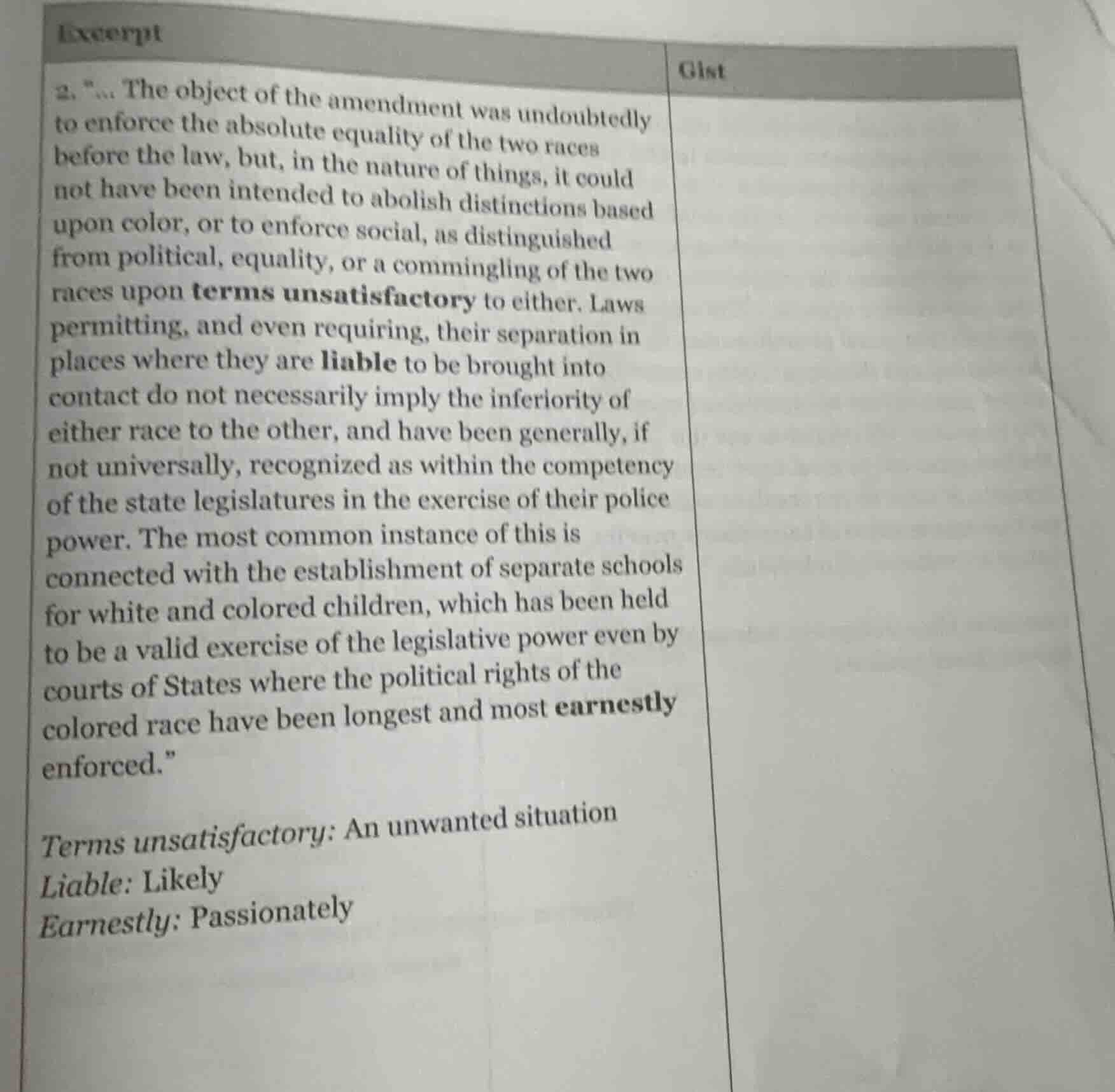
- “... the object of the amendment was undoubtedly to enforce the absolute equality of the two races before the law, but, in the nature of things, it could not have been intended to abolish distinctions based upon color, or to enforce social, as distinguished from political, equality, or a commingling of the two races upon terms unsatisfactory to either. laws permitting, and even requiring, their separation in places where they are liable to be brought into contact do not necessarily imply the inferiority of either race to the other, and have been generally, if not universally, recognized as within the competency of the state legislatures in the exercise of their police power. the most common instance of this is connected with the establishment of separate schools for white and colored children, which has been held to be a valid exercise of the legislative power even by courts of states where the political rights of the colored race have been longest and most earnestly enforced.”
terms unsatisfactory: an unwanted situation
liable: likely
earnestly: passionately
gist
Brief Explanations
This is an excerpt from a legal ruling (likely Plessy v. Ferguson) that holds that while a constitutional amendment aimed for racial equality before the law, it did not ban racial distinctions or social equality. It argues state-mandated racial separation (like segregated schools) is a valid use of state police power and does not inherently mean one race is inferior.

Snap & solve any problem in the app
Get step-by-step solutions on Sovi AI
Photo-based solutions with guided steps
Explore more problems and detailed explanations
The gist of the excerpt is:
- The targeted amendment only sought legal, not social, racial equality, and did not aim to eliminate color-based distinctions or unwanted racial mixing.
- Laws requiring racial separation in shared spaces are a valid use of state legislative police power, as they do not inherently signal racial inferiority. Segregated schools are cited as a widely accepted example of this, even in states with strong records of enforcing Black political rights.