QUESTION IMAGE
Question
exclusive
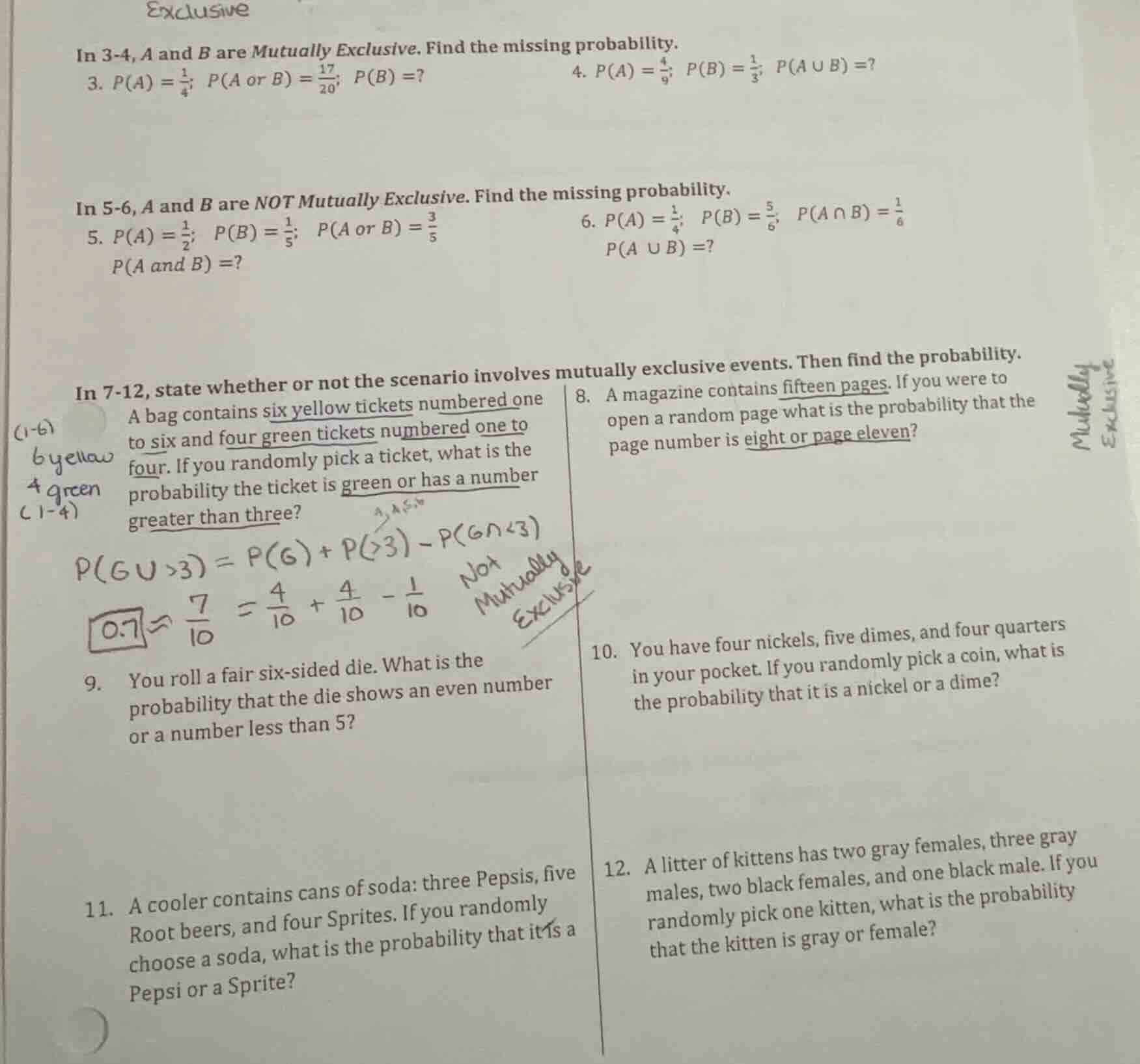
in 3-4, a and b are mutually exclusive. find the missing probability.
- $p(a) = \frac{1}{4}$; $p(a \text{ or } b) = \frac{17}{20}$; $p(b) = ?$
- $p(a) = \frac{4}{9}$; $p(b) = \frac{1}{3}$; $p(a \cup b) = ?$
in 5-6, a and b are not mutually exclusive. find the missing probability.
- $p(a) = \frac{1}{2}$; $p(b) = \frac{1}{5}$; $p(a \text{ or } b) = \frac{3}{5}$
$p(a \text{ and } b) = ?$
- $p(a) = \frac{1}{4}$; $p(b) = \frac{5}{6}$; $p(a \cap b) = \frac{1}{6}$
$p(a \cup b) = ?$
in 7-12, state whether or not the scenario involves mutually exclusive events. then find the probability.
- a bag contains six yellow tickets numbered one to six and four green tickets numbered one to four. if you randomly pick a ticket, what is the probability the ticket is green or has a number greater than three?
$p(g \cup >3) = p(g) + p(>3) - p(g \cap >3)$
$0.7 \approx \frac{7}{10} = \frac{4}{10} + \frac{4}{10} - \frac{1}{10}$ not mutually exclusive
- a magazine contains fifteen pages. if you were to open a random page what is the probability that the page number is eight or page eleven?
- you roll a fair six - sided die. what is the probability that the die shows an even number or a number less than 5?
- you have four nickels, five dimes, and four quarters in your pocket. if you randomly pick a coin, what is the probability that it is a nickel or a dime?
- a cooler contains cans of soda: three pepsis, five root beers, and four sprites. if you randomly choose a soda, what is the probability that it is a pepsi or a sprite?
- a litter of kittens has two gray females, three gray males, two black females, and one black male. if you randomly pick one kitten, what is the probability that the kitten is gray or female?
---
Problems 3-4 (Mutually Exclusive)
Step1: Recall mutual exclusivity formula
For mutually exclusive events, $P(A \cup B) = P(A) + P(B)$
---
Problem 3
Step1: Rearrange to solve for $P(B)$
$P(B) = P(A \cup B) - P(A)$
Step2: Substitute given values
$P(B) = \frac{17}{20} - \frac{1}{4} = \frac{17}{20} - \frac{5}{20}$
Step3: Calculate the difference
$P(B) = \frac{12}{20} = \frac{3}{5}$
Problem 4
Step1: Substitute into mutual exclusivity formula
$P(A \cup B) = \frac{4}{9} + \frac{1}{3}$
Step2: Convert to common denominator
$P(A \cup B) = \frac{4}{9} + \frac{3}{9}$
Step3: Sum the probabilities
$P(A \cup B) = \frac{7}{9}$
---
Problems 5-6 (Not Mutually Exclusive)
Step1: Recall general addition rule
$P(A \cup B) = P(A) + P(B) - P(A \cap B)$
---
Problem 5
Step1: Rearrange to solve for $P(A \cap B)$
$P(A \cap B) = P(A) + P(B) - P(A \cup B)$
Step2: Substitute given values
$P(A \cap B) = \frac{1}{2} + \frac{1}{5} - \frac{3}{5}$
Step3: Calculate the result
$P(A \cap B) = \frac{5}{10} + \frac{2}{10} - \frac{6}{10} = \frac{1}{10}$
Problem 6
Step1: Substitute into general addition rule
$P(A \cup B) = \frac{1}{4} + \frac{5}{6} - \frac{1}{6}$
Step2: Simplify the expression
$P(A \cup B) = \frac{1}{4} + \frac{4}{6} = \frac{1}{4} + \frac{2}{3}$
Step3: Find common denominator and sum
$P(A \cup B) = \frac{3}{12} + \frac{8}{12} = \frac{11}{12}$
---
Problems 7-12
---
Problem 7
Step1: Identify non-mutual exclusivity
Green tickets can have numbers >3, so use $P(G \cup >3) = P(G) + P(>3) - P(G \cap >3)$
Step2: Calculate individual probabilities
$P(G)=\frac{4}{10}, P(>3)=\frac{4}{10}, P(G \cap >3)=\frac{1}{10}$
Step3: Substitute and compute
$P(G \cup >3) = \frac{4}{10} + \frac{4}{10} - \frac{1}{10} = \frac{7}{10}$
Problem 8
Step1: Confirm mutual exclusivity
A page can't be 8 and 11, so $P(8 \cup 11)=P(8)+P(11)$
Step2: Substitute page probabilities
$P(8 \cup 11) = \frac{1}{15} + \frac{1}{15}$
Step3: Sum the probabilities
$P(8 \cup 11) = \frac{2}{15}$
Problem 9
Step1: Identify non-mutual exclusivity
Even numbers can be <5, use $P(\text{Even} \cup <5) = P(\text{Even}) + P(<5) - P(\text{Even} \cap <5)$
Step2: Calculate individual probabilities
$P(\text{Even})=\frac{3}{6}, P(<5)=\frac{4}{6}, P(\text{Even} \cap <5)=\frac{2}{6}$
Step3: Substitute and compute
$P(\text{Even} \cup <5) = \frac{3}{6} + \frac{4}{6} - \frac{2}{6} = \frac{5}{6}$
Problem 10
Step1: Confirm mutual exclusivity
A coin can't be nickel and dime, so $P(\text{Nickel} \cup \text{Dime})=P(\text{Nickel})+P(\text{Dime})$
Step2: Substitute coin probabilities
$P(\text{Nickel} \cup \text{Dime}) = \frac{4}{13} + \frac{5}{13}$
Step3: Sum the probabilities
$P(\text{Nickel} \cup \text{Dime}) = \frac{9}{13}$
Problem 11
Step1: Confirm mutual exclusivity
A soda can't be Pepsi and Sprite, so $P(\text{Pepsi} \cup \text{Sprite})=P(\text{Pepsi})+P(\text{Sprite})$
Step2: Substitute soda probabilities
$P(\text{Pepsi} \cup \text{Sprite}) = \frac{3}{12} + \frac{4}{12}$
Step3: Sum the probabilities
$P(\text{Pepsi} \cup \text{Sprite}) = \frac{7}{12}$
Problem 12
Step1: Identify non-mutual exclusivity
A kitten can be gray and female, use $P(\text{Gray} \cup \text{Female}) = P(\text{Gray}) + P(\text{Female}) - P(\text{Gray} \cap \text{Female})$
Step2: Calculate individual probabilities
$P(\text{Gray})=\frac{5}{8}, P(\text{Female})=\frac{4}{8}, P(\text{Gray} \cap \text{Female})=\frac{2}{8}$
Step3: Substitute and compute
$P(\text{Gray} \cup \text{Female}) = \frac{5}{8} + \frac{4…

Snap & solve any problem in the app
Get step-by-step solutions on Sovi AI
Photo-based solutions with guided steps
Explore more problems and detailed explanations
- Problem 3: $\boldsymbol{\frac{3}{5}}$
- Problem 4: $\boldsymbol{\frac{7}{9}}$
- Problem 5: $\boldsymbol{\frac{1}{10}}$
- Problem 6: $\boldsymbol{\frac{11}{12}}$
- Problem 7: $\boldsymbol{\frac{7}{10}}$
- Problem 8: $\boldsymbol{\frac{2}{15}}$
- Problem 9: $\boldsymbol{\frac{5}{6}}$
- Problem 10: $\boldsymbol{\frac{9}{13}}$
- Problem 11: $\boldsymbol{\frac{7}{12}}$
- Problem 12: $\boldsymbol{\frac{7}{8}}$