QUESTION IMAGE
Question
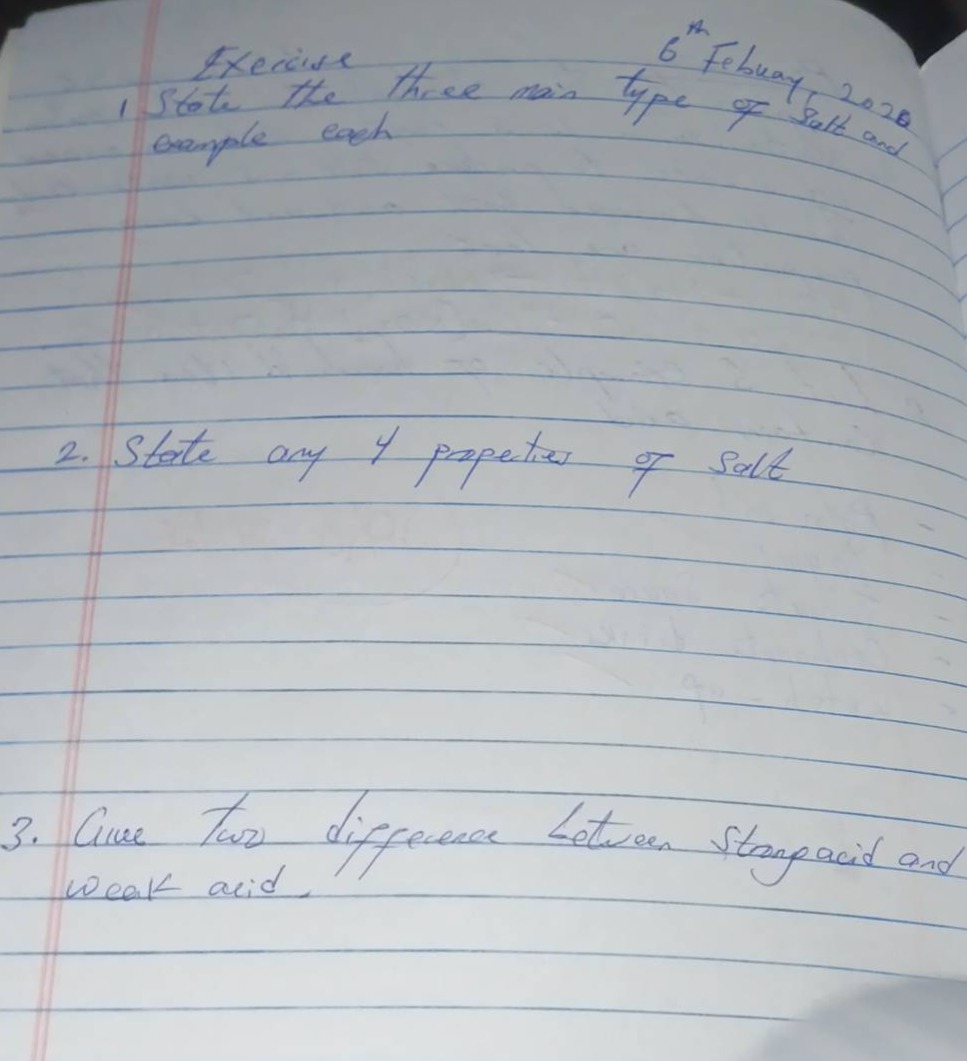
exercise
6th february, 2020
- state the three main type of salt and example each
- state any 4 properties of salt
- give two difference between strong acid and weak acid
Response
Sub - Question 1: State the three main types of salt and an example each
Brief Explanations
Salts can be classified based on the acids and bases from which they are formed. The three main types are:
- Acidic Salt: Formed when a strong acid reacts with a weak base or when a polyprotic acid is partially neutralized. For example, Sodium bisulfate ($\ce{NaHSO_4}$), formed from the partial neutralization of sulfuric acid ($\ce{H_2SO_4}$) with sodium hydroxide ($\ce{NaOH}$).
- Basic Salt: Formed when a strong base reacts with a weak acid or when a polybasic base is partially neutralized. For example, Calcium hydroxide chloride ($\ce{Ca(OH)Cl}$), formed from the partial neutralization of calcium hydroxide ($\ce{Ca(OH)_2}$) with hydrochloric acid ($\ce{HCl}$).
- Neutral Salt: Formed from the reaction of a strong acid and a strong base. For example, Sodium chloride ($\ce{NaCl}$), formed from the reaction of hydrochloric acid ($\ce{HCl}$) and sodium hydroxide ($\ce{NaOH}$).
Brief Explanations
- Physical State: Most salts are crystalline solids at room temperature. For example, sodium chloride ($\ce{NaCl}$) has a cubic crystalline structure.
- Solubility in Water: Many salts are soluble in water, like potassium nitrate ($\ce{KNO_3}$), while some are insoluble, like silver chloride ($\ce{AgCl}$). The solubility follows certain rules (e.g., salts of Group 1 metals are generally soluble).
- Melting and Boiling Points: Salts usually have high melting and boiling points. For example, sodium chloride melts at around $801^\circ\mathrm{C}$ and boils at around $1465^\circ\mathrm{C}$ because of the strong ionic bonds in their crystal lattice.
- Electrical Conductivity: In the molten state or in aqueous solution, salts can conduct electricity as they dissociate into ions (e.g., molten sodium chloride conducts electricity due to the presence of $\ce{Na^+}$ and $\ce{Cl^-}$ ions).
Brief Explanations
- Degree of Ionization: A strong acid (e.g., $\ce{HCl}$) ionizes completely in aqueous solution, meaning almost all the acid molecules dissociate into ions ($\ce{HCl -> H^+ + Cl^-}$). A weak acid (e.g., $\ce{CH_3COOH}$) ionizes partially, with only a small fraction of acid molecules dissociating into ions ($\ce{CH_3COOH
ightleftharpoons H^+ + CH_3COO^-}$).
- Strength of Conjugate Base: The conjugate base of a strong acid (e.g., $\ce{Cl^-}$ from $\ce{HCl}$) is a weak base, as it has little tendency to accept a proton. The conjugate base of a weak acid (e.g., $\ce{CH_3COO^-}$ from $\ce{CH_3COOH}$) is a strong base, as it has a greater tendency to accept a proton.

Snap & solve any problem in the app
Get step-by-step solutions on Sovi AI
Photo-based solutions with guided steps
Explore more problems and detailed explanations
- Acidic Salt - Example: $\ce{NaHSO_4}$
- Basic Salt - Example: $\ce{Ca(OH)Cl}$
- Neutral Salt - Example: $\ce{NaCl}$