QUESTION IMAGE
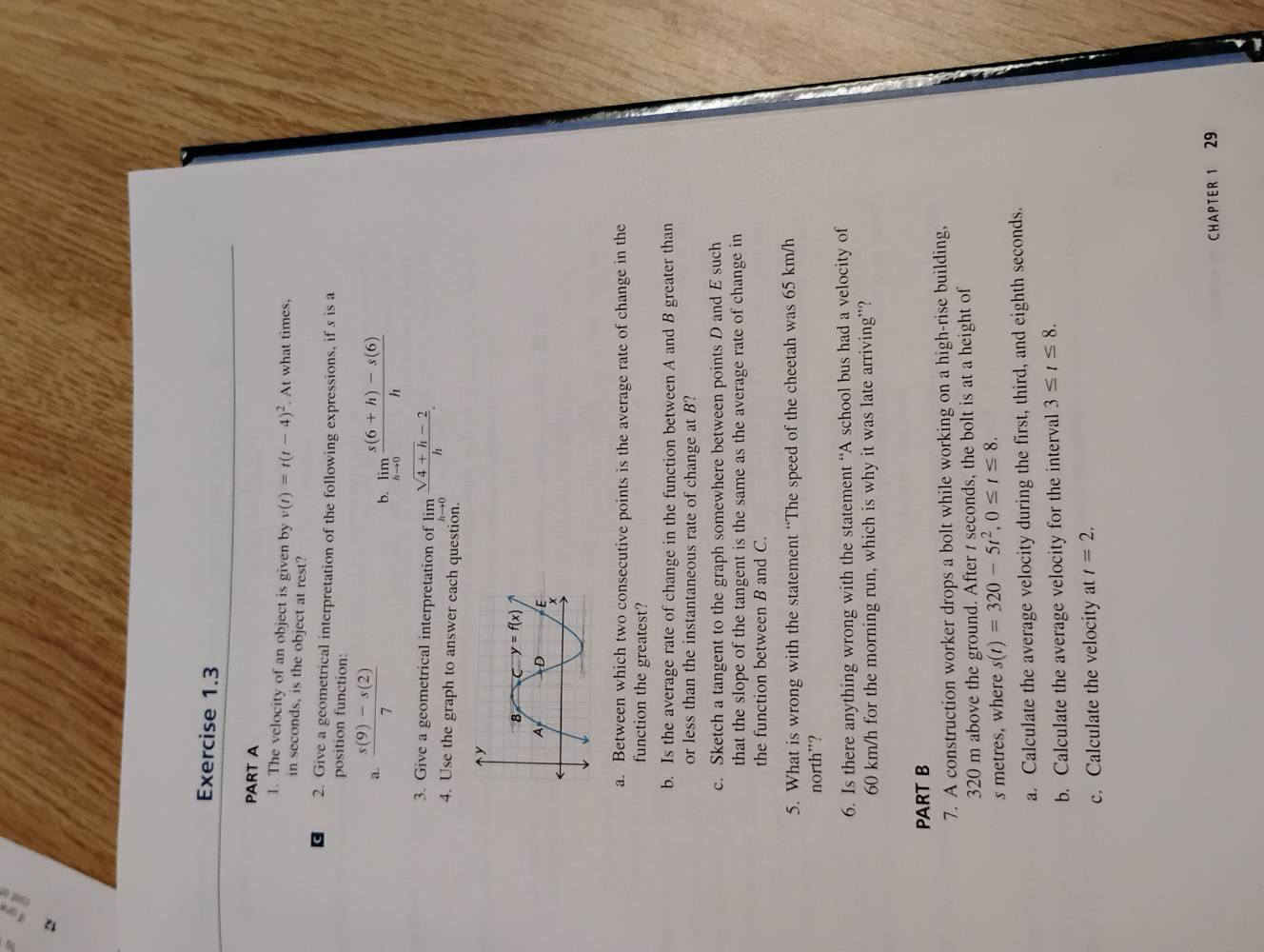
Question
exercise 1.3
part a
- the velocity of an object is given by ( v(t) = t(t - 4)^2 ), in seconds. at what times, in seconds, is the object at rest?
- give a geometrical interpretation of the following expressions, if ( s ) is a position function:
a. ( \frac{s(9) - s(2)}{7} )
b. ( limlimits_{h \to 0} \frac{s(6 + h) - s(6)}{h} )
c. ( limlimits_{h \to 0} \frac{sqrt{4 + h} - 2}{h} )
- give a geometrical interpretation of ( limlimits_{h \to 0} \frac{s(6 + h) - s(6)}{h} ).
- use the graph to answer each question.
(there is a graph of ( y = f(x) ) with points a, b, c, d, e)
a. between which two consecutive points is the average rate of change in the function the greatest?
b. is the average rate of change in the function between a and b greater than or less than the instantaneous rate of change at b?
c. sketch a tangent to the graph somewhere between d and e such that the slope of the tangent is the same as the average rate of change in the function between b and c.
- what is wrong with the statement “the speed of the cheetah was 65 km/h north”?
- is there anything wrong with the statement “a school bus had a velocity of 60 km/h for the morning run, which is why it was late arriving”?
part b
- a construction worker drops a bolt while working on a high - rise building, 320 m above the ground. after ( t ) seconds, the bolt is at a height of ( s(t)=320 - 5t^{2},0leq tleq8 ), in metres, where ( s(t) ).
a. calculate the average velocity during the first, third, and eighth seconds.
b. calculate the average velocity for the interval ( 3leq tleq8 ).
c. calculate the velocity at ( t = 2 ).
PART A
1.
Step 1: Recall when velocity is zero
An object is at rest when its velocity \( v(t) = 0 \). Given \( v(t)=(t - 4)^2 \).
Set \( (t - 4)^2=0 \).
Step 2: Solve for \( t \)
Taking square roots on both sides, \( t - 4 = 0\), so \( t = 4 \).
The expression \( \frac{s(9)-s(2)}{7} \) represents the average rate of change of the position function \( s(t) \) over the interval from \( t = 2 \) to \( t=9 \). The average rate of change of a function \( f(t) \) over the interval \([a,b]\) is given by \( \frac{f(b)-f(a)}{b - a} \), here \( a = 2 \), \( b=9 \) and \( b - a=7 \), so it's the average velocity (since velocity is the rate of change of position) from \( t = 2 \) to \( t = 9 \).
b.
The limit \( \lim_{h
ightarrow0}\frac{s(6 + h)-s(6)}{h} \) represents the instantaneous rate of change of the position function \( s(t) \) at \( t = 6 \). By the definition of the derivative, \( f^{\prime}(x)=\lim_{h
ightarrow0}\frac{f(x + h)-f(x)}{h} \), so this limit is the instantaneous velocity (derivative of position function) at \( t = 6 \).
3.

Snap & solve any problem in the app
Get step-by-step solutions on Sovi AI
Photo-based solutions with guided steps
Explore more problems and detailed explanations
The object is at rest when \( t = 4 \) seconds.