QUESTION IMAGE
Question
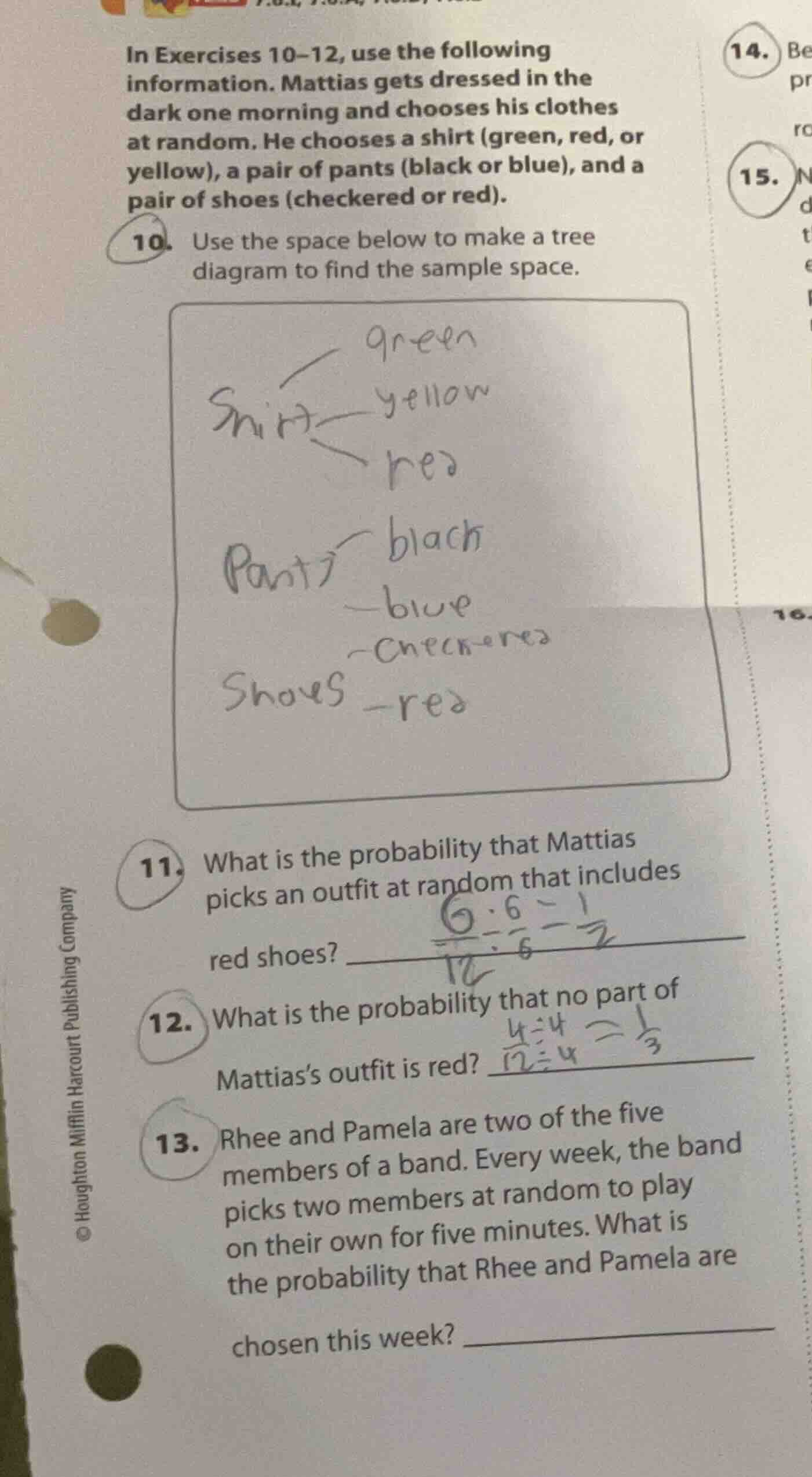
in exercises 10–12, use the following information. mattias gets dressed in the dark one morning and chooses his clothes at random. he chooses a shirt (green, red, or yellow), a pair of pants (black or blue), and a pair of shoes (checkered or red). 10. use the space below to make a tree diagram to find the sample space. 11. what is the probability that mattias picks an outfit at random that includes red shoes? 12. what is the probability that no part of mattias’s outfit is red? 13. rhee and pamela are two of the five members of a band. every week, the band picks two members at random to play on their own for five minutes. what is the probability that rhee and pamela are chosen this week? 14. be pr ro 15. n d t e 16.
Question 10: Tree Diagram for Sample Space
Step 1: Start with Shirts
The shirt has 3 options: green, yellow, red. So the first level of the tree has 3 branches (green, yellow, red).
Step 2: Add Pants to Each Shirt
For each shirt, there are 2 pants options (black, blue). So from each shirt branch, draw 2 branches for pants.
Step 3: Add Shoes to Each Pants
For each pants branch, there are 2 shoes options (checkered, red). So from each pants branch, draw 2 branches for shoes.
The sample space (all possible outfits) can be listed by following each path:
- Green shirt:
- Green - Black - Checkered
- Green - Black - Red
- Green - Blue - Checkered
- Green - Blue - Red
- Yellow shirt:
- Yellow - Black - Checkered
- Yellow - Black - Red
- Yellow - Blue - Checkered
- Yellow - Blue - Red
- Red shirt:
- Red - Black - Checkered
- Red - Black - Red
- Red - Blue - Checkered
- Red - Blue - Red
Question 11: Probability of Red Shoes
Step 1: Find Total Outcomes
From the tree diagram, total number of outfits = number of shirts × number of pants × number of shoes = \( 3\times2\times2 = 12 \).
Step 2: Find Favorable Outcomes (Red Shoes)
For red shoes, regardless of shirt and pants, we count the number of outfits with red shoes. For each shirt (3) and each pants (2), there is 1 red shoe option. So favorable outcomes = \( 3\times2\times1 = 6 \).
Step 3: Calculate Probability
Probability = \( \frac{\text{Favorable Outcomes}}{\text{Total Outcomes}} = \frac{6}{12} = \frac{1}{2} \).
Step 1: Determine Restrictions
No red means:
- Shirt: cannot be red (so 2 options: green, yellow)
- Pants: no red (pants are black or blue, so 2 options)
- Shoes: no red (so 1 option: checkered)
Step 2: Calculate Favorable Outcomes
Favorable outcomes = number of non - red shirts × number of pants × number of non - red shoes = \( 2\times2\times1 = 4 \).
Step 3: Calculate Probability
Total outcomes = 12 (from Q11). Probability = \( \frac{4}{12} = \frac{1}{3} \).

Snap & solve any problem in the app
Get step-by-step solutions on Sovi AI
Photo-based solutions with guided steps
Explore more problems and detailed explanations
\( \frac{1}{2} \)