QUESTION IMAGE
Question
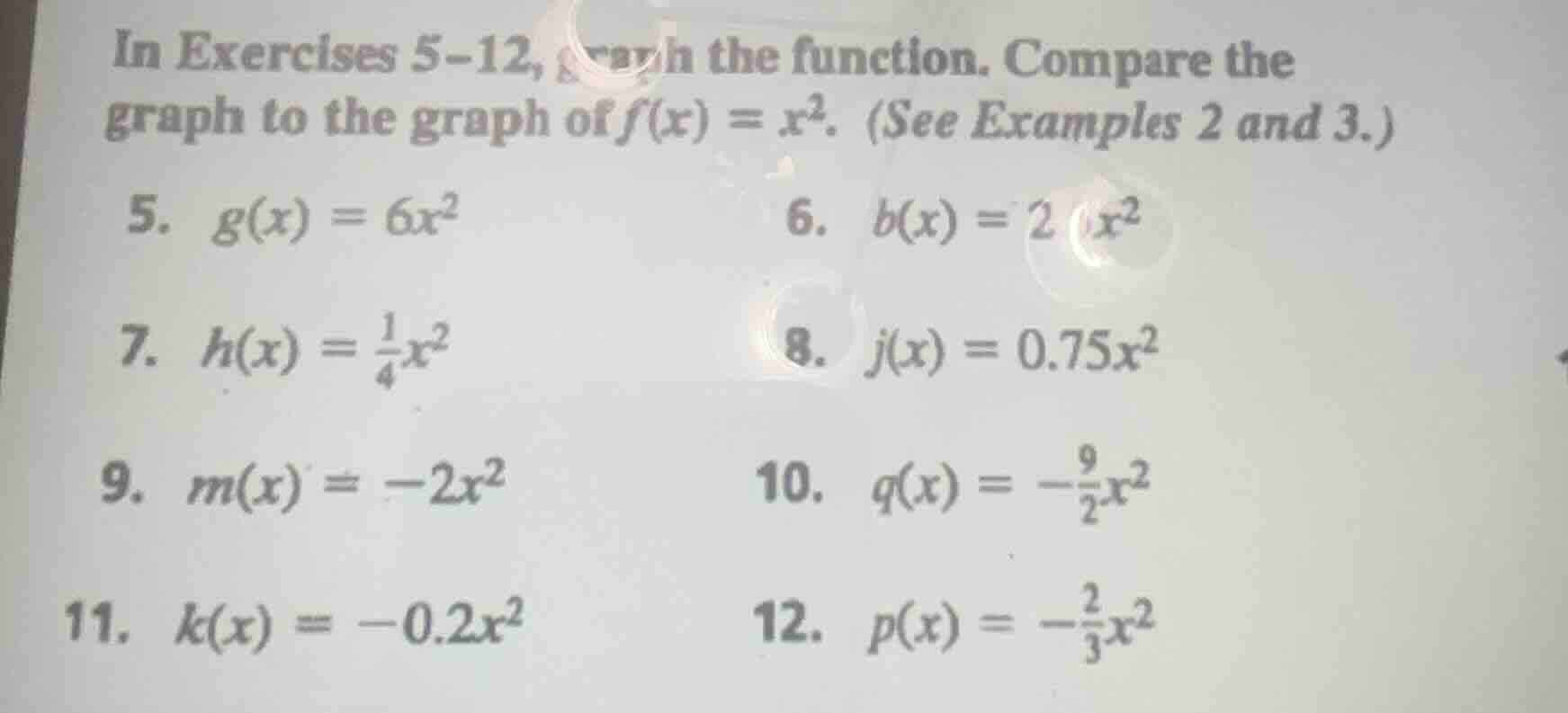
in exercises 5–12, graph the function. compare the graph to the graph of ( f(x) = x^2 ). (see examples 2 and 3.)
- ( g(x) = 6x^2 ) 6. ( b(x) = 2x^2 )
- ( h(x) = \frac{1}{4}x^2 ) 8. ( j(x) = 0.75x^2 )
- ( m(x) = -2x^2 ) 10. ( q(x) = -\frac{9}{2}x^2 )
- ( k(x) = -0.2x^2 ) 12. ( p(x) = -\frac{2}{3}x^2 )
Let's take problem 5: \( g(x) = 6x^2 \) and compare it to \( f(x)=x^2 \). We can also analyze other problems similarly. Here's the step - by - step for graphing and comparison:
For \( g(x)=6x^2 \) (Problem 5)
Step 1: Recall the parent function
The parent function is \( f(x)=x^2 \), which is a parabola opening upwards with vertex at the origin \((0,0)\). The general form of a quadratic function is \( y = ax^2+bx + c \), and for \( f(x)=x^2 \), \( a = 1\), \( b = 0\), \( c = 0\).
Step 2: Analyze the transformation for \( g(x)=6x^2 \)
For the function \( g(x)=ax^2\) (where \( a = 6\) in this case) compared to \( f(x)=x^2\) (\( a = 1\)):
- When \(|a|>1\), the graph of \( y = ax^2\) is a vertical stretch of the graph of \( y=x^2\). Since \(|6|>1\), the graph of \( g(x) = 6x^2\) is a vertical stretch of the graph of \( f(x)=x^2\) by a factor of 6.
- Both \( f(x)\) and \( g(x)\) have the same vertex \((0,0)\) and the same axis of symmetry \(x = 0\) (the y - axis). The graph of \( g(x)\) is narrower than the graph of \( f(x)\) because the coefficient \(a = 6\) is greater than 1 in absolute value.
For \( b(x)=2x^2 \) (Problem 6)
Step 1: Recall the parent function
The parent function is still \( f(x)=x^2\) (parabola opening up, vertex at \((0,0)\)).
Step 2: Analyze the transformation for \( b(x)=2x^2 \)
For \( b(x)=2x^2\) with \( a = 2\):
- Since \(|2|>1\), the graph of \( b(x)\) is a vertical stretch of the graph of \( f(x)\) by a factor of 2.
- The vertex is at \((0,0)\) and the axis of symmetry is \(x = 0\). The graph of \( b(x)\) is narrower than \( f(x)\) but wider than \( g(x)\) (since \(2<6\)).
For \( h(x)=\frac{1}{4}x^2 \) (Problem 7)
Step 1: Recall the parent function
Parent function \( f(x)=x^2\).
Step 2: Analyze the transformation for \( h(x)=\frac{1}{4}x^2 \)
For \( h(x)=\frac{1}{4}x^2\) with \( a=\frac{1}{4}\):
- When \(0<|a|<1\), the graph of \( y = ax^2\) is a vertical compression of the graph of \( y = x^2\). Since \(0<\frac{1}{4}<1\), the graph of \( h(x)\) is a vertical compression of the graph of \( f(x)\) by a factor of \(\frac{1}{4}\).
- The vertex is at \((0,0)\) and the axis of symmetry is \(x = 0\). The graph of \( h(x)\) is wider than the graph of \( f(x)\).
For \( j(x)=0.75x^2 \) (Problem 8)
Step 1: Recall the parent function
Parent function \( f(x)=x^2\).
Step 2: Analyze the transformation for \( j(x)=0.75x^2 \)
For \( j(x)=0.75x^2\) with \( a = 0.75\) (and \(0<0.75<1\)):
- The graph of \( j(x)\) is a vertical compression of the graph of \( f(x)\) by a factor of \(0.75\).
- The vertex is at \((0,0)\) and the axis of symmetry is \(x = 0\). The graph of \( j(x)\) is wider than \( f(x)\) but narrower than \( h(x)\) (since \(0.75>\frac{1}{4}\)).
For \( m(x)=- 2x^2 \) (Problem 9)
Step 1: Recall the parent function
Parent function \( f(x)=x^2\) (opens up).
Step 2: Analyze the transformation for \( m(x)=-2x^2 \)
For \( m(x)=-2x^2\) with \( a=-2\):
- The negative sign of \(a\) means the graph opens downward (compared to \( f(x)\) which opens upward).
- Since \(| - 2|=2>1\), the graph is a vertical stretch of the graph of \( y=-x^2\) (the reflection of \( f(x)\) over the x - axis) by a factor of 2. Or we can say it is a reflection of the graph of \( y = 2x^2\) over the x - axis. The vertex is at \((0,0)\) and the axis of symmetry is \(x = 0\).
For \( q(x)=-\frac{9}{2}x^2 \) (Problem 10)
Step 1: Recall the parent function
Parent function \( f(x)=x^2\).
Step 2: Analyze the transformation for \( q(x)=-\frac{9}{2}x^2 \)
For \…

Snap & solve any problem in the app
Get step-by-step solutions on Sovi AI
Photo-based solutions with guided steps
Explore more problems and detailed explanations
Let's take problem 5: \( g(x) = 6x^2 \) and compare it to \( f(x)=x^2 \). We can also analyze other problems similarly. Here's the step - by - step for graphing and comparison:
For \( g(x)=6x^2 \) (Problem 5)
Step 1: Recall the parent function
The parent function is \( f(x)=x^2 \), which is a parabola opening upwards with vertex at the origin \((0,0)\). The general form of a quadratic function is \( y = ax^2+bx + c \), and for \( f(x)=x^2 \), \( a = 1\), \( b = 0\), \( c = 0\).
Step 2: Analyze the transformation for \( g(x)=6x^2 \)
For the function \( g(x)=ax^2\) (where \( a = 6\) in this case) compared to \( f(x)=x^2\) (\( a = 1\)):
- When \(|a|>1\), the graph of \( y = ax^2\) is a vertical stretch of the graph of \( y=x^2\). Since \(|6|>1\), the graph of \( g(x) = 6x^2\) is a vertical stretch of the graph of \( f(x)=x^2\) by a factor of 6.
- Both \( f(x)\) and \( g(x)\) have the same vertex \((0,0)\) and the same axis of symmetry \(x = 0\) (the y - axis). The graph of \( g(x)\) is narrower than the graph of \( f(x)\) because the coefficient \(a = 6\) is greater than 1 in absolute value.
For \( b(x)=2x^2 \) (Problem 6)
Step 1: Recall the parent function
The parent function is still \( f(x)=x^2\) (parabola opening up, vertex at \((0,0)\)).
Step 2: Analyze the transformation for \( b(x)=2x^2 \)
For \( b(x)=2x^2\) with \( a = 2\):
- Since \(|2|>1\), the graph of \( b(x)\) is a vertical stretch of the graph of \( f(x)\) by a factor of 2.
- The vertex is at \((0,0)\) and the axis of symmetry is \(x = 0\). The graph of \( b(x)\) is narrower than \( f(x)\) but wider than \( g(x)\) (since \(2<6\)).
For \( h(x)=\frac{1}{4}x^2 \) (Problem 7)
Step 1: Recall the parent function
Parent function \( f(x)=x^2\).
Step 2: Analyze the transformation for \( h(x)=\frac{1}{4}x^2 \)
For \( h(x)=\frac{1}{4}x^2\) with \( a=\frac{1}{4}\):
- When \(0<|a|<1\), the graph of \( y = ax^2\) is a vertical compression of the graph of \( y = x^2\). Since \(0<\frac{1}{4}<1\), the graph of \( h(x)\) is a vertical compression of the graph of \( f(x)\) by a factor of \(\frac{1}{4}\).
- The vertex is at \((0,0)\) and the axis of symmetry is \(x = 0\). The graph of \( h(x)\) is wider than the graph of \( f(x)\).
For \( j(x)=0.75x^2 \) (Problem 8)
Step 1: Recall the parent function
Parent function \( f(x)=x^2\).
Step 2: Analyze the transformation for \( j(x)=0.75x^2 \)
For \( j(x)=0.75x^2\) with \( a = 0.75\) (and \(0<0.75<1\)):
- The graph of \( j(x)\) is a vertical compression of the graph of \( f(x)\) by a factor of \(0.75\).
- The vertex is at \((0,0)\) and the axis of symmetry is \(x = 0\). The graph of \( j(x)\) is wider than \( f(x)\) but narrower than \( h(x)\) (since \(0.75>\frac{1}{4}\)).
For \( m(x)=- 2x^2 \) (Problem 9)
Step 1: Recall the parent function
Parent function \( f(x)=x^2\) (opens up).
Step 2: Analyze the transformation for \( m(x)=-2x^2 \)
For \( m(x)=-2x^2\) with \( a=-2\):
- The negative sign of \(a\) means the graph opens downward (compared to \( f(x)\) which opens upward).
- Since \(| - 2|=2>1\), the graph is a vertical stretch of the graph of \( y=-x^2\) (the reflection of \( f(x)\) over the x - axis) by a factor of 2. Or we can say it is a reflection of the graph of \( y = 2x^2\) over the x - axis. The vertex is at \((0,0)\) and the axis of symmetry is \(x = 0\).
For \( q(x)=-\frac{9}{2}x^2 \) (Problem 10)
Step 1: Recall the parent function
Parent function \( f(x)=x^2\).
Step 2: Analyze the transformation for \( q(x)=-\frac{9}{2}x^2 \)
For \( q(x)=-\frac{9}{2}x^2\) with \( a =-\frac{9}{2}\):
- The negative sign implies the graph opens downward.
- Since \(|\frac{-9}{2}|=\frac{9}{2}>1\), the graph is a vertical stretch of the graph of \( y=-x^2\) by a factor of \(\frac{9}{2}\). The vertex is at \((0,0)\) and the axis of symmetry is \(x = 0\).
For \( k(x)=-0.2x^2 \) (Problem 11)
Step 1: Recall the parent function
Parent function \( f(x)=x^2\).
Step 2: Analyze the transformation for \( k(x)=-0.2x^2 \)
For \( k(x)=-0.2x^2\) with \( a=-0.2\) (and \(0<| - 0.2|=0.2<1\)):
- The negative sign means the graph opens downward.
- Since \(0.2<1\), the graph is a vertical compression of the graph of \( y=-x^2\) by a factor of \(0.2\). The vertex is at \((0,0)\) and the axis of symmetry is \(x = 0\).
For \( p(x)=-\frac{2}{3}x^2 \) (Problem 12)
Step 1: Recall the parent function
Parent function \( f(x)=x^2\).
Step 2: Analyze the transformation for \( p(x)=-\frac{2}{3}x^2 \)
For \( p(x)=-\frac{2}{3}x^2\) with \( a =-\frac{2}{3}\):
- The negative sign implies the graph opens downward.
- Since \(0<|\frac{-2}{3}|=\frac{2}{3}<1\), the graph is a vertical compression of the graph of \( y=-x^2\) by a factor of \(\frac{2}{3}\). The vertex is at \((0,0)\) and the axis of symmetry is \(x = 0\).
To graph these functions:
- For functions with \(a>0\) (problems 5 - 8):
- Create a table of values. For example, for \( g(x)=6x^2\), when \(x=-2\), \(g(-2)=6\times(-2)^2 = 24\); when \(x=-1\), \(g(-1)=6\times(-1)^2 = 6\); when \(x = 0\), \(g(0)=0\); when \(x = 1\), \(g(1)=6\); when \(x = 2\), \(g(2)=24\). Plot these points \((-2,24),(-1,6),(0,0),(1,6),(2,24)\) and draw a smooth parabola opening upwards.
- For functions with \(a < 0\) (problems 9 - 12):
- Create a table of values. For example, for \( m(x)=-2x^2\), when \(x=-2\), \(m(-2)=-2\times(-2)^2=-8\); when \(x=-1\), \(m(-1)=-2\times(-1)^2=-2\); when \(x = 0\), \(m(0)=0\); when \(x = 1\), \(m(1)=-2\); when \(x = 2\), \(m(2)=-8\). Plot these points \((-2,-8),(-1,-2),(0,0),(1,-2),(2,-8)\) and draw a smooth parabola opening downwards.
If we were to summarize the comparison for a general \( y = ax^2\) vs \( y=x^2\):
- If \(|a|>1\), vertical stretch (narrower graph for \(a>0\), narrower graph opening down for \(a < 0\)).
- If \(0<|a|<1\), vertical compression (wider graph for \(a>0\), wider graph opening down for \(a < 0\)).
- If \(a<0\), reflection over the x - axis (changes the direction of opening).
- All have vertex at \((0,0)\) and axis of symmetry \(x = 0\).