QUESTION IMAGE
Question
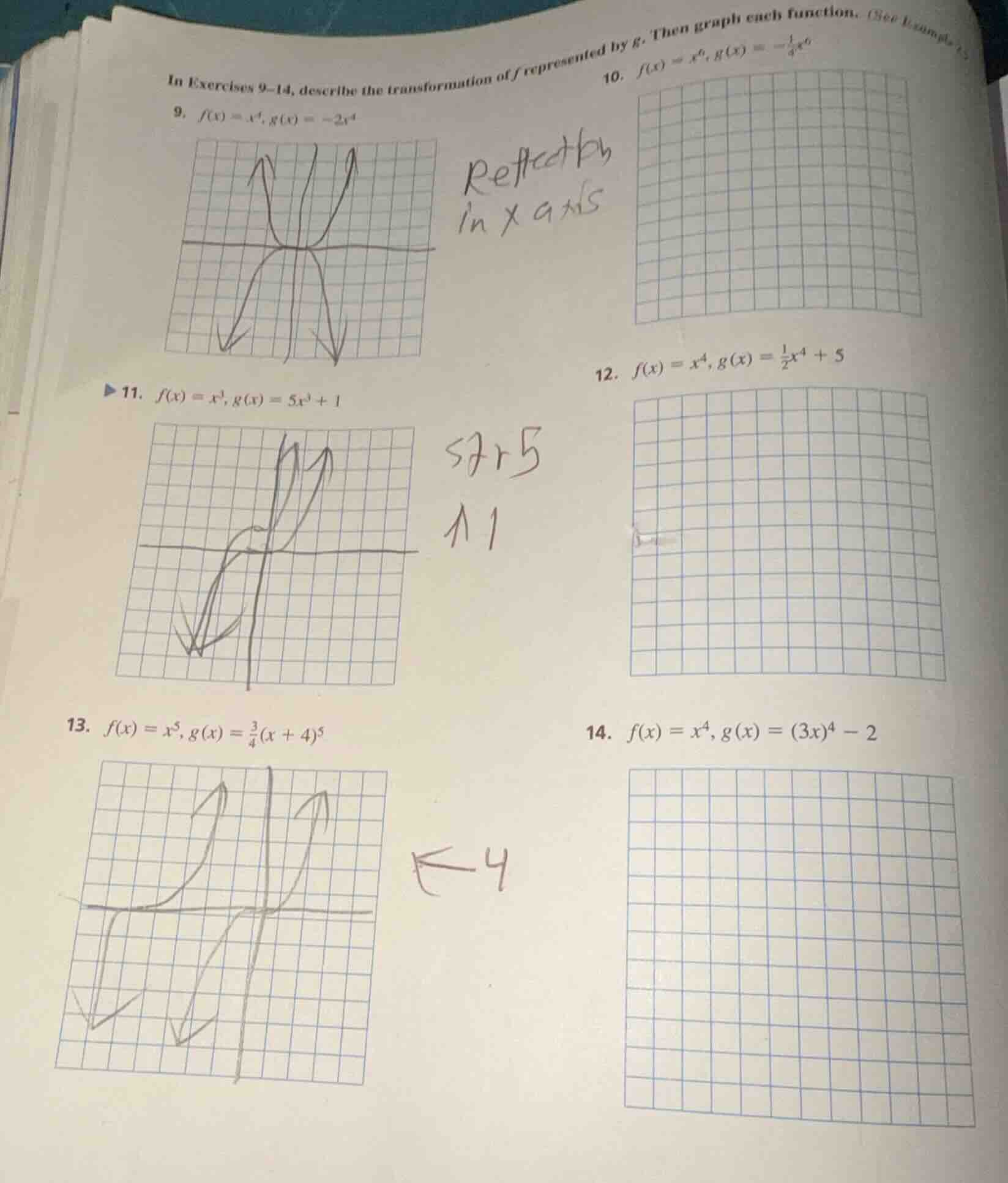
in exercises 9–14, describe the transformation of ( f ) represented by ( g ). then graph each function. (see example
- ( f(x) = x^4 ), ( g(x) = -2x^4 )
- ( f(x) = x^6 ), ( g(x) = -\frac{1}{4}x^6 )
- ( f(x) = x^3 ), ( g(x) = 5x^3 + 1 )
- ( f(x) = x^4 ), ( g(x) = \frac{1}{2}x^4 + 5 )
- ( f(x) = x^5 ), ( g(x) = \frac{3}{4}(x + 4)^5 )
- ( f(x) = x^4 ), ( g(x) = (3x)^4 - 2 )
Step1: Analyze Exercise 9 transformation
Compare $g(x)=-2x^4$ to $f(x)=x^4$.
- Reflection over x-axis: $-f(x)$
- Vertical stretch by factor 2: $-2f(x)$
Step2: Analyze Exercise 10 transformation
Compare $g(x)=-\frac{1}{4}x^6$ to $f(x)=x^6$.
- Reflection over x-axis: $-f(x)$
- Vertical shrink by factor $\frac{1}{4}$: $-\frac{1}{4}f(x)$
Step3: Analyze Exercise 11 transformation
Compare $g(x)=5x^3+1$ to $f(x)=x^3$.
- Vertical stretch by factor 5: $5f(x)$
- Shift up 1 unit: $5f(x)+1$
Step4: Analyze Exercise 12 transformation
Compare $g(x)=\frac{1}{2}x^4+5$ to $f(x)=x^4$.
- Vertical shrink by factor $\frac{1}{2}$: $\frac{1}{2}f(x)$
- Shift up 5 units: $\frac{1}{2}f(x)+5$
Step5: Analyze Exercise 13 transformation
Compare $g(x)=\frac{3}{4}(x+4)^5$ to $f(x)=x^5$.
- Shift left 4 units: $f(x+4)$
- Vertical shrink by factor $\frac{3}{4}$: $\frac{3}{4}f(x+4)$
Step6: Analyze Exercise 14 transformation
Compare $g(x)=(3x)^4-2$ to $f(x)=x^4$.
- Horizontal shrink by factor $\frac{1}{3}$: $f(3x)$
- Shift down 2 units: $f(3x)-2$

Snap & solve any problem in the app
Get step-by-step solutions on Sovi AI
Photo-based solutions with guided steps
Explore more problems and detailed explanations
- Reflection over the x-axis, vertical stretch by a factor of 2.
- Reflection over the x-axis, vertical shrink by a factor of $\frac{1}{4}$.
- Vertical stretch by a factor of 5, shift up 1 unit.
- Vertical shrink by a factor of $\frac{1}{2}$, shift up 5 units.
- Shift left 4 units, vertical shrink by a factor of $\frac{3}{4}$.
- Horizontal shrink by a factor of $\frac{1}{3}$, shift down 2 units.
(Graphing instructions: For each, plot the parent function $f(x)$ first, then apply the listed transformations point-by-point to sketch $g(x)$ on the provided grids.)