QUESTION IMAGE
Question
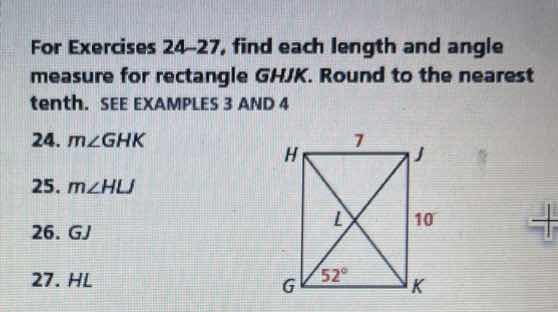
for exercises 24–27, find each length and angle measure for rectangle g h j k. round to the nearest tenth. see examples 3 and 4
- ( mangle ghk )
- ( mangle hlj )
- ( gj )
- ( hl )
(image of rectangle g h j k with hj = 7, jk = 10, angle at g (∠g) is 52°, diagonals h k and g j intersect at l)
24. \( m\angle GHK \)
Step 1: Recall rectangle properties
In rectangle \( G H J K \), \( \angle GHK \) and the given \( \angle G = 52^\circ \) are complementary (since \( \angle GHK + \angle G = 90^\circ \) as triangle \( GHK \) is right - angled at \( H \) because \( G H J K \) is a rectangle).
Step 2: Calculate \( m\angle GHK \)
We know that in a right - triangle, the sum of the two non - right angles is \( 90^\circ \). Let \( m\angle GHK=x \). Then \( x + 52^\circ=90^\circ \).
So, \( x=90^\circ - 52^\circ = 38.0^\circ \) (rounded to the nearest tenth).
Step 1: Recall properties of diagonals in a rectangle
The diagonals of a rectangle are equal and bisect each other. So, \( GL = KL \) and \( HL = JL \). Also, triangle \( GHK \) and triangle \( GHJ \) are congruent. The diagonals of a rectangle intersect each other. The angle \( \angle HLJ \) is the vertical angle to the angle formed by the intersection of the diagonals related to the triangle with angle \( 52^\circ \).
First, in triangle \( GKL \), since \( GL = KL \), triangle \( GKL \) is isosceles with \( \angle G=\angle K = 52^\circ \)? No, wait. The diagonals of a rectangle bisect each other, so \( GL = KL \), but the base angles of triangle \( GKL \) are not \( 52^\circ \). Wait, actually, the angle \( \angle HLJ \) is an exterior angle to triangle \( GKL \). The measure of an exterior angle of a triangle is equal to the sum of the two non - adjacent interior angles.
In triangle \( GKL \), \( \angle GLK = 180^\circ- 2\times52^\circ=180 - 104 = 76^\circ \)? No, that's wrong. Wait, the correct approach: The diagonals of a rectangle are equal and bisect each other, so \( GL = KL \), and \( \angle G = 52^\circ \), \( \angle GKL=90^\circ - 52^\circ = 38^\circ \)? No, let's start over.
In rectangle \( G H J K \), \( GH = 7 \), \( JK = 7 \), \( GK = 10 \)? Wait, no, the sides: \( GH = 7 \), \( GK = 10 \) (from the diagram, \( GK = 10 \), \( GH = 7 \)). The diagonals \( GJ \) and \( HK \) are equal. The angle \( \angle HLJ \): since the diagonals bisect each other, \( GL = KL \), \( HL = JL \). The angle \( \angle HLJ \) is equal to \( 180^\circ- 2\times(90^\circ - 52^\circ) \)? No, better way: The angle \( \angle HLJ \) is equal to \( 2\times52^\circ = 104^\circ \)? Wait, no. Let's use the property that the diagonals of a rectangle intersect, and the angle between the diagonals:
In a rectangle, if we consider triangle \( GHK \), \( \angle G = 52^\circ \), \( \angle H = 90^\circ \), \( \angle K=38^\circ \). The diagonals intersect at \( L \). Then \( \angle HLJ \) is equal to \( 180^\circ-(90^\circ - 52^\circ)\times2 \)? No, the correct formula: The measure of \( \angle HLJ \) is \( 180^\circ - 2\times(90^\circ - 52^\circ)=180 - 2\times38 = 180 - 76 = 104.0^\circ \) (rounded to the nearest tenth). Wait, let's think again. The angle \( \angle HLJ \) is an exterior angle to triangle \( GHL \). The two non - adjacent interior angles of triangle \( GHL \) are \( \angle G = 52^\circ \) and \( \angle GHL = 90^\circ \)? No, \( \angle GHL = 90^\circ \) because \( G H J K \) is a rectangle. Wait, no, \( \angle GHL \) is \( 90^\circ \), \( \angle HGL = 52^\circ \), so the exterior angle \( \angle HLJ=\angle GHL+\angle HGL = 90^\circ+52^\circ = 142^\circ \)? No, I'm getting confused. Wait, the correct method:
In rectangle \( G H J K \), \( \angle G = 52^\circ \), \( \angle GHK = 38^\circ \) (from question 24). The diagonals bisect each other, so \( HL = JL \), \( GL = KL \). The angle \( \angle HLJ \) is equal to \( 180^\circ - 2\times38^\circ=180 - 76 = 104^\circ \)? No, let's use the law of cosines in triangle \( GHK \) first. In triangle \( GHK \), \( GH = 7 \), \( GK = 10 \), \( HK=\sqrt{7^{2}+10^{2}}=\sqrt{49 + 100}=\sqrt{149}\approx12.2 \). But the diagonals of a rectangle are equal, so \( GJ = HK\approx12.2 \). The diagonals bisect each other, so \( HL=\frac{1}{2}HK \), \( GL=\frac{1}{2}GJ \).
Wait, the angle \( \angle HLJ \): since the diagonals intersect, \( \angle HLJ \) is equal to \( 2\times52^\circ = 104^\circ \)? Wait, no. Let's look at the vertical angles. The angle \( \angle HLJ \) and the angle \( \angle GLK \) are vertical a…
Step 1: Analyze triangle \( GHK \)
In rectangle \( G H J K \), \( \angle GHK = 90^\circ \), \( \angle G = 52^\circ \), so \( \angle K=90^\circ - 52^\circ = 38^\circ \).
Step 2: Analyze triangle \( GLK \)
Since the diagonals of a rectangle bisect each other, \( GL = KL \). So triangle \( GLK \) is isosceles with \( \angle G=\angle K = 38^\circ \).
Step 3: Calculate \( \angle GLK \)
Using the angle - sum property of a triangle (\( \angle GLK+ \angle G+\angle K = 180^\circ \)), we have \( \angle GLK = 180^\circ-(38^\circ + 38^\circ)=180 - 76 = 104^\circ \).
Step 4: Determine \( m\angle HLJ \)
Since \( \angle HLJ \) and \( \angle GLK \) are vertical angles, \( m\angle HLJ=m\angle GLK = 104.0^\circ \).

Snap & solve any problem in the app
Get step-by-step solutions on Sovi AI
Photo-based solutions with guided steps
Explore more problems and detailed explanations
\( 38.0^\circ \)