QUESTION IMAGE
Question
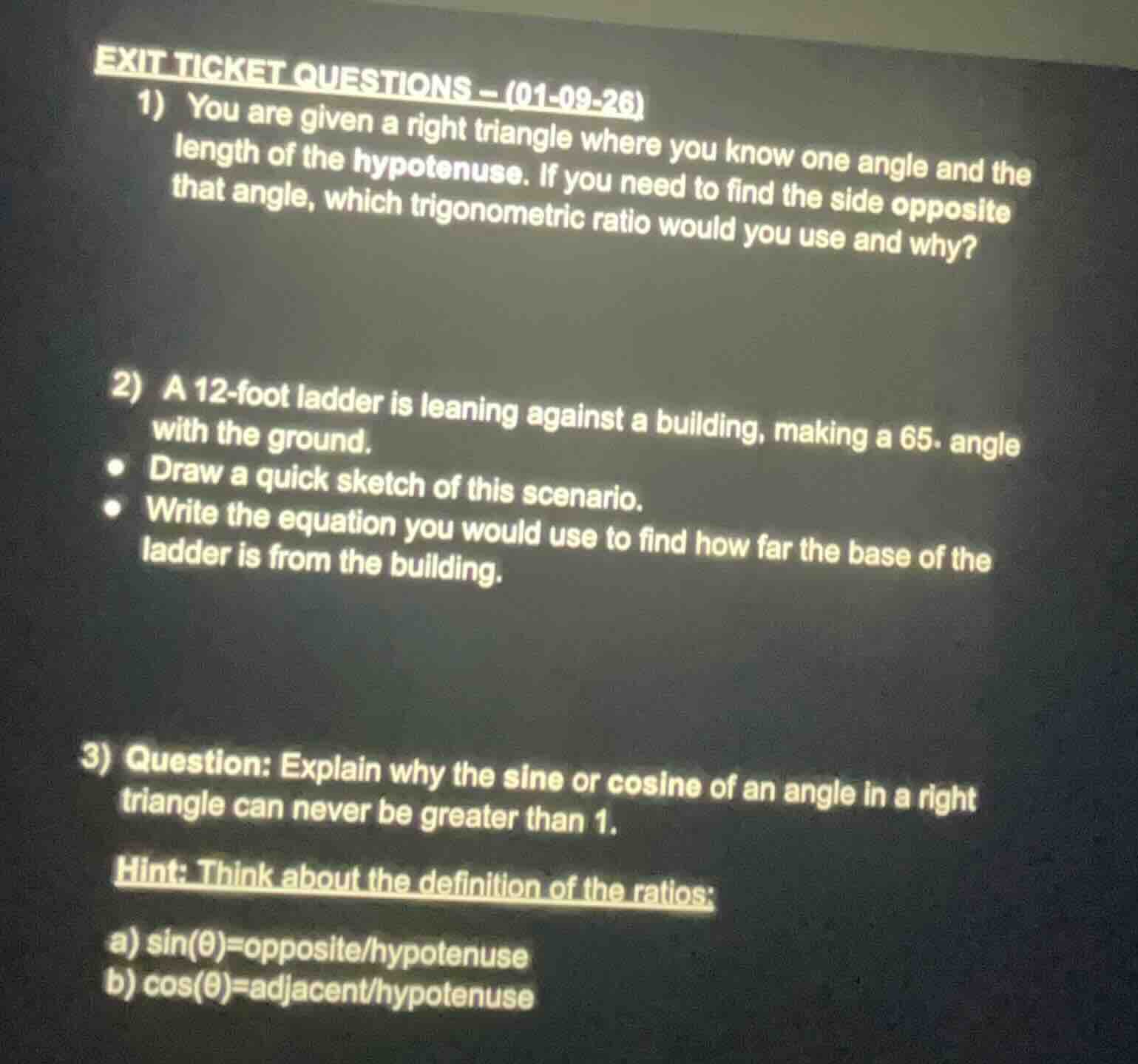
exit ticket questions – (01-09-26)
- you are given a right triangle where you know one angle and the length of the hypotenuse. if you need to find the side opposite that angle, which trigonometric ratio would you use and why?
- a 12-foot ladder is leaning against a building, making a 65° angle with the ground.
- draw a quick sketch of this scenario.
- write the equation you would use to find how far the base of the ladder is from the building.
- question: explain why the sine or cosine of an angle in a right triangle can never be greater than 1.
hint: think about the definition of the ratios:
a) sin(θ)=opposite/hypotenuse
b) cos(θ)=adjacent/hypotenuse
Brief Explanations
- The sine trigonometric ratio is defined as $\sin(\theta) = \frac{\text{opposite}}{\text{hypotenuse}}$, which directly links the known angle, known hypotenuse, and unknown opposite side.
- The scenario forms a right triangle where the 12-foot ladder is the hypotenuse, the distance from the building to the ladder base is the side adjacent to the 65° angle. Using the cosine ratio (adjacent over hypotenuse) gives the equation to solve for this distance $x$.
- In a right triangle, the hypotenuse is always the longest side. For sine ($\frac{\text{opposite}}{\text{hypotenuse}}$) and cosine ($\frac{\text{adjacent}}{\text{hypotenuse}}$), the numerator (opposite/adjacent side) is always shorter than or equal to the hypotenuse. A fraction with a numerator ≤ denominator will always have a value ≤ 1.

Snap & solve any problem in the app
Get step-by-step solutions on Sovi AI
Photo-based solutions with guided steps
Explore more problems and detailed explanations
- Sine ratio; it relates opposite/hypotenuse.
- Sketch: Right triangle (ladder=hypotenuse, ground=adjacent, building=opposite); Equation: $\cos(65^\circ) = \frac{x}{12}$
- Sine/cosine can never exceed 1.