QUESTION IMAGE
Question
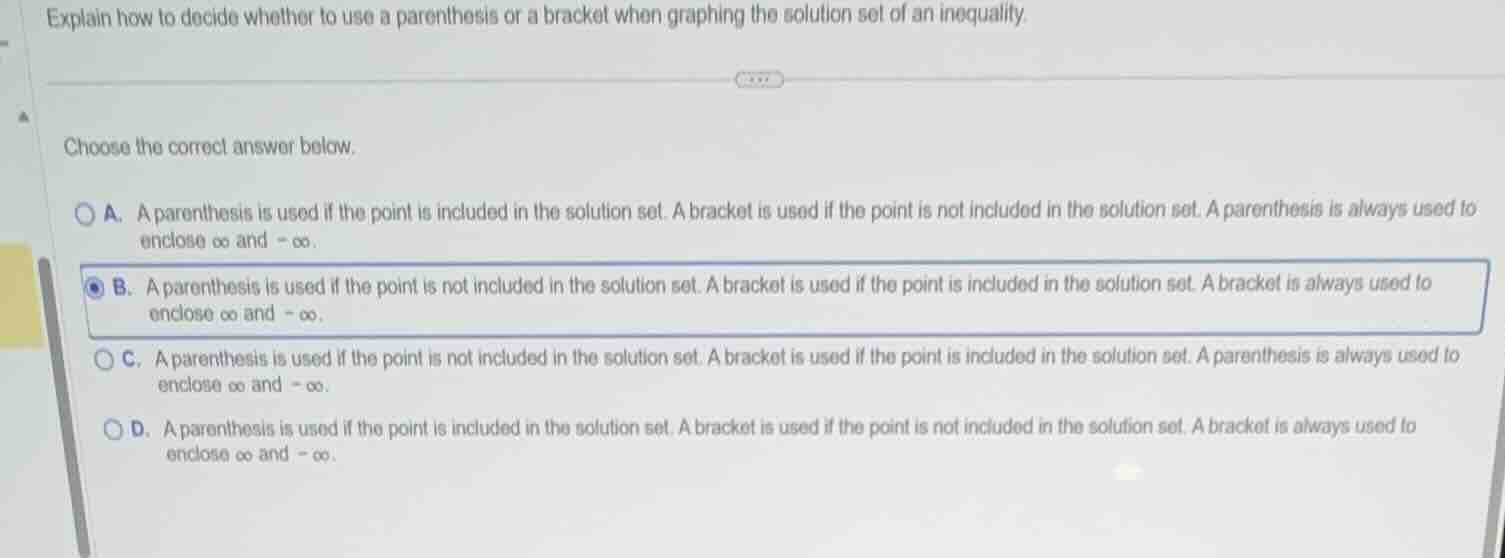
explain how to decide whether to use a parenthesis or a bracket when graphing the solution set of an inequality.
choose the correct answer below.
a. a parenthesis is used if the point is included in the solution set. a bracket is used if the point is not included in the solution set. a parenthesis is always used to enclose ∞ and -∞.
b. a parenthesis is used if the point is not included in the solution set. a bracket is used if the point is included in the solution set. a bracket is always used to enclose ∞ and -∞.
c. a parenthesis is used if the point is not included in the solution set. a bracket is used if the point is included in the solution set. a parenthesis is always used to enclose ∞ and -∞.
d. a parenthesis is used if the point is included in the solution set. a bracket is used if the point is not included in the solution set. a bracket is always used to enclose ∞ and -∞.
Parentheses are used for endpoints not included in the solution set (from inequalities like $<$ or $>$), while brackets are used for endpoints included (from inequalities like $\leq$ or $\geq$). Infinity ($\infty$) and negative infinity ($-\infty$) are never actual reachable points, so they are always enclosed in parentheses, not brackets. Option C correctly states these rules.

Snap & solve any problem in the app
Get step-by-step solutions on Sovi AI
Photo-based solutions with guided steps
Explore more problems and detailed explanations
C. A parenthesis is used if the point is not included in the solution set. A bracket is used if the point is included in the solution set. A parenthesis is always used to enclose ∞ and −∞.