QUESTION IMAGE
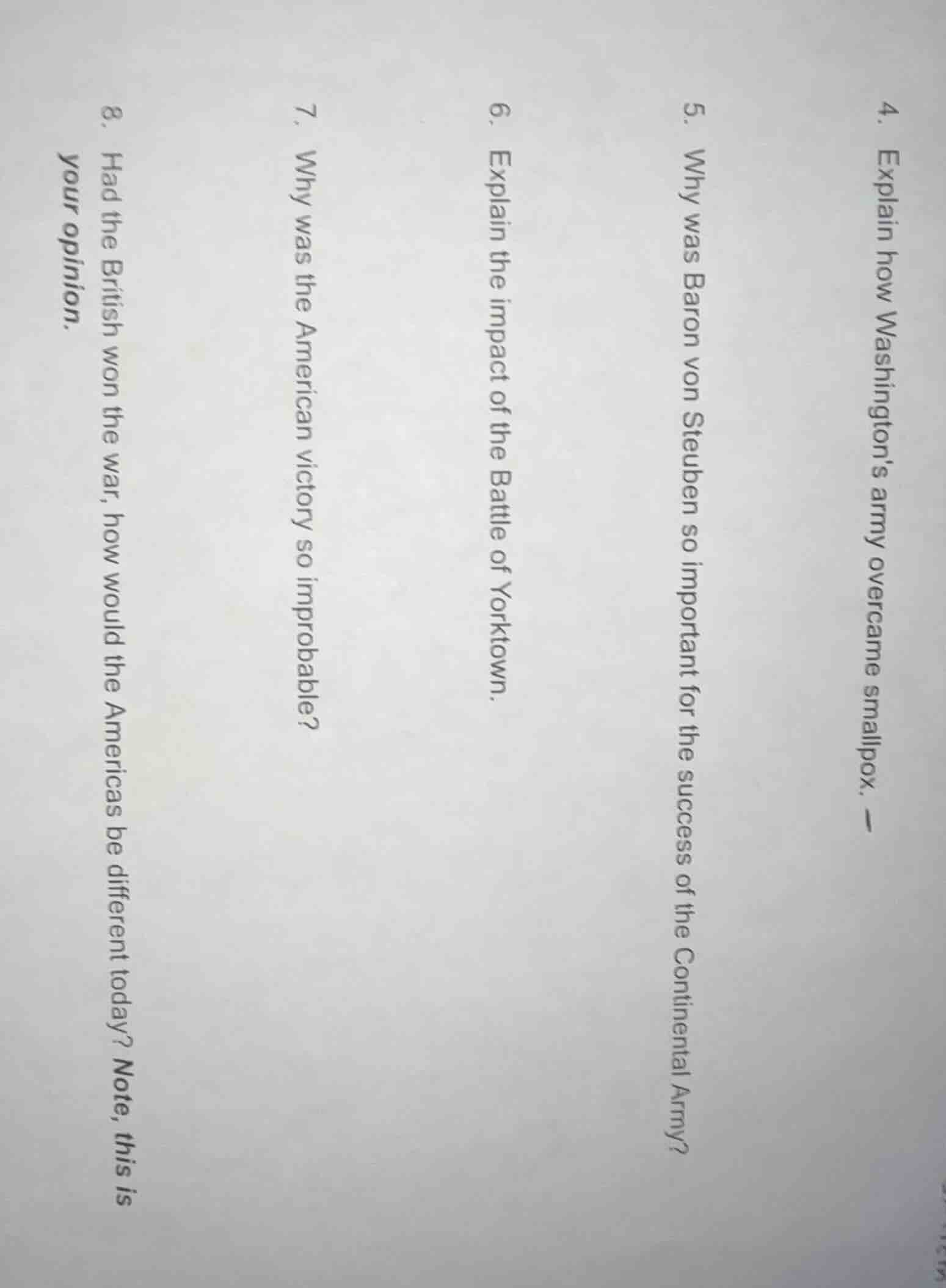
Question
- explain how washingtons army overcame smallpox.
- why was baron von steuben so important for the success of the continental army?
- explain the impact of the battle of yorktown.
- why was the american victory so improbable?
- had the british won the war, how would the americas be different today? note, this is your opinion.
Brief Explanations
- During the Revolutionary War, George Washington ordered the systematic inoculation of his Continental Army using variolation—scraping material from smallpox blisters into cuts on healthy soldiers' skin. This created mild infections that granted immunity, drastically reducing smallpox outbreaks that had previously decimated troop numbers and allowed the army to maintain fighting strength.
- Baron von Steuben, a Prussian military officer, trained the undisciplined, poorly drilled Continental Army at Valley Forge in 1778. He standardized combat drills, hygiene practices, and command structures, transforming the ragtag force into a professional, cohesive military unit capable of standing against British regulars.
- The 1781 Battle of Yorktown was the decisive final major battle of the American Revolution. American and French forces trapped British General Cornwallis' army, forcing his surrender. This victory convinced the British government to enter peace negotiations, leading to the 1783 Treaty of Paris that formally recognized U.S. independence.
- The American victory was improbable because the British had the world's most powerful navy, a large, well-trained professional army, greater financial resources, and control of major cities. The Americans had a small, underfunded, poorly equipped militia with limited supply lines, and faced internal divisions and desertions.
- If the British had won, the U.S. would not exist as an independent nation. The colonies would remain part of the British Empire, with colonial governments under tighter British control. Slavery might have been abolished earlier (as Britain ended it in 1833) but Indigenous dispossession would likely have continued. American cultural and political identity would be deeply tied to British institutions, with no independent U.S. legal or governmental systems.

Snap & solve any problem in the app
Get step-by-step solutions on Sovi AI
Photo-based solutions with guided steps
Explore more problems and detailed explanations
- Washington mandated mass variolation of troops, using smallpox blister material to induce immunity, eliminating deadly outbreaks and preserving army strength.
- He trained the undisciplined Continental Army in professional drills, hygiene, and command, turning it into a capable fighting force.
- It forced British General Cornwallis' surrender, ending major combat and pushing Britain to negotiate the 1783 Treaty of Paris, which recognized U.S. independence.
- Britain had a superior military, more resources, and control of key cities, while the U.S. had a small, underfunded, untrained force with supply issues.
- The U.S. would not exist as an independent nation; colonies would remain under strict British rule, with British institutions shaping culture, politics, and likely earlier abolition of slavery but continued Indigenous displacement.