QUESTION IMAGE
Question
explain what is meant by wave - particle duality.
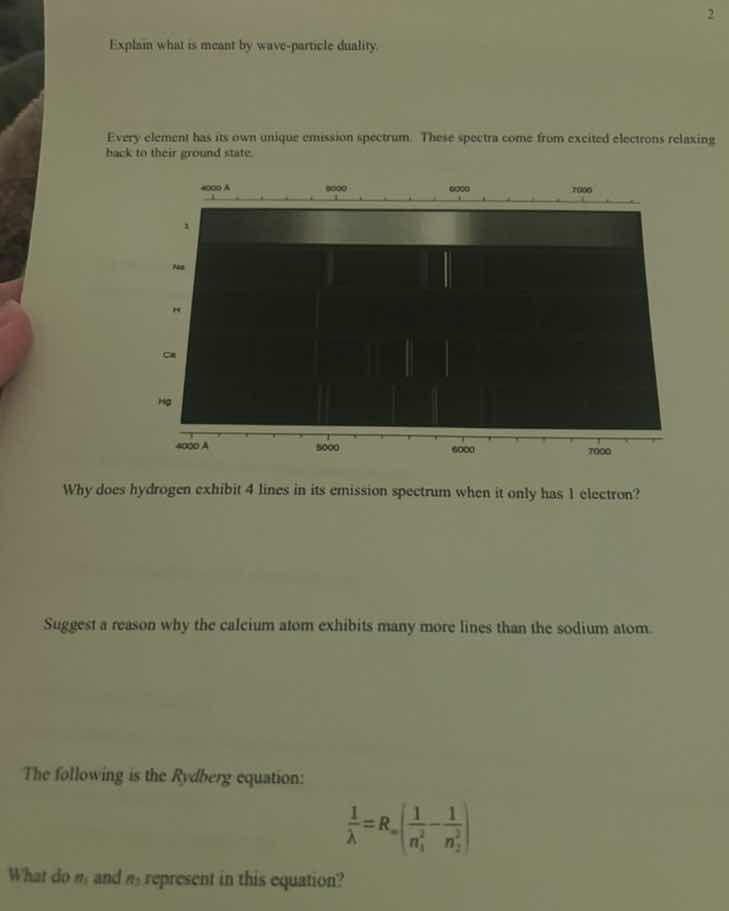
every element has its own unique emission spectrum. these spectra come from excited electrons relaxing back to their ground state.
why does hydrogen exhibit 4 lines in its emission spectrum when it only has 1 electron?
suggest a reason why the calcium atom exhibits many more lines than the sodium atom.
the following is the rydberg equation:
\\(\frac{1}{\lambda}=r_{\infty}\left(\frac{1}{n_{1}^{2}} - \frac{1}{n_{2}^{2}}\
ight)\\)
what do \\(n_1\\) and \\(n_2\\) represent in this equation?
Brief Explanations
- Wave-particle duality: Describes that all quantum-scale objects (like electrons, photons) exhibit properties of both waves (e.g., interference, diffraction) and particles (e.g., momentum, discrete energy transfer) depending on the experimental setup.
- Hydrogen's 4 emission lines: A single hydrogen electron can absorb energy to jump to multiple higher energy levels. When it relaxes back to a lower common energy level (e.g., the n=2 level for the visible Balmer series), each different downward transition from a higher level (n=3,4,5,6) releases a photon of a specific, distinct wavelength, creating 4 visible lines.
- Calcium vs. sodium lines: Sodium has only 1 valence electron, while calcium has 2 valence electrons. Calcium has more possible electron energy level transitions (including interactions between its two valence electrons and more core electron excitation possibilities), leading to more distinct photon wavelengths and thus more emission lines.
- Rydberg equation variables: $n_1$ represents the principal quantum number of the lower, final energy level that the electron relaxes to. $n_2$ represents the principal quantum number of the higher, initial energy level that the electron falls from, where $n_2 > n_1$.

Snap & solve any problem in the app
Get step-by-step solutions on Sovi AI
Photo-based solutions with guided steps
Explore more problems and detailed explanations
- Wave-particle duality is the principle that all quantum entities (such as electrons and photons) display both wave-like (e.g., interference) and particle-like (e.g., discrete energy) properties depending on the experiment.
- The single hydrogen electron can be excited to multiple higher energy levels; when it drops back to a common lower energy level, each distinct transition emits a photon of a unique wavelength, creating 4 visible lines.
- Calcium has 2 valence electrons (compared to sodium's 1), allowing for far more unique electron energy level transitions (including interactions between valence electrons and more core electron excitations), resulting in more emission lines.
- $n_1$ = principal quantum number of the lower final energy level; $n_2$ = principal quantum number of the higher initial energy level ($n_2 > n_1$).