QUESTION IMAGE
Question
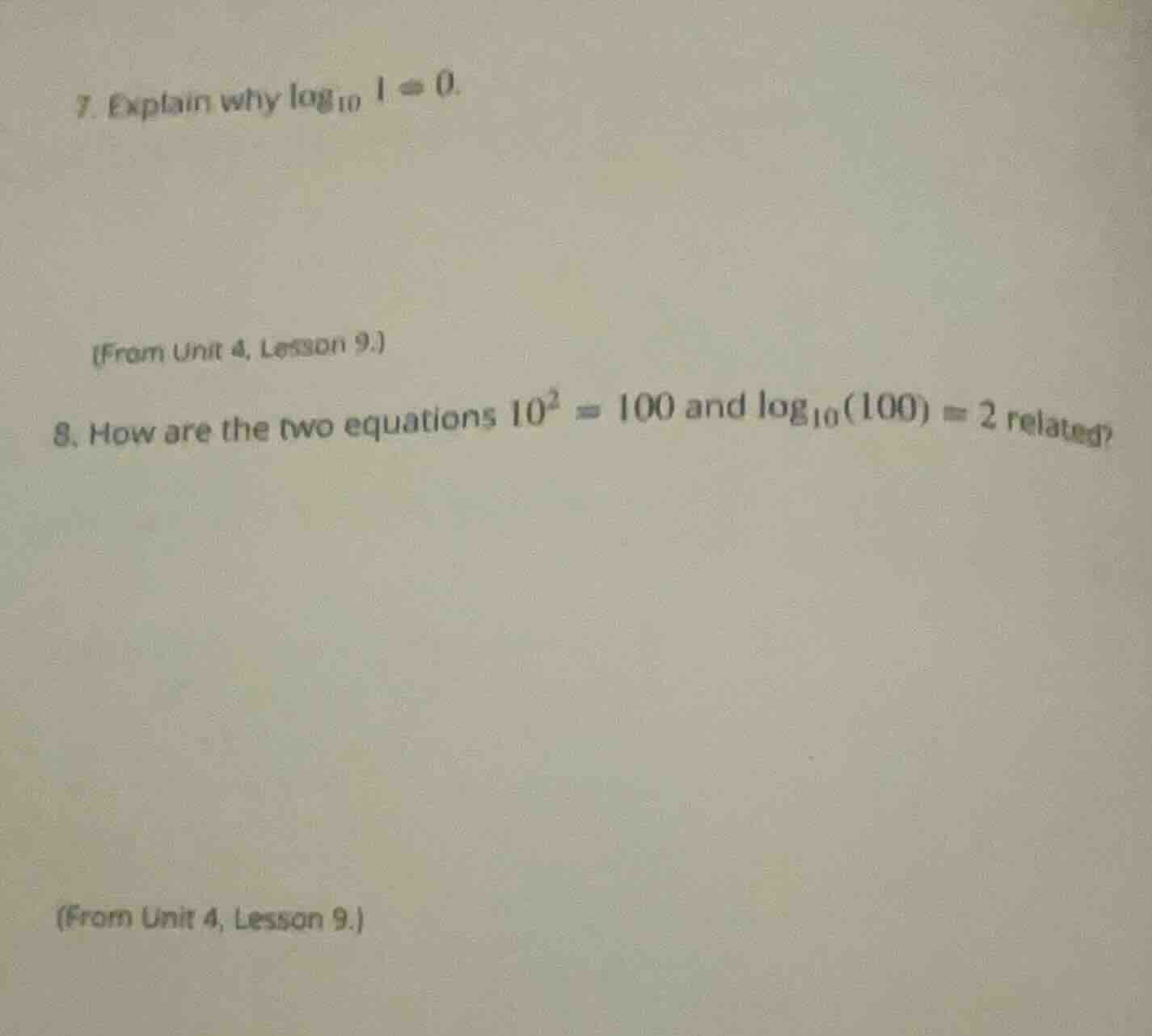
- explain why \\(\log_{10} 1 = 0\\).
(from unit 4, lesson 9.)
- how are the two equations \\(10^2 = 100\\) and \\(\log_{10}(100) = 2\\) related?
(from unit 4, lesson 9.)
Question 7
Step1: Recall logarithm definition
The logarithm function \( \log_b(a) = c \) is defined as \( b^c = a \) (where \( b>0, b
eq1 \)). For \( \log_{10}(1) \), let \( \log_{10}(1) = x \).
Step2: Apply the definition
By the definition of logarithms, this means \( 10^x = 1 \). We know that any non - zero number raised to the power of 0 is 1, so \( 10^0 = 1 \). Thus, \( x = 0 \), so \( \log_{10}(1)=0 \).
Recall the relationship between exponential and logarithmic functions. The exponential form is \( b^y=x \) and the logarithmic form is \( \log_b(x)=y \), where \( b > 0,b
eq1 \).
In the equation \( 10^2 = 100 \), we have \( b = 10 \), \( y = 2 \), and \( x = 100 \) in the exponential form \( b^y=x \).
In the equation \( \log_{10}(100)=2 \), we have \( b = 10 \), \( x = 100 \), and \( y = 2 \) in the logarithmic form \( \log_b(x)=y \).
So the two equations are related by the inverse relationship between exponential and logarithmic functions with base 10. The exponential equation \( 10^2 = 100 \) can be converted to the logarithmic equation \( \log_{10}(100)=2 \) (and vice - versa) using the definition of a logarithm: \( \log_b(x)=y\iff b^y = x \) (where \( b = 10 \), \( x = 100 \), \( y = 2 \)).

Snap & solve any problem in the app
Get step-by-step solutions on Sovi AI
Photo-based solutions with guided steps
Explore more problems and detailed explanations
Using the definition of a logarithm \( \log_b(a)=c\iff b^c = a \), for \( \log_{10}(1) \), let \( \log_{10}(1)=x \). Then \( 10^x = 1 \). Since \( 10^0 = 1 \), we have \( x = 0 \), so \( \log_{10}(1)=0 \).