QUESTION IMAGE
Question
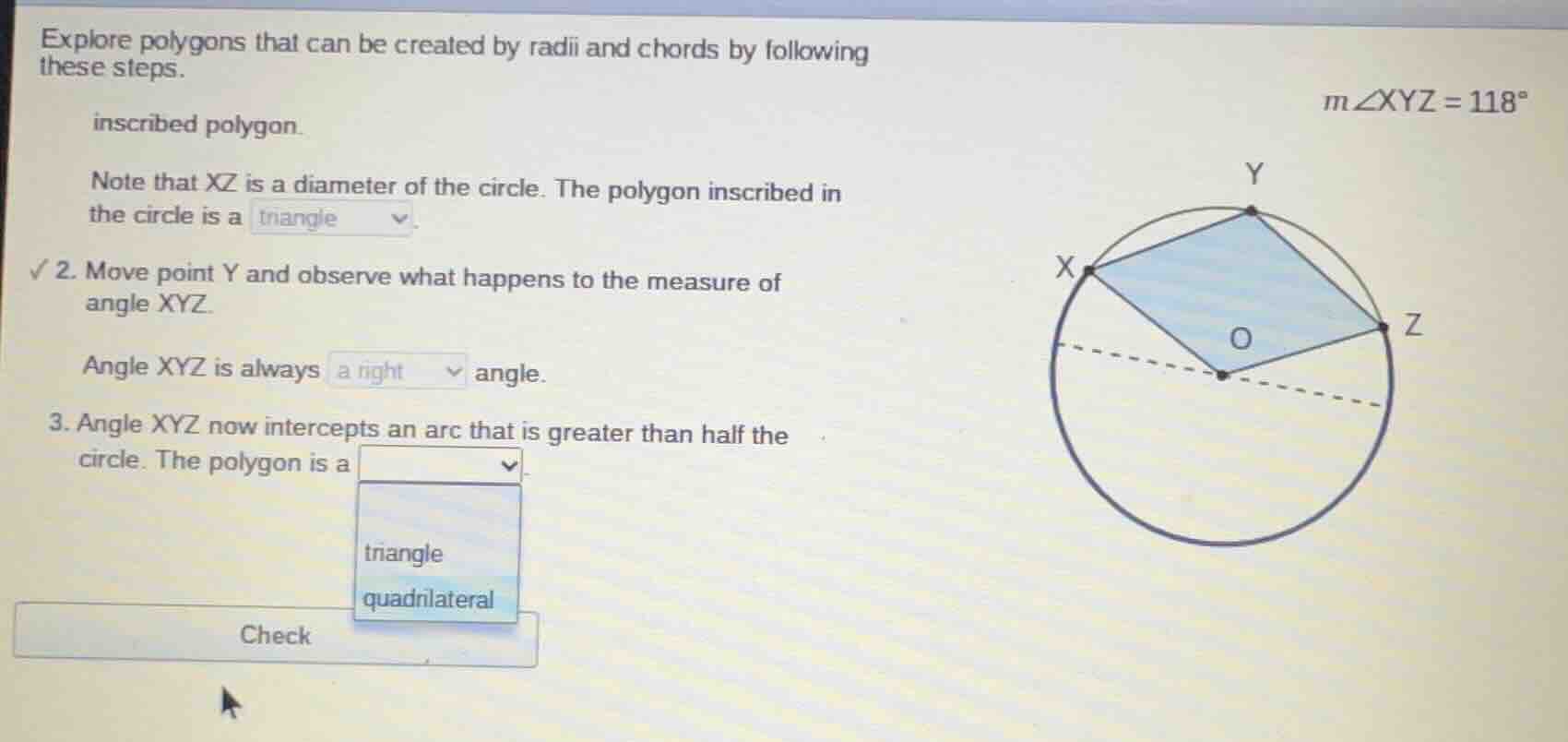
explore polygons that can be created by radii and chords by following these steps. inscribed polygon. note that xz is a diameter of the circle. the polygon inscribed in the circle is a triangle. 2. move point y and observe what happens to the measure of angle xyz. angle xyz is always a right angle. 3. angle xyz now intercepts an arc that is greater than half the circle. the polygon is a dropdown with triangle, quadrilateral. check m∠xyz = 118° image of circle with points x, y, z, o, and quadrilateral xyzo
Step1: Identify the number of vertices
The polygon has vertices X, Y, Z, and O? Wait, no, looking at the diagram, the polygon is formed by points X, Y, Z, and the center? Wait, no, the diagram shows a quadrilateral? Wait, no, the inscribed polygon: when we have X, Y, Z, and the circle. Wait, the original was a triangle (X, Y, Z with XZ diameter). Now, if angle XYZ intercepts an arc greater than half the circle, and the polygon has four vertices? Wait, no, the options are triangle or quadrilateral. Wait, the figure in the diagram is a quadrilateral (X, Y, Z, and the center? No, the blue shape is a quadrilateral with vertices X, Y, Z, and... Wait, no, the problem says "the polygon inscribed in the circle" – wait, the first part was a triangle (X, Y, Z). Now, if we have angle XYZ intercepting an arc greater than half the circle, and the polygon has four sides? Wait, the options are triangle or quadrilateral. Let's think: a triangle has 3 sides, quadrilateral has 4. The diagram shows a quadrilateral (X, Y, Z, and another point? Wait, no, the blue shape is a quadrilateral with vertices X, Y, Z, and O? No, O is the center. Wait, maybe the polygon is X, Y, Z, and another point? Wait, no, the problem says "the polygon inscribed in the circle" – when you have four points on the circle, it's a quadrilateral. Wait, the first step was a triangle (three points: X, Y, Z with XZ diameter). Now, if angle XYZ intercepts an arc greater than half the circle, and the polygon has four vertices (X, Y, Z, and another? Wait, no, the diagram shows a quadrilateral (X, Y, Z, and the center? No, the blue shape is a quadrilateral with X, Y, Z, and... Wait, maybe the polygon is a quadrilateral because it has four sides (X to Y, Y to Z, Z to O? No, O is the center. Wait, no, the inscribed polygon: points on the circle. So X, Y, Z are on the circle, and maybe another point? Wait, the first part was a triangle (X, Y, Z). Now, if we move Y, and the polygon becomes a quadrilateral? Wait, the options are triangle or quadrilateral. The diagram shows a quadrilateral (the blue shape has four sides: X to Y, Y to Z, Z to O? No, O is the center. Wait, maybe the polygon is X, Y, Z, and the center, but that's not inscribed. Wait, no, inscribed polygon has vertices on the circle. So X, Y, Z are on the circle, and maybe another point? Wait, the first step was a triangle (three points). Now, if the angle XYZ intercepts an arc greater than half the circle, and the polygon has four sides, so it's a quadrilateral. So the answer should be quadrilateral.
Step2: Confirm the number of sides
A triangle has 3 sides, quadrilateral has 4. The diagram shows a quadrilateral (the blue shape with four vertices: X, Y, Z, and another? Wait, no, the blue shape is a quadrilateral with X, Y, Z, and the center? No, O is the center. Wait, maybe the polygon is X, Y, Z, and a fourth point on the circle. So the polygon is a quadrilateral. So the correct option is quadrilateral.

Snap & solve any problem in the app
Get step-by-step solutions on Sovi AI
Photo-based solutions with guided steps
Explore more problems and detailed explanations
quadrilateral