QUESTION IMAGE
Question
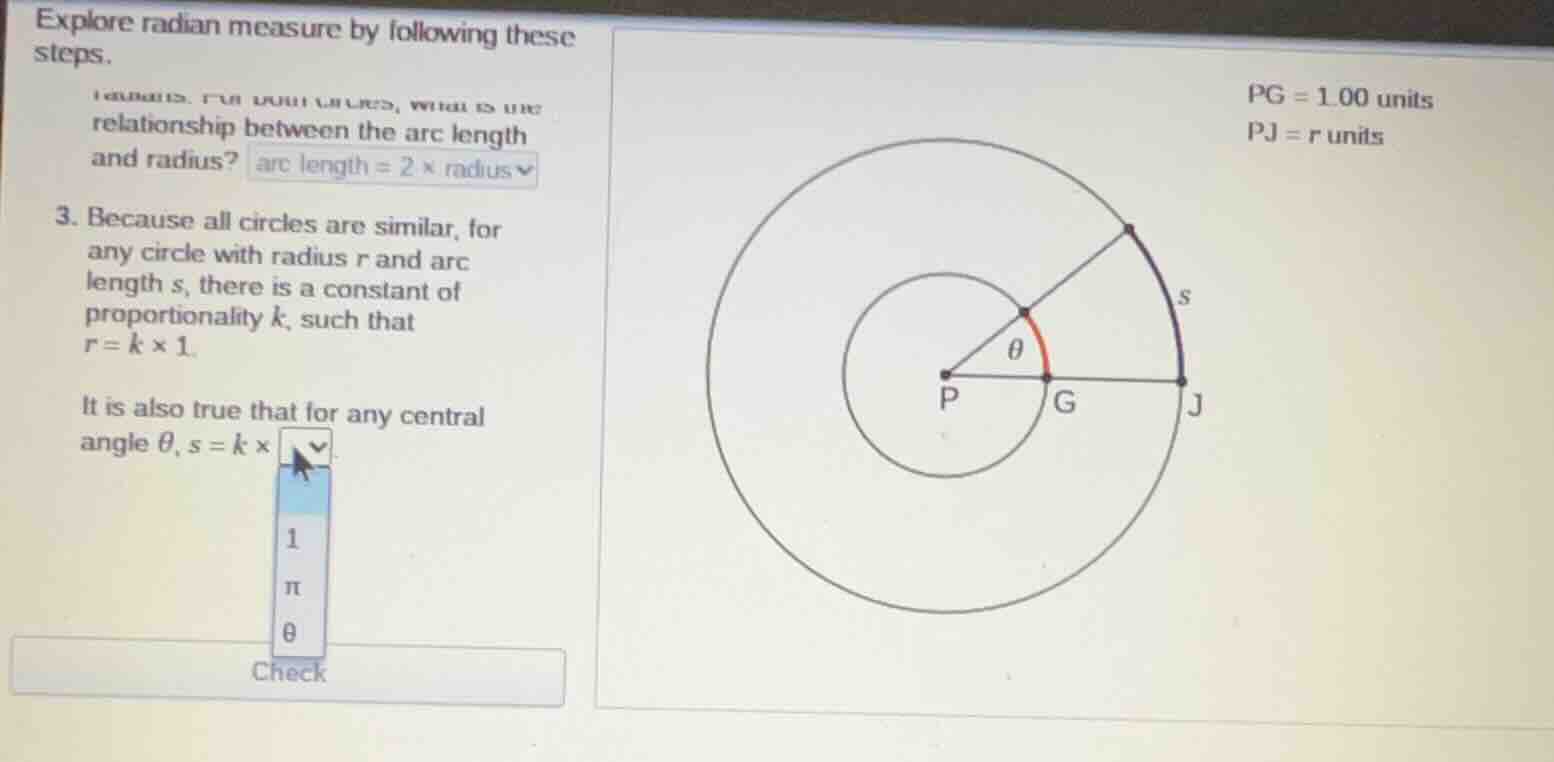
explore radian measure by following these steps. relationship between the arc length and radius? arc length = 2 × radius 3. because all circles are similar, for any circle with radius r and arc length s, there is a constant of proportionality k, such that r = k × 1. it is also true that for any central angle θ, s = k × dropdown with options 1, π, θ pg = 1.00 units pj = r units diagram of two concentric circles with center p, radius pg=1, pj=r, central angle θ, arc s on the larger circle
Step1: Recall the arc length formula in radians
The formula for the length of an arc \( s \) of a circle with radius \( r \) and central angle \( \theta \) (in radians) is \( s = r\theta \). From the problem, we know that for the unit circle (radius \( r = 1 \)), \( r=k\times1 \), so \( k = r \) when \( r = 1 \), but more importantly, the relationship between arc length, radius, and central angle in radians is \( s=r\theta \). Comparing with \( s = k\times \text{(something)} \), and since \( k \) is related to the radius and the angle, and the formula for arc length in radians is \( s = r\theta \), and we can think of the proportionality. Since the central angle is \( \theta \), and the arc length formula is \( s = r\theta \), and from the first part \( r = k\times1 \), so substituting \( r = k \) into \( s = r\theta \) gives \( s=k\times\theta \).
Step2: Determine the missing term
So the missing term in \( s = k\times \) [blank] should be \( \theta \), because the arc length formula in radians is \( s = r\theta \), and since \( r = k\times1 \) (so \( k = r \) for the unit circle), then \( s = k\times\theta \).

Snap & solve any problem in the app
Get step-by-step solutions on Sovi AI
Photo-based solutions with guided steps
Explore more problems and detailed explanations
\(\boldsymbol{\theta}\)