QUESTION IMAGE
Question
exponential growth functions
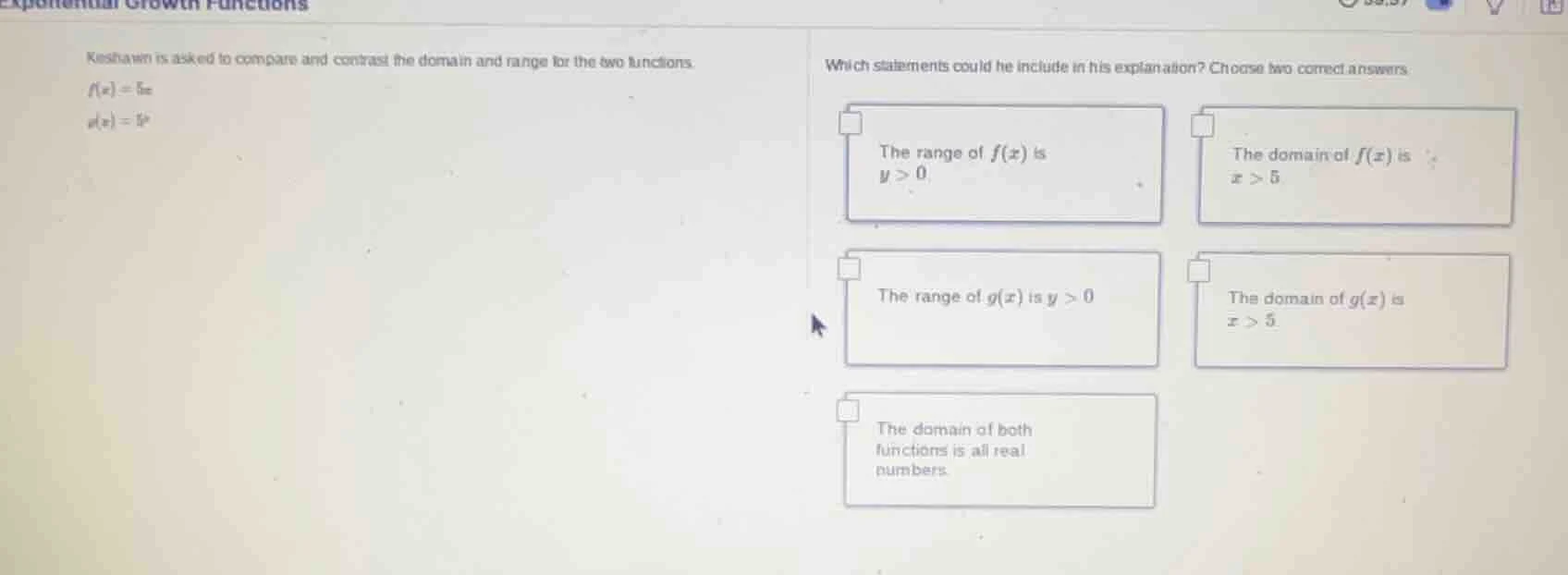
keshawn is asked to compare and contrast the domain and range for the two functions.
$f(x)=5x$
$g(x)=5^x$
which statements could he include in his explanation? choose two correct answers
the range of $f(x)$ is $y > 0$
the domain of $f(x)$ is $x > 5$
the range of $g(x)$ is $y > 0$
the domain of $g(x)$ is $x > 5$
the domain of both functions is all real numbers.
Brief Explanations
- For $f(x)=5x$ (linear function):
- Domain: All real numbers (you can input any real $x$).
- Range: All real numbers (outputs all real $y$ values).
- For $g(x)=5^x$ (exponential function):
- Domain: All real numbers (you can input any real $x$).
- Range: $y>0$ (exponential functions with positive base never output 0 or negative values).
- Evaluate each statement:
- "The range of $f(x)$ is $y>0$": False (linear function has all real numbers as range).
- "The domain of $f(x)$ is $x>5$": False (domain is all real numbers).
- "The range of $g(x)$ is $y>0$": True (matches exponential function range).
- "The domain of $g(x)$ is $x>5$": False (domain is all real numbers).
- "The domain of both functions is all real numbers": True (both linear and exponential functions accept all real $x$ inputs).

Snap & solve any problem in the app
Get step-by-step solutions on Sovi AI
Photo-based solutions with guided steps
Explore more problems and detailed explanations
- The range of $g(x)$ is $y > 0$
- The domain of both functions is all real numbers