QUESTION IMAGE
Question
express the following probability as a simplified fraction and as a decimal.
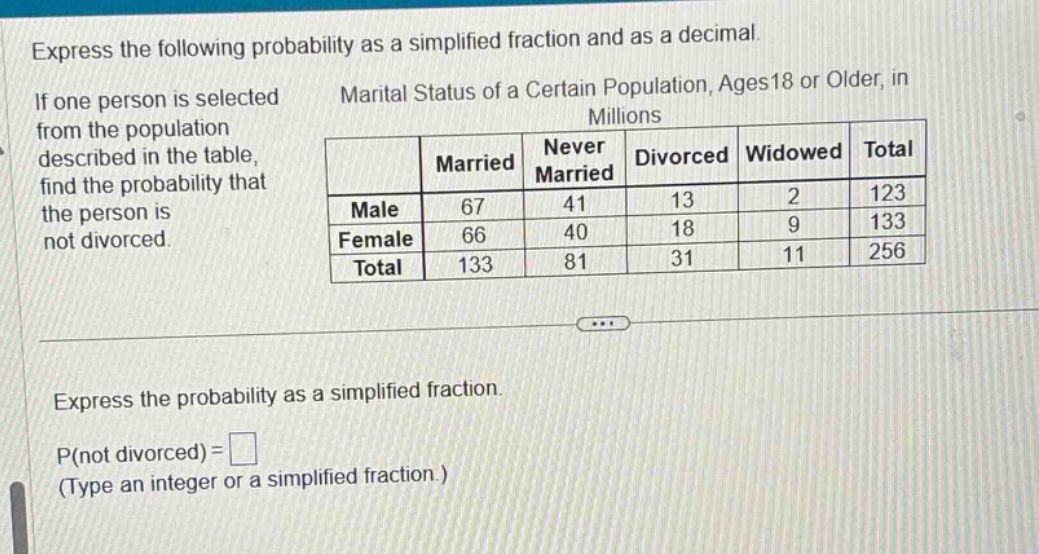
if one person is selected from the population described in the table, find the probability that the person is not divorced.
marital status of a certain population, ages18 or older, in millions
| married | never married | divorced | widowed | total | |
| male | 67 | 41 | 13 | 2 | 123 |
| female | 66 | 40 | 18 | 9 | 133 |
| total | 133 | 81 | 31 | 11 | 256 |
express the probability as a simplified fraction.
p(not divorced) = \\(\square\\)
(type an integer or a simplified fraction.)
Step1: Find total population
The total population (from the "Total" row and "Total" column) is 256 million.
Step2: Find number of divorced people
From the "Total" row and "Divorced" column, the number of divorced people is 31 million.
Step3: Find number of not divorced people
Subtract the number of divorced people from the total population: \( 256 - 31 = 225 \)
Step4: Calculate probability
The probability of not being divorced is the number of not divorced people divided by the total population: \( \frac{225}{256} \) (225 and 256 have no common factors other than 1, so it's simplified)

Snap & solve any problem in the app
Get step-by-step solutions on Sovi AI
Photo-based solutions with guided steps
Explore more problems and detailed explanations
\(\frac{225}{256}\)