QUESTION IMAGE
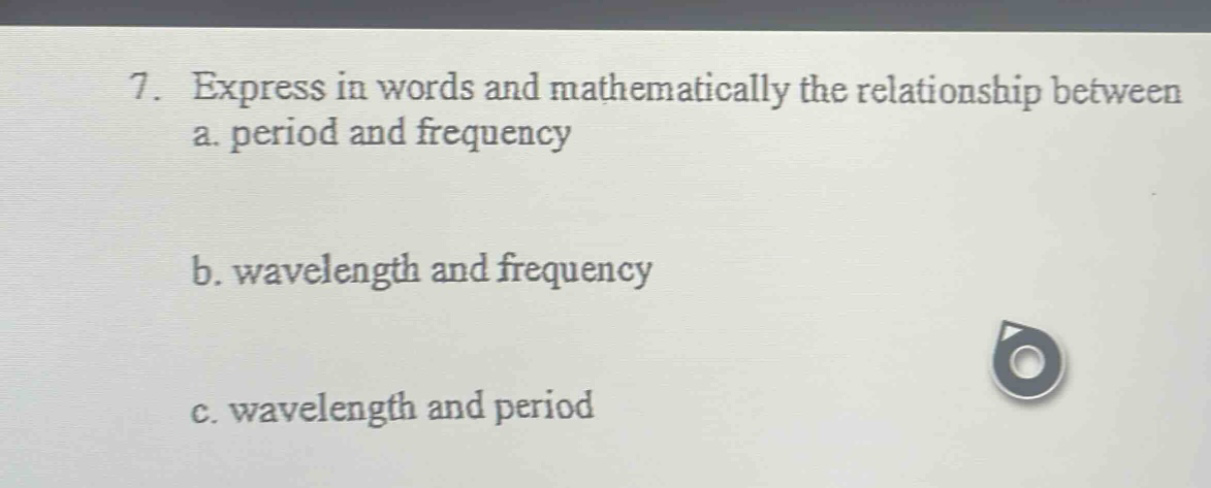
Question
- express in words and mathematically the relationship between
a. period and frequency
b. wavelength and frequency
c. wavelength and period
Response
Part a: Period and Frequency
Brief Explanations
- In words: Period ( \( T \)) is the time taken for one complete cycle of a wave to occur, and frequency ( \( f \)) is the number of cycles per unit time. They are reciprocal to each other, meaning as one increases, the other decreases.
- Mathematically: \( T=\frac{1}{f} \) or \( f = \frac{1}{T} \)
Brief Explanations
- In words: Wavelength ( \( \lambda \)) is the distance between two consecutive points in phase on a wave, and frequency ( \( f \)) is the number of cycles per unit time. For a wave traveling at a constant speed (usually the speed of light \( c \) for electromagnetic waves), wavelength and frequency are inversely proportional. As frequency increases, wavelength decreases, and vice versa.
- Mathematically: For a wave with speed \( v \) (e.g., \( v = c \) for light in vacuum), \( v=\lambda f \), so \( \lambda=\frac{v}{f} \) or \( f=\frac{v}{ \lambda} \)
Brief Explanations
- In words: Wavelength ( \( \lambda \)) is the distance between two consecutive points in phase on a wave, and period ( \( T \)) is the time taken for one complete cycle. For a wave traveling at speed \( v \), wavelength is equal to the product of the wave speed and the period. As the period increases (longer time for one cycle), the wavelength also increases if the speed is constant.
- Mathematically: Since \( v=\lambda f \) and \( f=\frac{1}{T} \), we can substitute \( f \) to get \( v=\frac{\lambda}{T} \), so \( \lambda = vT \)

Snap & solve any problem in the app
Get step-by-step solutions on Sovi AI
Photo-based solutions with guided steps
Explore more problems and detailed explanations
- In words: Period is the reciprocal of frequency (or frequency is the reciprocal of period).
- Mathematically: \( T=\frac{1}{f} \) (or \( f=\frac{1}{T} \))