QUESTION IMAGE
Question
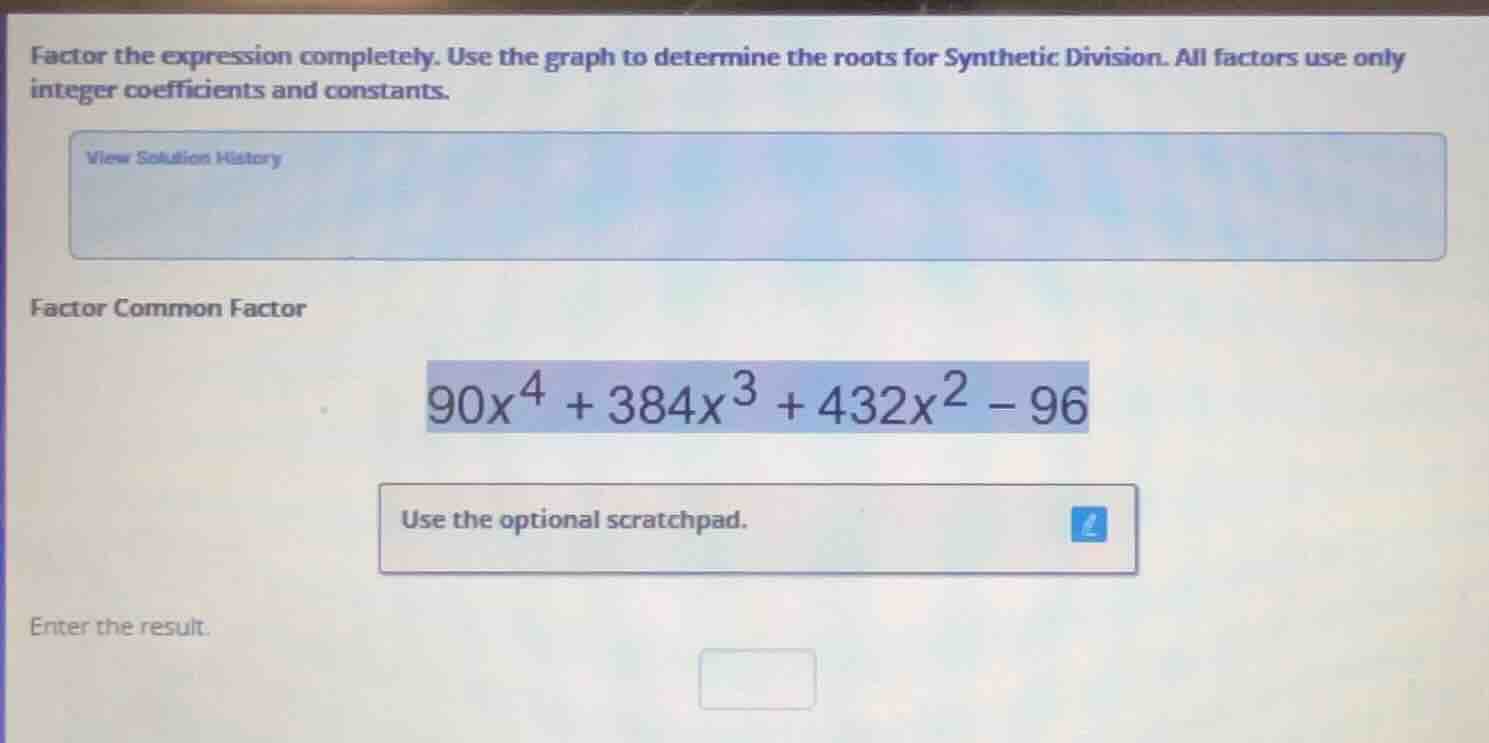
factor the expression completely. use the graph to determine the roots for synthetic division. all factors use only integer coefficients and constants.
view solution history
factor common factor
$90x^4 + 384x^3 + 432x^2 - 96$
use the optional scratchpad.
enter the result.
Step1: Factor out GCF
Find the greatest common factor (GCF) of all terms: $\text{GCF}(90, 384, 432, 96) = 6$
$90x^4 + 384x^3 + 432x^2 - 96 = 6(15x^4 + 64x^3 + 72x^2 - 16)$
Step2: Identify rational root
Use Rational Root Theorem: possible roots are $\pm1, \pm2, \pm4, \pm8, \pm16, \pm\frac{1}{3}, \pm\frac{2}{3}, ...$
Test $x=-2$: $15(-2)^4 + 64(-2)^3 + 72(-2)^2 -16 = 15(16)+64(-8)+72(4)-16=240-512+288-16=0$
So $(x+2)$ is a factor.
Step3: Synthetic division (degree 4)
Divide $15x^4 + 64x^3 + 72x^2 -16$ by $(x+2)$:
Result: $15x^3 + 34x^2 + 4x - 8$
Step4: Factor cubic polynomial
Test $x=\frac{2}{3}$ for $15x^3 + 34x^2 + 4x - 8$:
$15(\frac{2}{3})^3 +34(\frac{2}{3})^2 +4(\frac{2}{3}) -8 = 15(\frac{8}{27})+34(\frac{4}{9})+\frac{8}{3}-8=\frac{120}{27}+\frac{136}{9}+\frac{8}{3}-8=\frac{40}{9}+\frac{136}{9}+\frac{24}{9}-\frac{72}{9}=\frac{128}{9}
eq0$
Test $x=\frac{1}{3}$: $15(\frac{1}{3})^3 +34(\frac{1}{3})^2 +4(\frac{1}{3}) -8=\frac{15}{27}+\frac{34}{9}+\frac{4}{3}-8=\frac{5}{9}+\frac{34}{9}+\frac{12}{9}-\frac{72}{9}=-\frac{21}{9}
eq0$
Test $x=-2$ again: $15(-2)^3 +34(-2)^2 +4(-2)-8=15(-8)+34(4)-8-8=-120+136-16=0$
So $(x+2)$ is a factor again.
Step5: Synthetic division (degree 3)
Divide $15x^3 + 34x^2 + 4x - 8$ by $(x+2)$:
Result: $15x^2 + 4x - 4$
Step6: Factor quadratic polynomial
Factor $15x^2 + 4x - 4$:
Find two numbers: $10$ and $-6$ (since $10\times(-6)=-60$, $10+(-6)=4$)
$15x^2 +10x -6x -4 = 5x(3x+2)-2(3x+2)=(5x-2)(3x+2)$
Step7: Combine all factors
Put all factored terms together with the initial GCF:
$6(x+2)(x+2)(5x-2)(3x+2)=6(x+2)^2(5x-2)(3x+2)$

Snap & solve any problem in the app
Get step-by-step solutions on Sovi AI
Photo-based solutions with guided steps
Explore more problems and detailed explanations
$6(x+2)^2(3x+2)(5x-2)$