QUESTION IMAGE
Question
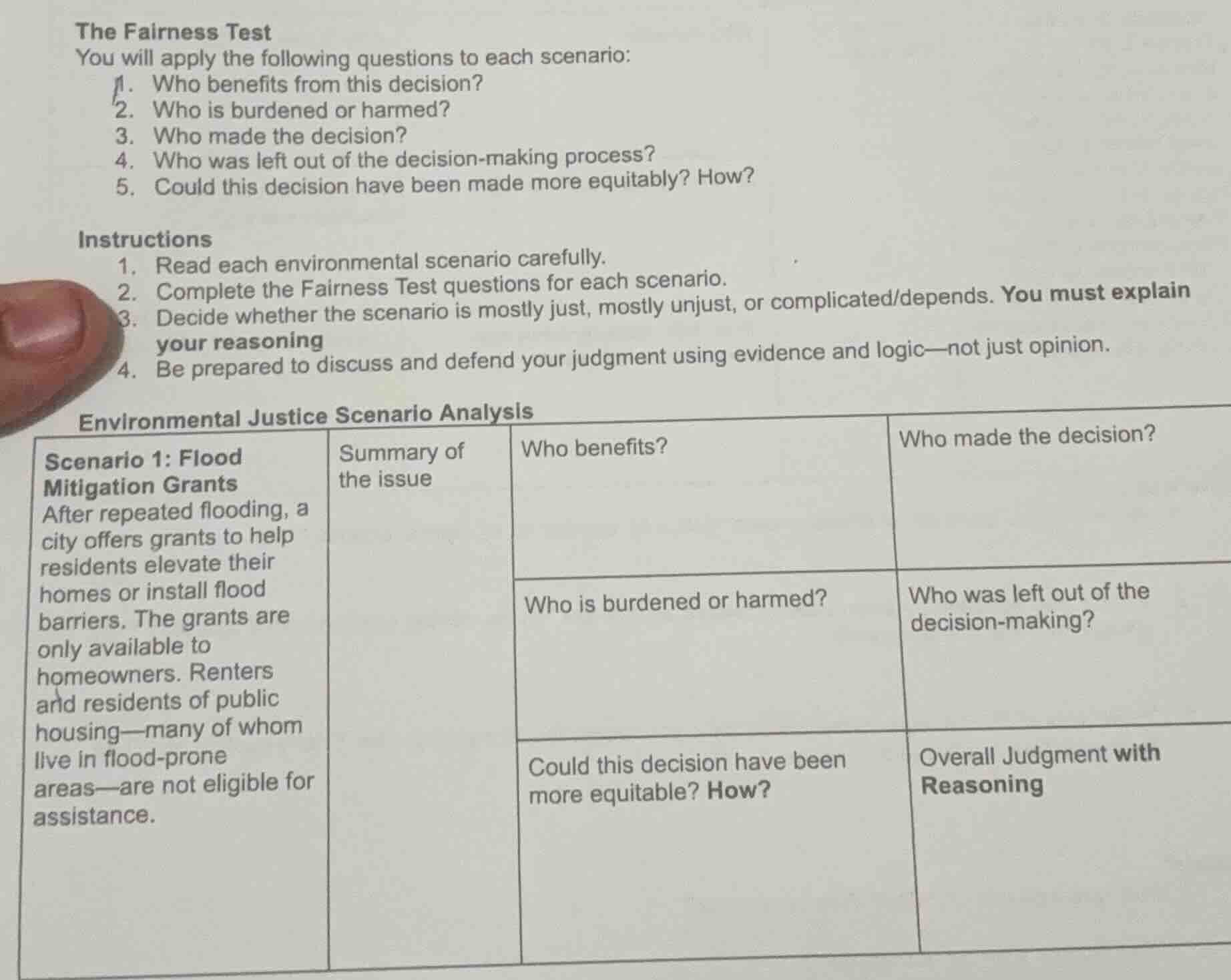
the fairness test
you will apply the following questions to each scenario:
- who benefits from this decision?
- who is burdened or harmed?
- who made the decision?
- who was left out of the decision - making process?
- could this decision have been made more equitably? how?
instructions
- read each environmental scenario carefully.
- complete the fairness test questions for each scenario.
- decide whether the scenario is mostly just, mostly unjust, or complicated/depends. you must explain your reasoning
- be prepared to discuss and defend your judgment using evidence and logic—not just opinion.
environmental justice scenario analysis
scenario 1: flood mitigation grants
after repeated flooding, a city offers grants to help residents elevate their homes or install flood barriers. the grants are only available to homeowners. renters and residents of public housing—many of whom live in flood - prone areas—are not eligible for assistance.
| summary of the issue | who benefits? | who made the decision? | |
|---|---|---|---|
| who is burdened or harmed? | who was left out of the decision - making? | ||
| could this decision have been more equitable? how? | overall judgment with reasoning | ||
Summary of the issue
A city offers flood mitigation grants (for home elevation or flood barriers) but restricts eligibility to homeowners. Renters and public housing residents (many in flood - prone areas) are excluded.
Who benefits?
Homeowners in the city, especially those in flood - prone areas, benefit. They can use the grants to protect their properties from flooding, reducing damage and potential financial losses.
Who is burdened or harmed?
Renters and public housing residents, particularly those in flood - prone areas, are burdened. They face the risk of flood damage to their living spaces but have no access to the financial assistance that homeowners get to mitigate this risk. This can lead to greater financial strain (e.g., paying for repairs out - of - pocket) and increased vulnerability to the negative impacts of flooding.
Who made the decision?
It is most likely city officials (such as those in the city’s housing department, public works department, or a committee responsible for flood mitigation policies) who made the decision to limit the grants to homeowners.
Who was left out of the decision - making?
Renters and public housing residents were left out of the decision - making process. Their perspectives on the need for flood mitigation assistance and how the grant program could be structured to include them were not considered in the decision to restrict eligibility to homeowners.
Could this decision have been more equitable? How?
Yes, the decision could have been more equitable. The city could expand the eligibility criteria to include renters and public housing residents. For renters, the city could work with landlords to allow grant funds to be used for flood mitigation measures on rental properties (with proper agreements in place). For public housing, the city’s public housing authority could be involved in applying for and implementing flood mitigation projects using the grant funds. Additionally, the decision - making process could have included input from renters and public housing residents to better understand their needs and develop a more inclusive program.
Overall Judgment with Reasoning
The scenario is mostly unjust. The decision to exclude renters and public housing residents from flood mitigation grants creates an unfair distinction based on housing tenure. Homeowners and non - homeowners in flood - prone areas face similar flood risks, but only homeowners can access the assistance. This violates the principle of equity in distributing resources for flood mitigation, as it disadvantages a group (renters and public housing residents) that is also vulnerable to flooding. While the intent may have been to simplify the grant process by focusing on homeowners, it fails to address the needs of a significant portion of the city’s population living in flood - prone areas.

Snap & solve any problem in the app
Get step-by-step solutions on Sovi AI
Photo-based solutions with guided steps
Explore more problems and detailed explanations
Summary of the issue
A city offers flood mitigation grants (for home elevation or flood barriers) but restricts eligibility to homeowners. Renters and public housing residents (many in flood - prone areas) are excluded.
Who benefits?
Homeowners in the city, especially those in flood - prone areas, benefit. They can use the grants to protect their properties from flooding, reducing damage and potential financial losses.
Who is burdened or harmed?
Renters and public housing residents, particularly those in flood - prone areas, are burdened. They face the risk of flood damage to their living spaces but have no access to the financial assistance that homeowners get to mitigate this risk. This can lead to greater financial strain (e.g., paying for repairs out - of - pocket) and increased vulnerability to the negative impacts of flooding.
Who made the decision?
It is most likely city officials (such as those in the city’s housing department, public works department, or a committee responsible for flood mitigation policies) who made the decision to limit the grants to homeowners.
Who was left out of the decision - making?
Renters and public housing residents were left out of the decision - making process. Their perspectives on the need for flood mitigation assistance and how the grant program could be structured to include them were not considered in the decision to restrict eligibility to homeowners.
Could this decision have been more equitable? How?
Yes, the decision could have been more equitable. The city could expand the eligibility criteria to include renters and public housing residents. For renters, the city could work with landlords to allow grant funds to be used for flood mitigation measures on rental properties (with proper agreements in place). For public housing, the city’s public housing authority could be involved in applying for and implementing flood mitigation projects using the grant funds. Additionally, the decision - making process could have included input from renters and public housing residents to better understand their needs and develop a more inclusive program.
Overall Judgment with Reasoning
The scenario is mostly unjust. The decision to exclude renters and public housing residents from flood mitigation grants creates an unfair distinction based on housing tenure. Homeowners and non - homeowners in flood - prone areas face similar flood risks, but only homeowners can access the assistance. This violates the principle of equity in distributing resources for flood mitigation, as it disadvantages a group (renters and public housing residents) that is also vulnerable to flooding. While the intent may have been to simplify the grant process by focusing on homeowners, it fails to address the needs of a significant portion of the city’s population living in flood - prone areas.