QUESTION IMAGE
Question
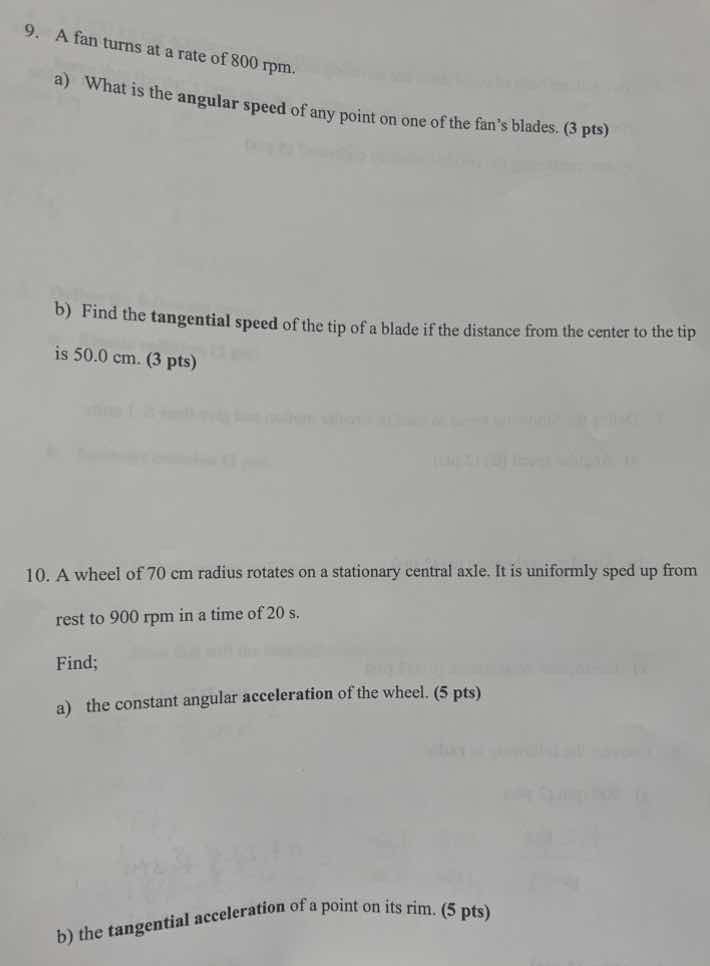
- a fan turns at a rate of 800 rpm.
a) what is the angular speed of any point on one of the fan’s blades. (3 pts)
b) find the tangential speed of the tip of a blade if the distance from the center to the tip is 50.0 cm. (3 pts)
- a wheel of 70 cm radius rotates on a stationary central axle. it is uniformly sped up from rest to 900 rpm in a time of 20 s.
find;
a) the constant angular acceleration of the wheel. (5 pts)
b) the tangential acceleration of a point on its rim. (5 pts)
Question 9
Part (a)
Step 1: Recall the formula for angular speed
Angular speed \(\omega\) is related to revolutions per minute (rpm) by the conversion factor \(2\pi\) radians per revolution and \(\frac{1}{60}\) minutes per second. The formula is \(\omega = 2\pi f\), where \(f\) is the frequency in revolutions per second. First, convert rpm to revolutions per second: \(f=\frac{800}{60}\) revolutions per second.
Step 2: Calculate angular speed
\(\omega = 2\pi\times\frac{800}{60}\)
Simplify: \(\omega=\frac{1600\pi}{60}=\frac{80\pi}{3}\approx 83.78\) rad/s
Step 1: Recall the formula for tangential speed
Tangential speed \(v\) is related to angular speed \(\omega\) and radius \(r\) by \(v = r\omega\). First, convert the radius to meters: \(r = 50.0\space cm=0.500\space m\). We already found \(\omega=\frac{80\pi}{3}\) rad/s from part (a).
Step 2: Calculate tangential speed
\(v = 0.500\times\frac{80\pi}{3}\)
Simplify: \(v=\frac{40\pi}{3}\approx 41.89\) m/s
Step 1: Recall the formula for angular acceleration
For uniformly accelerated rotational motion, the formula is \(\omega=\omega_0+\alpha t\), where \(\omega_0 = 0\) (starts from rest), \(\omega\) is the final angular speed, \(\alpha\) is the angular acceleration, and \(t\) is the time. First, convert the final rpm to rad/s. \(f=\frac{900}{60}=15\) revolutions per second. Then \(\omega = 2\pi\times15 = 30\pi\) rad/s.
Step 2: Solve for angular acceleration
From \(\omega=\omega_0+\alpha t\), with \(\omega_0 = 0\), we have \(\alpha=\frac{\omega}{t}\). Substitute \(\omega = 30\pi\) rad/s and \(t = 20\space s\).
\(\alpha=\frac{30\pi}{20}=\frac{3\pi}{2}\approx 4.71\) rad/s²

Snap & solve any problem in the app
Get step-by-step solutions on Sovi AI
Photo-based solutions with guided steps
Explore more problems and detailed explanations
The angular speed is \(\frac{80\pi}{3}\) rad/s (or approximately \(83.8\) rad/s).