QUESTION IMAGE
Question
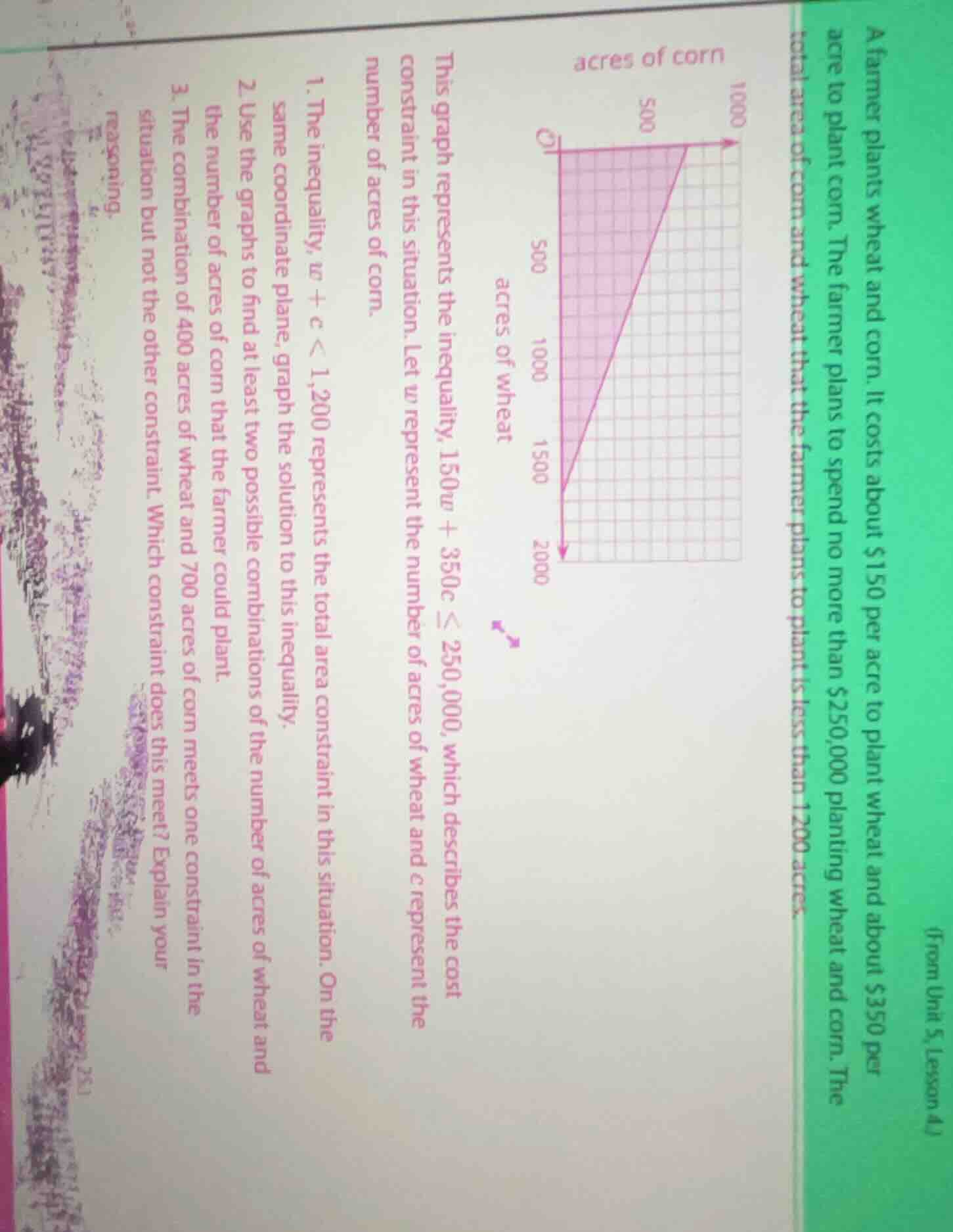
a farmer plants wheat and corn. it costs about $150 per acre to plant wheat and about $350 per acre to plant corn. the farmer plans to spend no more than $250,000 planting wheat and corn. the total area of corn and wheat that the farmer plans to plant is less than 1200 acres.
this graph represents the inequality ( 150w + 350c leq 250,000 ), which describes the cost constraint in this situation. let ( w ) represent the number of acres of wheat and ( c ) represent the number of acres of corn.
- the inequality, ( w + c < 1,200 ) represents the total area constraint in this situation. on the same coordinate plane, graph the solution to this inequality.
- use the graphs to find at least two possible combinations of the number of acres of wheat and the number of acres of corn that the farmer could plant.
- the combination of 400 acres of wheat and 700 acres of corn meets one constraint in the situation but not the other constraint. which constraint does this meet? explain your reasoning.
Question 1: Graphing \( w + c < 1200 \)
Step 1: Rewrite the inequality as a line
First, consider the boundary line \( w + c = 1200 \). To graph this, find the intercepts. When \( w = 0 \), \( c = 1200 \). When \( c = 0 \), \( w = 1200 \). Since the inequality is \( w + c < 1200 \) (strictly less than), the line should be dashed.
Step 2: Determine the region to shade
Test a point not on the line, like \( (0,0) \). Plugging into \( w + c < 1200 \), we get \( 0 + 0 < 1200 \), which is true. So we shade the region containing \( (0,0) \), which is below and to the left of the dashed line \( w + c = 1200 \).
Step 1: Analyze the cost constraint \( 150w + 350c \leq 250000 \) and area constraint \( w + c < 1200 \)
We need to find points \( (w, c) \) that satisfy both. Let's find two points:
- First combination: Let's take \( w = 0 \). For the cost constraint: \( 150(0) + 350c \leq 250000 \Rightarrow c \leq \frac{250000}{350} \approx 714.29 \). And from \( w + c < 1200 \), \( c < 1200 \). So \( c = 700 \) (since \( 700 < 714.29 \) and \( 0 + 700 < 1200 \)). So \( (0, 700) \) is a combination.
- Second combination: Let's take \( c = 0 \). For the cost constraint: \( 150w + 350(0) \leq 250000 \Rightarrow w \leq \frac{250000}{150} \approx 1666.67 \). From \( w + c < 1200 \), \( w < 1200 \). So \( w = 1000 \) (since \( 1000 < 1200 \) and \( 150(1000) + 350(0) = 150000 \leq 250000 \)). So \( (1000, 0) \) is a combination.
Step 2: Verify another point (optional)
Take \( w = 500 \), \( c = 500 \). Check cost: \( 150(500) + 350(500) = 75000 + 175000 = 250000 \), which satisfies \( 150w + 350c \leq 250000 \). Check area: \( 500 + 500 = 1000 < 1200 \), which satisfies \( w + c < 1200 \). So \( (500, 500) \) is also a combination.
Step 1: Check the area constraint \( w + c < 1200 \)
For \( w = 400 \), \( c = 700 \), \( w + c = 400 + 700 = 1100 \), and \( 1100 < 1200 \), so it satisfies the area constraint.
Step 2: Check the cost constraint \( 150w + 350c \leq 250000 \)
Calculate \( 150(400) + 350(700) = 60000 + 245000 = 305000 \). Now, \( 305000 > 250000 \), so it does not satisfy the cost constraint \( 150w + 350c \leq 250000 \).

Snap & solve any problem in the app
Get step-by-step solutions on Sovi AI
Photo-based solutions with guided steps
Explore more problems and detailed explanations
The solution to \( w + c < 1200 \) is the region below the dashed line \( w + c = 1200 \) (with intercepts at \( (1200, 0) \) and \( (0, 1200) \)) and containing the origin.