QUESTION IMAGE
Question
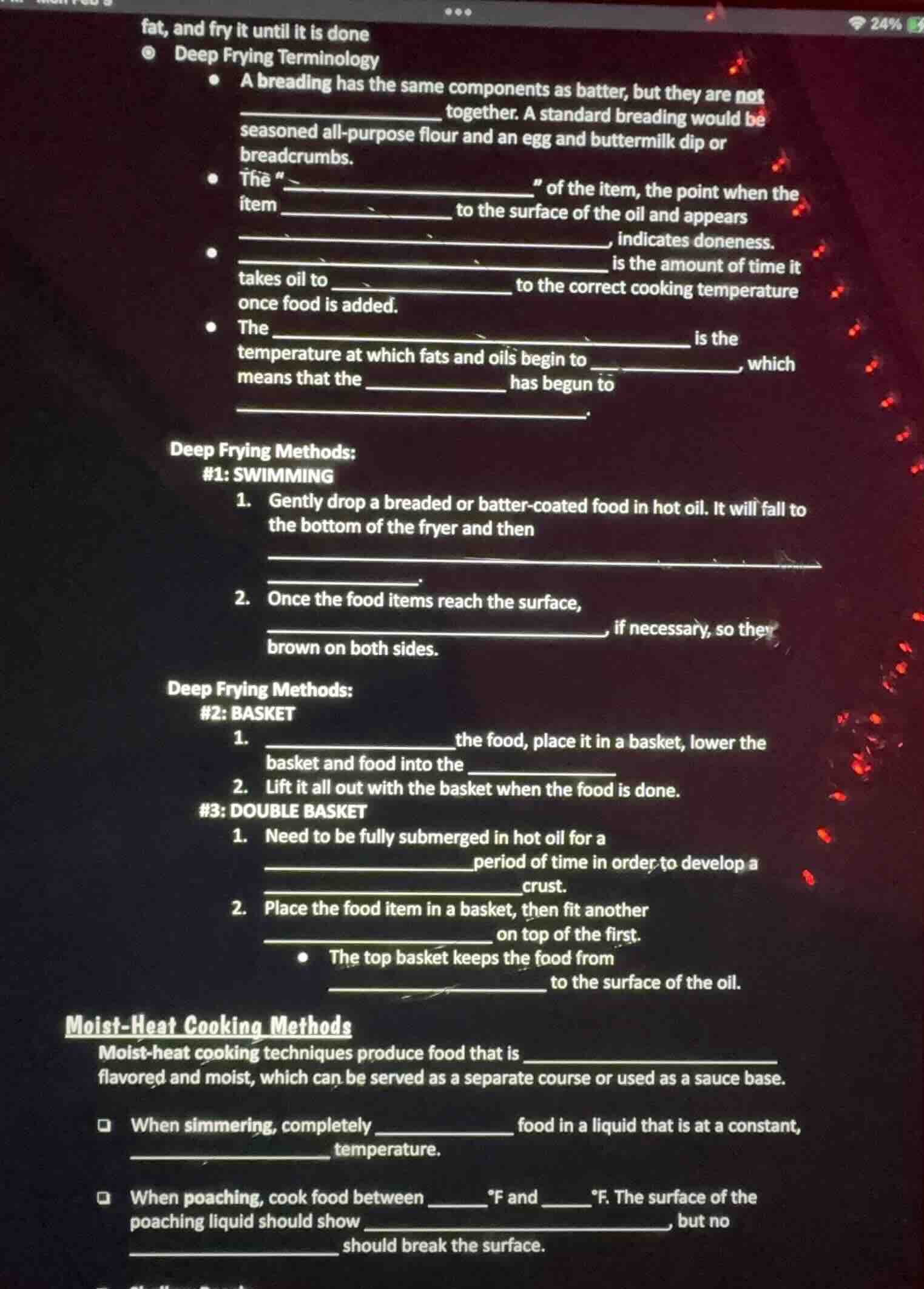
fat, and fry it until it is done⊙ deep frying terminology● a breading has the same components as batter, but they are not __________ together. a standard breading would be seasoned all-purpose flour and an egg and buttermilk dip or breadcrumbs.● the “________________” of the item, the point when the item ________ to the surface of the oil and appears ______________________, indicates doneness.● ______________________ is the amount of time it takes oil to ________ to the correct cooking temperature once food is added.● the ____________________________ is the temperature at which fats and oils begin to ________, which means that the ________ has begun to ______________________.deep frying methods:#1: swimming1. gently drop a breaded or batter-coated food in hot oil. it will fall to the bottom of the fryer and then ______________________.2. once the food items reach the surface, ______________________, if necessary, so they brown on both sides.deep frying methods:#2: basket1. ________ the food, place it in a basket, lower the basket and food into the ________2. lift it all out with the basket when the food is done.#3: double basket1. need to be fully submerged in hot oil for a ________________ period of time in order to develop a ________________ crust.2. place the food item in a basket, then fit another ________________ on top of the first.● the top basket keeps the food from ________________ to the surface of the oil.moist-heat cooking methodsmoist-heat cooking techniques produce food that is ________________ flavored and moist, which can be served as a separate course or used as a sauce base.□ when simmering, completely ________ food in a liquid that is at a constant, ________________ temperature.□ when poaching, cook food between __°f and __°f. the surface of the poaching liquid should show ______________________, but no ________________________ should break the surface.
Fill-in-the-blanks completed using standard culinary deep frying and moist-heat cooking terminology.

Snap & solve any problem in the app
Get step-by-step solutions on Sovi AI
Photo-based solutions with guided steps
Explore more problems and detailed explanations
Deep Frying Terminology
- A breading has the same components as batter, but they are not mixed together. A standard breading would be seasoned all-purpose flour and an egg and buttermilk dip or breadcrumbs.
- The "float point" of the item, the point when the item rises to the surface of the oil and appears golden brown and crisp, indicates doneness.
- Recovery time is the amount of time it takes oil to return to the correct cooking temperature once food is added.
- The smoke point is the temperature at which fats and oils begin to smoke, which means that the fat/oil has begun to break down and degrade.
Deep Frying Methods: #1: SWIMMING
- Gently drop a breaded or batter-coated food in hot oil. It will fall to the bottom of the fryer and then rise to the surface as it cooks.
- Once the food items reach the surface, turn them over, if necessary, so they brown on both sides.
Deep Frying Methods: #2: BASKET
- Coat/prep the food, place it in a basket, lower the basket and food into the hot oil.
- Lift it all out with the basket when the food is done.
Deep Frying Methods: #3: DOUBLE BASKET
- Need to be fully submerged in hot oil for a set/extended period of time in order to develop a crisp, uniform crust.
- Place the food item in a basket, then fit another basket on top of the first.
- The top basket keeps the food from rising/floating to the surface of the oil.
Moist-Heat Cooking Methods
Moist-heat cooking techniques produce food that is tender, well flavored and moist, which can be served as a separate course or used as a sauce base.
- When simmering, completely submerge food in a liquid that is at a constant, low (185-205°F / 85-96°C) temperature.
- When poaching, cook food between 160°F and 180°F. The surface of the poaching liquid should show very small, gentle bubbles, but no rolling bubbles/boiling action should break the surface.